New Player Friendly: Tournaments vs. Narrative Events
By Ian
Special thanks to Noah, as much of this article came from a conversation we had.
Lines in the sand
There’s a common thread in Warhammer discourse that tournament play is more accessible than narrative play. I’ve heard it referred to as “the lowest common denominator”, aka everyone is playing from the same starting point. There’s a lot of discussion that tournaments are easier to get into because it has that pre-game conversation for you: bring your toughest list, we’re playing one mission from this handful, on one of these common terrain layouts. Though there is some truth to this, I think the “tournament play is more accessible than narrative play” is a much more nuanced discussion.
You may note I’m using the term “tournament play” rather than “matched play” and I think this is an important distinction. You and your buddy can generate a mission from a matched play missions deck and bring armies you think are roughly even: i.e. you can have a casual game using matched play rules. You could even use tournament terrain and missions (and, though I’m very far from a tournament player, my understanding is tournament missions are basically pre-generated from the current matched play missions deck). Tournament play is specifically using a tournament mission, specifically on a tournament layout (either from GW or one of the other tournament circuits), and players bringing the toughest list they can: all vestiges of theme, friendliness, and story are left on the cutting room floor of the list-building. That’s not to say that a tournament player’s army isn’t thematic, lovingly painted, and piloted by a friendly opponent, but generally when the list is being crafted, these are all secondly concerns (i.e. a tournament player, in this example, isn’t going to bring a sub-optimal unit just because it’s thematic or fits into head-canon). Again, people have brought narrative lists to tournaments, but the Platonic ideal of a 40k tournament player sure as hell isn’t.
For narrative play, I’m going to be leaning on our blog’s original, broad definition of narrative play. This is much broader than GW’s narrative play—namely games using Crusade rules and Crusade missions—and I’ll try to address this as I go, as I recognize that our narrative play definition is far more broad than the limited tournament play definition above. That being said, narrative events are not as narrowly defined as tournaments, so I think it’s reasonable to allow this flexibility for the sake of argument.
Finally, I’ll mention here that my sort of vision of a tournament is not of a room of stern, Win At All Costs players shouting rules at each other, but more of a beer-league hockey tournament: most of the people are there ‘cause they love the game, want to hangout with friends, and meet new people. They might have funny jerseys, they always grab a drink afterwards, and, yes, maybe there’s that one person who takes it way too seriously, but mostly people there are pretty chill.
Tournaments as far as the eye can see
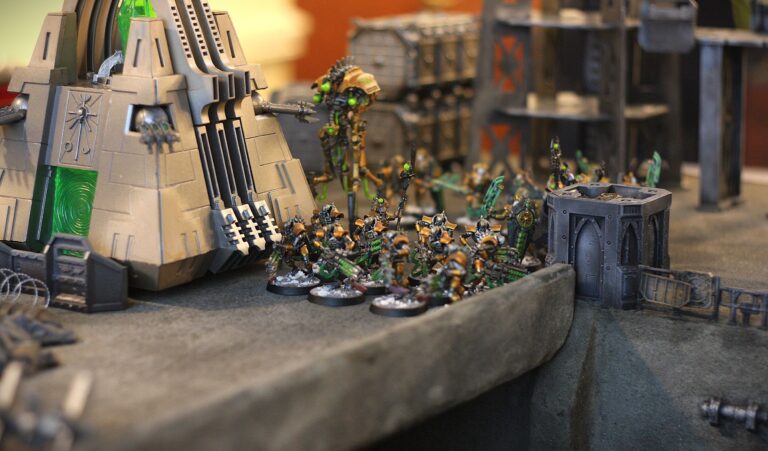
Hot damn there are a lot of 40k tournaments! I live in the Greater Toronto Area and, if I’m willing to drive an hour, I could go to a one-day tournament every weekend. There are events everywhere, and there’s a very good reason for this: they are easy to run. GW and other tournament organizations have put a ton of work into creating resources for competitive events so an organizer can basically plug and play a few missions and set up terrain with very specific measurements already outlined.
On the other hand, there are almost no 40k narrative events outside of big conventions. And guess what: GW does not provide the same narrative event framework they do for tournaments. That’s not to say there is nothing: GW publishes Crusade books at the same pace as matched play materials, so we have narrative missions. But we don’t have that same resources: there’s no suggested terrain layouts, and there are no suggested mission packs in the same way they’re presented for tournaments.
Lack of support goes further than this. Despite being out for almost five years at the time of writing, GW has never published official app support for Crusade (though there are third party options). Furthermore, the GW app that does exist has no crusade rules included, and no Legends units (which are only suggested to be disallowed at tournaments: they are otherwise legal in all other game modes from a published rules standpoint). We’ve had a whole discussion about issues with Legends if you’re interested.
I can hear your counter to all this: people want to play in tournaments, that’s why tournament play is popular and why we have so many more tournaments than narrative events. To argue against this, I’m going to point to a survey Goonhammer published regarding player motivations where 42% percent of respondents were identified as players whose motivation playing 40k was to win (i.e. competitive players). The rest of the respondents’ motivation was more around the social aspect of the game, the hobby side, or the narrative draw of the setting, even if they were attending events.
Because the vast majority of 40k events are tournaments, I think it’s safe to assume that a big chunk of the players attending tournaments are not tournament players: i.e. they’re there to be social or show off their painting. If we adjust for the fact that Goonhammer is primarily a competitive play website (and therefore more respondents would be tournament players) I would guess that closer to a third of the actual 40k player base are tournament players. And to be clear, I’m not suggesting that the other two thirds of 40k players are narrative players, but rather that a significant majority of players are not competitive players (players attending to win) but rather people who just want to socialize and have fun.
So what conclusion am I trying to draw from all this? I’d argue that one of the reasons tournaments are popular is because they are easy to run (in part because there is additional support and resources for them), not because it’s what the player base wants, and if there were more narrative events they would be well attended. Would they be more popular than tournaments? Maybe not, but if they were better supported there’d probably be more than one of them a year.
Of course, tournaments have become so popular that they have dominated the 40k community, not only for in-person events but online. New players getting into the game will be bombarded with tournament play content when they search for advice on social media. If GW was to steer more into narrative event support, it could take a long time for it to gain serious traction.

Those who are new here
Speaking of new players, is tournament play the best way for someone to get into the game? Tournaments are almost universally played at 2,000 points, which is a huge milestone in both money—purchasing the army—and time—painting said army, though not all tournaments require fully painted. There are smaller tournaments at the 1,000 point mark, but they are much rarer, and these events aren’t considered “official” for tournament rankings. I’ve even seen them disregarded from tournament coverage.
I’d also suggest that matched play missions are not new player friendly. With the balancing of primary vs. secondary objectives, there’s a lot to track in a game, on top of your own army datasheets, abilities, and stratagems. Similarly, I don’t think Crusade is any more new player friendly, as the Agendas, Battle Honours, and Battlescars are also a huge amount of extra information to keep in mind.
Narrative missions can be much easier to understand for newer players, I’ll argue, though without Crusade trappings added on. Rather than abstracted objectives in matched play, telling a new player to take and hold a bridge is much more straightforward to understand than the twofold objectives found in Matched Play and Crusade (being secondary objectives and agendas, respectively). That being said, you could also have simplified Matched Play missions without any secondary objectives. Narrative games are also much more likely to have lower points limits, with 1,000 or 1,500 point games being far more common. However, there are plenty of narrative events that allow players to bring a 2,500+ point rosters (as an example, GW’s own 2025 Grand Narrative event uses a 3,000 point Crusade roster), or have a large Onslaught/Apocalypse-level finale (and, until recently, this was my preferred way of running campaigns and weekenders), so lower points limits are far from universal at narrative tables—though, again, more likely to be found at a narrative event than a tournament.
I think it’s worth noting though that as narrative games are usually more casual in terms of the power level of armies (you’re less likely to run into the top meta list at a narrative game), it’s much more approachable for a new player to bring an army built from a few starter sets and units they picked because they looked cool and still have a fun, close game. Contrast this with bringing a similar, under-tuned list to a tournament and the new player is likely to get tabled in most to all of their games (though as they get filtered down to the bottom rungs of tournament pairings, they may well find friendlier games).
There is a flipside to this: a narrative event could have complex army composition rules. As someone who’s written a set of army composition house rules and enforced them for an event, I can see how adding an extra layer of rules could be overwhelming for a new player.
Finally, the last hurdle for the power level of narrative games is defining and enforcing it. One of the oft-cited criticisms of narrative events is that while some players bring lore-driven, narrative-friendly lists, others bring the latest meta and stomp the floor. Some narrative events don’t have any additional army composition rules or restrictions meaning there can be a huge disparity in power level between different armies, and even if they do, there will be players who find the best way to min-max any system imposed on them.
The only solution I have to this is to foster a community of like-minded players and clearly communicate the expectations, but that is, of course, much easier said than done (and gets exponentially harder the larger and more public your event is).
Building the backstory
So far I’ve talked a lot about gaming, but there’s a big gaping hole in my argument: the narrative for these narrative games! Isn’t reading and consuming the lore for 40k a huge stumbling block for players new to narrative gaming?
I could point to a few online resources that are great primers for 40k lore (and will link them below) but there’s no guarantee a new player will find them, and there are plenty of bad primers as well. Similarly, I could suggest some novels, but asking a new player to read a small library to prep for a game is a bit much (though, again, I’ll post my faves below). I will argue that a new player prepping for a tournament will research online for list advice and strategy (or will, at least, if they want to win a game or two) and I think the time it takes to watch one or two introductory lore videos is roughly equivalent to doing stratagem research. I’m not saying that getting into the 40k lore isn’t easier than prepping tournament lists, but comparable from a time perspective.
However, I don’t think learning 40k lore is strictly necessary for narrative play. The basic premise of a narrative battle isn’t the political intricacies of the High Lords of Terra, how the Battle of Calth affected the Five Hundred Worlds, nor why Heretic Astartes vessels travel faster in the warp than Imperial ones. Rather, the premise of most narrative games is the battle itself: take and hold, last stand, sabotage, meat grinder. These aren’t concepts unique to Warhammer, but ones that have been fleshed out in books and movies for decades, not to mention actual history. Therefore, anyone who didn’t sleep through a high school history class probably has the background to give context to a narrative game.
Getting good
I think another part of accessibility for a game like 40k is how achievable mastery is. Last year, Goonhammer posted a great piece about the hours top tournament players logged over three years. I was blown away by the number of games these folks were playing, with most logging several hundred games over three years and some playing one to two thousand over three years. These players are averaging between one and twelve games a week (the average of the players mentioned in the article was about three and a half games a week). That’s a pretty wide margin and how achievable that is will vary wildly from player to player. I try to play one game a month, but I think I’m on the lower end: I can see how someone with a roommate who plays or someone who goes to several events each month, for example, could average multiple games a week. But even when I was playing more, averaging three to four games a week was way more than what I was clocking.
If three or four games a week is a requisite for mastery of competitive 40k, what does mastery of narrative 40k look like? Looking at our recently updated definition of narrative 40k, a narrative game has a story, fully painted and lore-driven armies, and a thematic mission played over nice terrain. Reading enough 40k books, painting a whole army, and building a decent-looking table (let’s assume you know how to choose an appropriate mission) takes a lot of time. Is it more or less time compared to mastering competitive 40k? That’s hard to say: it very well could be comparable or even more time.
However, mastering competitive 40k has very clear milestones and goal posts: climbing online rankings and winning tournaments. You could set milestones for narrative 40k–running a campaign, playing crusade games, reading book series, completing painting and terrain projects–but I think these are generally more nebulous than the concrete goals of competitive play. Therefore, though mastery of narrative 40k might be harder to define, achieving it could have the perception of being easier. Additionally, as you’re not competing against other people, achieving narrative 40k mastery (however you decide to define it) is entirely up to you. Have you painted enough, read enough, played enough? If yes, then congratulations! You’re a master! It doesn’t matter how many games you’ve won.
All the events
Getting back to tournament support, I want to theorize why GW provides additional support to tournaments in the form of Tournament Companions and not narrative companions. These started appearing in 10th edition, where before in 8th and 9th, the support was more or less equal: we’d get Matched Play books and Crusade books at roughly the same pace.
But tournaments were growing in popularity before 10th edition. In 9th edition they really exploded, with the number of tournament games skyrocketing compared to what we saw in 8th edition. Therefore, GW introducing Tournament Companions in 10th edition could be seen as responding to a demand rather than trying to guide the playerbase in any one direction.
Of course, right before tournaments exploded in popularity, something very significant happened: a global pandemic forced everyone inside and a bunch of people picked up a new hobby that they could do alone indoors. When lockdowns started to lift, people wanted to roll dice with all their freshly painted minis and tournaments are an easy way to get lots of games played in a short amount of time.
I don’t think tournaments exploded in popularity because matched play or tournament play is inherently better or more fun than narrative play, but they exploded in popularity because Warhammer exploded in popularity. From an event organizing perspective, tournaments are much easier to plan than a narrative event: therefore it makes sense that there were more of them, even before GW began publishing Tournament Companions to support the Chapter Approved (Matched Play) books or cards.
Behind closed doors
At the outset, I mentioned this article was inspired by a conversation I had with my friend Noah: I sent Noah a draft for comment and he came back with plenty of thoughts (some of which may inspire future articles), but I wanted to highlight some of his points and what better way to do that than by quoting him:
Narrative play tends to be behind closed doors. Prepping/planning for the event is a self-guided journey. Narrative games–especially the polished ones–happen in closed groups. Getting invited or being aware that these groups even exist is an obstacle itself: there’s a certain exclusivity to it.
If you can purchase a ticket and have an appropriate amount of points, you can go to a tournament. You might get chewed up and spit out but you will be accepted and allowed to play, because it’s primarily a tactical experience.
Narrative play has less defined goals. Narrative events tend to have an aversion to tournament-style play and have unwritten or unclear self regulation of power within list building. What is a narrative list requires further defining vs what is a tournament list.
The narrative community is less open and accepting of players and the communal expectations within narrative groups are subjective. Narrative play has a scope far greater than playing the game. Meanwhile, tournament expectations are clearly defined, exist within a ruleset and are universal.
Narrative play has a longer time horizon to payoff. It’s delayed gratification. Tournament play (i.e. matched play with guaranteed opponents at the bottom tables) has a shorter time horizon. You sign up on Tuesday, you play on Saturday. The payoff is shorter and easier to obtain.
Are narrative events more accessible than tournaments?
There’s a few takeaways from the above I want to highlight. First off, I believe a new player is less likely to run into a thunder hammer of a list at a narrative event than a tournament, meaning they are more likely to be able to meaningfully participate in the game. Secondly, though narrative events can certainly layer on lots of complexity, they are not beholden to the widely accepted tournament structures and, therefore, narrative events have much more potential to have simpler mechanics and requirements than a tournament. Finally, tournaments are not more popular because they are inherently better or because there are more competitive players.
So are narrative events better for new players than tournaments? They have the potential to be. However, tournaments are just so much easier to run than narrative events and there will almost always be more of them. Though I would love to see more support from GW for narrative events, the reality is this would not automatically equate to more narrative events: in 7th edition, for example, when GW was publishing campaign books while providing zero support for tournaments, tournaments were still far more popular than narrative events.
The last thing I’ll say on this is that creating and running narrative events is really tough and work intensive, which of course suggests that there can be a lot of bad narrative events (and you can definitely hear about some online). Hopefully the events showcased on this blog are inspiration for what a good narrative event looks like (and the feedback we’ve received from players has been almost entirely positive) and can inspire some budding event organizers.
If you’ve got thoughts about new player friendly events, why not drop us a line at contactus@wrongsideofthemaelstrom.com: we’d love to hear your thoughts!
Further reading
I’ve suggested the below before, but if you’re looking for an introduction to 40k lore, you can’t go wrong with these.
Introductory novels
First and Only is the first novel in Dan Abnett’s Gaunt’s Ghosts series and is an ensemble story about a regiment of regular humans facing the horrors of the galaxy. This gives a great ground-level introduction to the wars of 40k.
Xenos is the first book in the Eisenhorn trilogy, Dan Abnett’s first Inquisitor trilogy. It is essentially a detective noir story and gives great insight into the what the Imperium looks like off the battlefield.
Spear of the Emperor by Aaron Demski-Bowden focuses on two Space Marine chapters fighting on the dark side of the galaxy and is a fantastic introduction to 40k’s protagonists as well the “modern” state of 40k where the Imperium has been sundered in half.
Lore on YouTube
Arbitor Ian (a different Ian) is my favourite lore channel, and the below video is a great overview of 40k lore: