GMing 40k – A Narrative Gaming Experiment
By Ian
Inspiration
In October 2022, GW released a battle report on Warhammer+ reminiscent of old school Rogue Trader where there was a Game Master (GM) running the game for two players (they also released the mission on WarCom, which can be found here). Although the mission was kind of goofy, I immediately latched onto the idea with a bold, arrogant thought: “I can do this better”.
What does a GM do?
For anyone not familiar with tabletop roleplaying, a Game Master or Dungeon Master runs a roleplaying game (RPG), basically taking the role of all the non-player characters (NPCs) the players interact with and controlling the setting the players’ characters (PCs) exist in. I’ve played various roleplaying games, both as a player and a GM, for about a decade now, primarily in Fantasy Flight Games’ Star Wars Edge of the Empire system (which spawned their generic Genesys system). Some people feel that the role of a GM is to be adversarial to players, but the way I’ve always played is that a RPG is a collective storytelling experience where both players and GM build the world and the story.
The duties of a GM typically include writing the story/module/adventure/campaign that they’re helming. Running a game involves tracking the various NPCs and ensuring that everything goes smoothly, which runs the gamut of stopping the players from getting bogged down in minutiae discussion to toning up or down the power level of enemies during combat when a fight is too easy or difficult. Shows like Stranger Things, Big Bang Theory and Community have brought Dungeons & Dragons (and other RPGs by proxy) more into the spotlight, but rather than doing funny voices or chastising players (as is sometimes portrayed in television), I find the main role of the GM is always to tell an interesting story and let the players and their characters shine: they are the protagonists of the story, after all.
Writing the Story
This was my first outing GMing a game of Warhammer, so I decided to keep the scenario simple. The story was an inquisitor requisitioning a taskforce of Imperials to escort him to a ritual site on an enemy-held world. There, he would perform a warp ritual that would summon daemons, with the ultimate goal of summoning a daemon prince so that he could broker a pact with it–all while the non-Imperials tried to keep their territory.
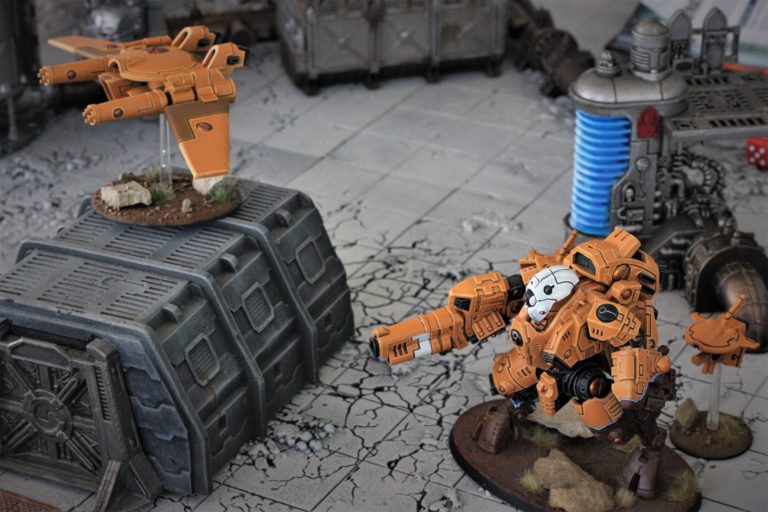
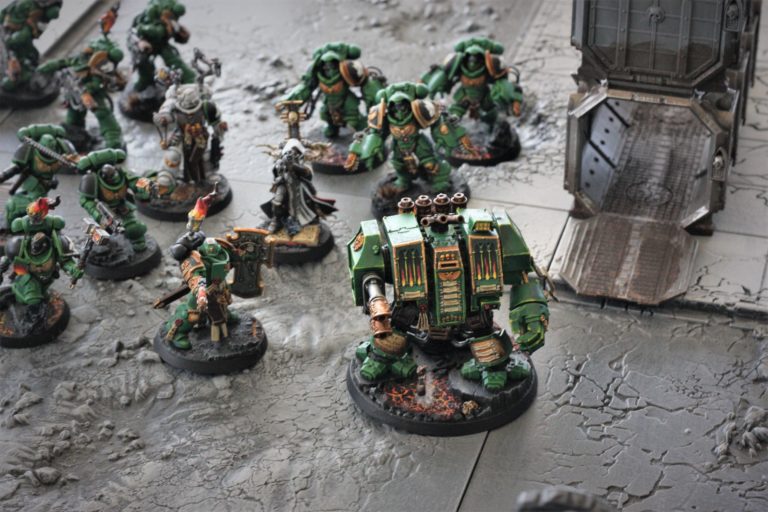
My two friends who agreed to play had Salamander and Tau armies, so those were the forces involved. If either had wanted to play a different army, I would have adapted accordingly, but both forces worked well. They were each given very vague objectives (the inscrutable inquisitor won’t divulge his goals; there’s Space Marines landing on our world, deploy and repel them while our human forces hold them off).
I felt the story was very basic, bringing forward popular 40k tropes: the radical inquisitor falling to chaos, Space Marines butting heads with higher ups over what’s right, and Tau defending a human world they have captured. What the story did was allow me to play several NPC forces: the human conscripts of the Tau and the rampaging daemons summoned by the inquisitor. I also added in environmental rules to represent the warp storm that erupts when the inquisitor begins his ritual plus rules for various terrain that the players could interact with. The latter was actually added only a few days before the event: I felt the scenario needed a little more and reviewing GW’s mission I realised that there needed to be more ways the players could interact with the environment.
How does a GM work in 40k?
40k really doesn’t need a GM: it’s an adversarial system. Any NPCs or environmental effects can be handled by rules that both players track together. The above scenario could be adapted so that the players tracked everything instead of the GM: even the secret objectives could work through a system of sealed envelopes (i.e. open envelope X2 when the inquisitor reaches the 3rd ritual phase) or through a digital system like a website or Google survey.
That being said, I don’t think it would work as well. This game was played with 9th edition rules, an edition that was already notoriously complex. Layering on more and more narrative rules would be a nightmare for players already trying to track their units and stratagems. Secondly, the daemons were meant to be a balancing point. If one player was gaining a massive lead, the daemons could turn to attack them: writing rules for determining who they attack would be much more difficult than simply having a GM play them.
When I GMed the game, my role was to control the NPC forces, remind players about various warp storm effects, and offer them choices when their models were near or interacted with various terrain pieces (I also took pictures). To be fair, I was worried I’d be bored. A few years ago, I ran an event at my home where I didn’t play but just organized and ensured everyone was at the right table. I was bored out of my mind. When the games changed, I was up and directing people, but then for 90+ minutes there was very little for me to do except wander around. I could see at a larger event this not happening as it is more involved, but at my little 10ish person event I was twiddling my thumbs most of the time.
That didn’t happen this time. I was almost as engaged as the players, ensuring that everything went off without a hitch. It wasn’t as involved as running a standard RPG, but I had a lot of fun.
Writing the Scenario
Firstly, I decided on a 1,000 point limit per player (not including the inquisitor, Tau auxiliary guardsmen or daemons): this would keep the game simple and potentially short if the experiment ended up being a bust. I also wanted the players to bring very narratively appropriate forces: the Salamander player was asked to only bring infantry and dreadnoughts, the Tau player to bring rapid response-type units, so no heavy battlesuits like Riptides or Broadsides.
For deployment, the Salamander player had a very standard deployment zone 12” from the objective at the centre of the table (the ritual site), meanwhile the Tau player came in from reserve. The Tau player was asked to split his army into 3 roughly equal forces (as close as he could for points and/or models) then he rolled an Intelligence check (see below) for his Warlord. Failure would’ve meant that I as GM chose which forces came in on which turns (1-3), but he passed and was allowed to deploy two forces of his choice on turn 1, and the third on turn 2.
Part of my worry with balancing this game was that the Salamander objective was roughly to move into the centre of the table and stay there while the Tau player surrounded and shot them. So I tried to stack the deck against the Tau player to balance things out. I didn’t realise while writing the scenario, but an unintended consequence was that the Tau markerlights couldn’t be activated on the turn they arrived from reserves, severely hampering the Tau firepower early on.
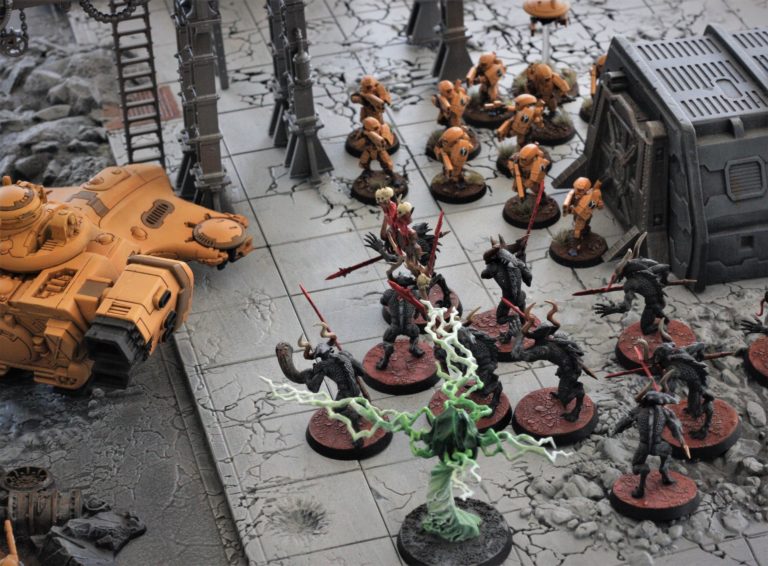
Additionally, having the daemons spawn as extra threats for the players would hopefully provide extra targets and keep more players’ models on the table. The daemons I own are mostly Khorne based, so they would be an extra scary threat to the squishy Tau. Initially, I was going to have all the daemons spawn at the ritual site with only a small chance of additional warp breaches opening. This I changed so that an additional breach opened each turn (with more being able to open randomly) to give additional spawn points that could threaten the Tau player (I should also mention the Tau player had far more experience playing 40k than the Salamander player).
I didn’t really write too detailed rules for how the various effects I was running would function (i.e. there’s no mechanical Action the Inquisitor is performing, just notes about timing of events), however I did have the details of what the effects were so I wouldn’t have to come up with things on the fly–though as the GM I was well within my purview to tweak. Which I did. Extensively.
In GW’s Battle for the Farm, they introduce additional narrative stats: Cool, Intelligence, and Willpower, which all key off modified Leadership checks. These I used for interactions with the environment, but honestly Cool and Willpower could probably just be straight Leadership, whereas Intelligence could be Leadership at a -2 penalty.
Most of the ritual effects were taken or modified from various existing narrative publications. Specific mention goes to the Daemon World rules in the 8th Edition Psychic Awakening book Pariah, which overall is a great resource for many environmental rules that can be easily adapted to the current edition. Also, the Friendly Fire rule was adapted from the “Seeds of Sedition” rule from the “Darkness Descends on Kolossi” mission in War Zone Charadon Act II: The Book of Fire (an excellent narrative gaming resource if you can find it).
Finally, the environment rules were mostly inspired by the rules in the Battle of the Farm, but made specifically for my terrain collection. One thing I would change about them in future games is have less rules about “looting” and have more varied ways to interact with the environment (i.e. firing the quad cannon or driving the tractor).
During the game
You can find a full write up of the battle report here, but I wanted to talk about the experience of GMing during the actual game. As I said before, the mission could’ve been done without a GM, but I think it really made things easier. If a player had a question about a rule or mission aspect, they just asked me. Similarly, rather than remembering to look up special rules whenever a particular terrain piece was neared, I would ask the players if they wished to search an armoury or man the quad cannon.
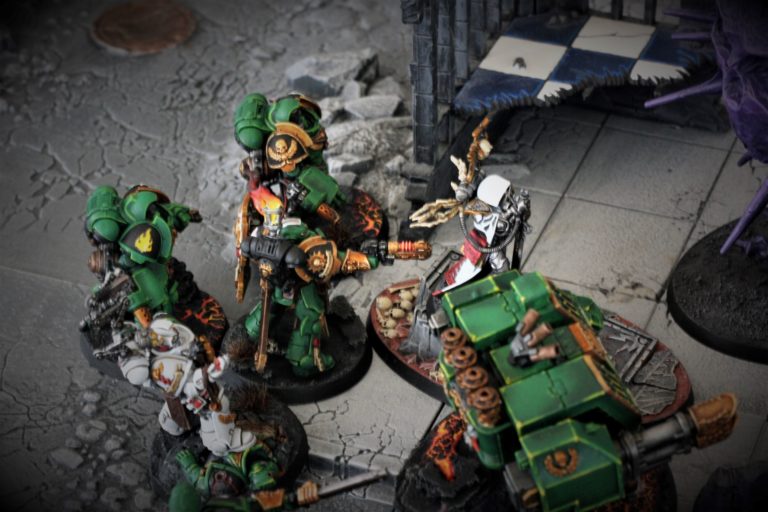
One hiccup that came up was the Salamander player executed the inquisitor much, much earlier than I anticipated. Once the daemons came out of the portal, he opened fire on his following turn. This was a bit of a problem as that meant many of the ritual effects and daemonic reinforcements would be sitting out. To deal with this, I fudged the rules a bit to allow daemons to appear and warp ritual effects to continue after the ritual was cancelled, instead closing a warp breach each turn as a slow countdown back to normalcy. It felt better than trashing half the special rules I wrote. And part of the reason the players were there was to play a cool narrative game, so those rules better be in play!
The players also leaned into the spirit of the game. There was at least one occasion where the Tau player could have gunned down the inquisitor when he was exposed early on, but chose not to keep the story going. If he had chosen to open fire, I could have stepped in as the GM to armour up the inquisitor with Plot!, but was glad I didn’t have to.
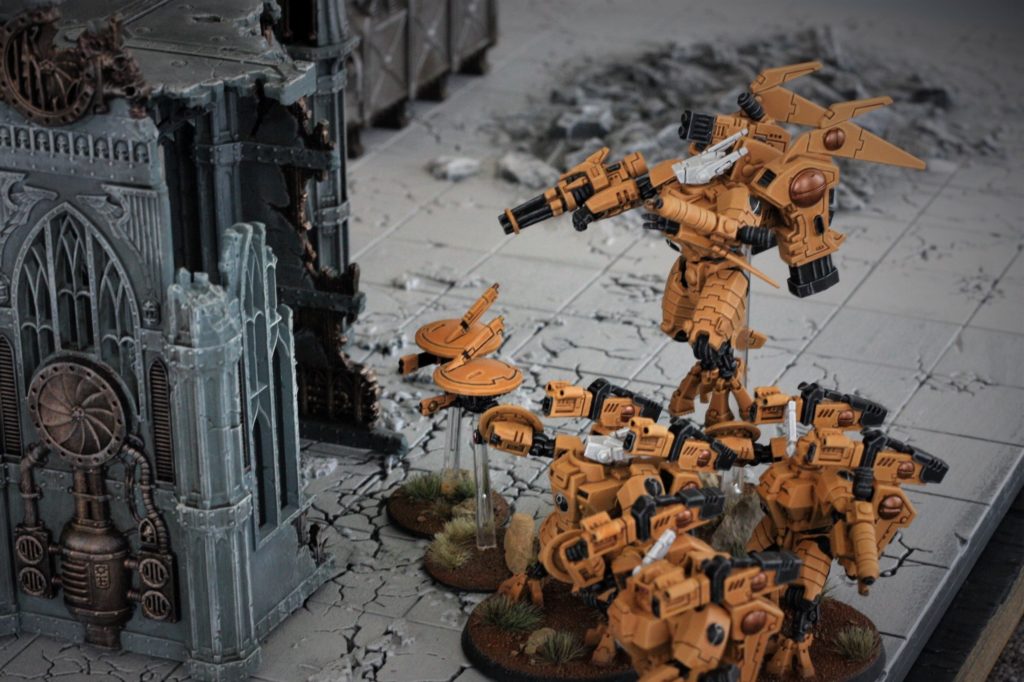
It’s also worth noting that my balance concerns were valid. Even with the reserves rules, the Tau army shot up the Salamanders very efficiently. I’m not saying Salamanders can’t beat Tau, but the setup of Marines in the middle surrounded by Tau favours the xenos quite significantly. By the end, the Tau didn’t have much left, and the Salamanders only had a few characters.
Finally, points gave the Salamanders a decisive victory, but I think the victory points scoring was the weakest part of the mission. More importantly than that, I had notes on where the story could go from there. Now that the Salamanders have killed an inquisitor in cold blood, the Grey Knights would show up to settle the score. With all the war raging on the surface, a Necron tomb was awoken below the surface and they rise to attack the Tau. Though the warp breaches were sealed, it has nevertheless drawn the attention of a Death Guard battlefleet, which arrive after their sorcerers have been directed by ill portents. These are just the ideas based upon the armies available between the two players and myself: if you’re running a similar narrative, the possibilities could be much, much wider.
Maximum Effort
There’s no way to sugarcoat this: GMing a game is a lot of work. Writing the mission alone took up tons of time, not just the writing itself but also researching similar missions. You also need to be engaged during the game, really being a third player controlling the environment.
That being said, it was worth it. GMing 40k was a great experience as well as an interesting experiment. It’s not something I plan on doing for every narrative game, but I will definitely explore it in the future.
A copy of the mission – updated to 10th edition – can be found here.
Photos and terrain by Ian.
Salamander models by Greg.
Tau models by Jacen.