Five Parsecs From Home: Hacking it to 40k
By Ian
This year I’ve had a number of massive life events: you, dear reader, may not have noticed as we carefully prescheduled content so there would be no break in postings (at one point I had written nearly four months of articles in advance), but rest assured: it’s been a year.
This has meant my already limited hobby and game time has shrunk. It’s not a bad thing, life’s going good, but it means I’ve had to make some adjustments.
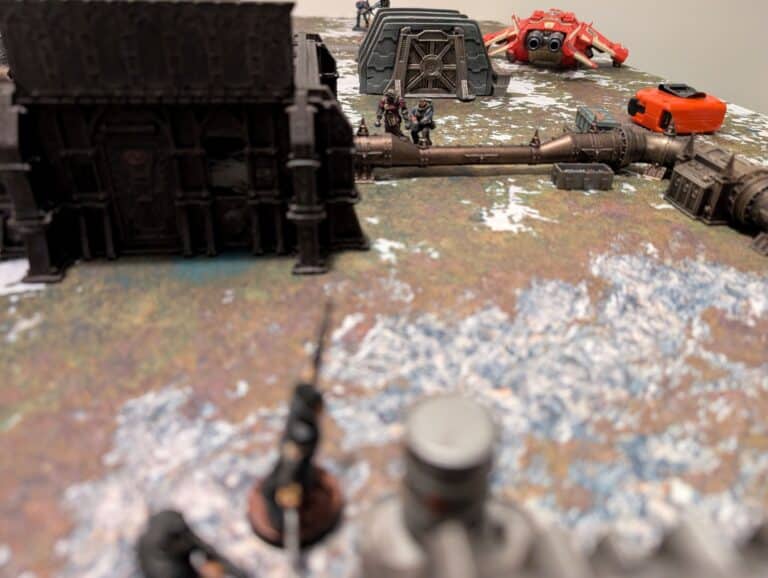
Who’s parsec is it anyway?
Peachy’s video review of Five Parsecs From Home came up on my YouTube algorithm a few months back and I was intrigued. I remembered Variance Hammer had done a series on the game also, though I had skipped over it at the time. After Peachy’s glowing review, I went back and read VH’s articles, and then I bought the rulebook.
5PFH is a hybrid RPG and skirmish wargame. You play a starship crew on the fringe of civilized space, picking up odd jobs and trying to pay off debt while avoiding rivals. It’s played as a campaign, and each campaign turn contains one battle plus rolling on a whole lot of tables.
After reading VH’s detailed log of the game, though, I was actually surprised there weren’t more tables: for example, there are no name tables for characters, planets, nor organizations and players are expected to narratively connect the dots and fill in these gaps (that being said, there are expansions with more tables, though I haven’t picked any up yet). That’s fine, but it wasn’t really what I was expecting. Though, as you’ll see, it leaves a lot of creative space, which I’ve taken full advantage of.
So how does it play? At the time of writing, I’ve got four campaign turns under my belt, each of which has a skirmish battle. Anyone familiar with 40k will pick up the rules quickly: you move a character and then attack (either brawling if your duder is engaged, otherwise shooting). Ranged attacks are a hit roll, wound roll, and a saving throw (though how you determine the required roll is different than 40k). Initiative is simple: a few of your quicker characters will act, then all the enemies, then all the rest of your Crew. Different types of enemies have different behaviour and how each group acts is broken down nicely.
The biggest difference I’ve found between 5PFH and 40k rules-wise is that it’s typically harder to hit/wound/save, especially before you’ve upgraded your PCs and found better gear. Most of the time you need 5+ or 6s, and the best armour save in the core game seems to be 5+. While this can create times where you’re rolling lots of dice and not a lot is happening, when your frontline character does catch a round it certainly ups the tension. Once you’ve gotten a handle on the rules, the game also plays fast, so going through a turn where everybody misses doesn’t feel like a huge waste.
Solo Gaming
Beyond the actual game mechanics, 5PFH relies on “emergent narrative” through a fun thing humans do called apophenia. I’m very far from a psychologist, but my limited reading on apophenia has told me it’s the ability to create meaning from random occurrences or unrelated events, such as recognizing a shape in a cloud. Anyone who has GMed a roleplaying game will know it as when their players pick up on some innocuous detail and assume or imagine the story/puzzle/quest hinges on it (a good GM will incorporate it into the story, but that’s besides the point). The dark side of apophenia is when people get drawn into conspiracy theories by connecting random, unrelated details or events (Berkowitz).
What is emergent narrative then? It’s the stories we create through this, and through random occurrences in the game (Tweetum), such as explaining how a low level character in a roleplaying game pulled off an amazing feat (as a result of rolling a critical success or triumph, for example).
These two concepts really come alive in 5PFH, as there are so many random events between and during games that you essentially build the narrative through dice rolls. For example, I had a character go down in one mission and be sent to sick bay for 6 campaign turns (i.e. cannot participate in battles or between game activities) so decided she was in a coma, without the rest of the Crew really understanding why. But a few turns later when she was randomly selected to gain experience for training with a mentor, I decided she’d been visited in a dream.
In another random campaign event, two crew got into a fight. I’d written their background to be that they went way back, but now they’d had a fist fight. What did that say about their relationship? Maybe it was more complicated than just good friends, that they were longstanding allies who tolerated each other but drove the other over the line from time to time.
These are all the types of interactions that could happen in a good RPG, but, instead of collaborating with other players and the GM, in 5PFH you riff off what the dice tell you.
Making it Grimdark
There’s a sister fantasy game called Five Leagues From the Borderlands that I debated picking up instead of 5PFH, but in the end I have such a huge 40k backlog it felt better to go SciFi. I could use the game as an excuse to paint odds and ends from my collection–Blackstone Fortress characters, Necromunda gangs, or just random figures I had lying around–and also work on some terrain.
The other reason for going SciFi is I wanted to convert the game to the 40k setting. My gaming group already has a well-populated sector of space from previous 40k campaigns, a lot of the playable species in 5PFH have 40k analogues, and most of the weapons were very similar to wargear found in the Imperium.
The first hurdle was what to play. Instinctively, I wanted to play an Inquisitor and their retinue. Though I think there may be a way to make this work, it would require too many house rules. Inquisitors typically aren’t scrounging for resources and doing odd jobs. The next idea was to play as a Rogue Trader’s entourage. Though this was closer to home, Rogue Traders possess vast wealth and power and have the same issues as Inquisitors. You could say they’re a disgraced Inquisitor or Rogue Trader on hard times, but it also begs the question of which class they should be, and then you’re already violating the first stage of the book: randomly generating *checks notes* everything.
What does that leave then? Well, I don’t think I’ve read a single 40k story about a crew trying to scrape by on the edge of space. But that doesn’t mean they don’t exist. The character Harlon Nayl from Dan Abnett’s Eisenhorn and Ravenor series is a former bounty hunter (a classic fringer trope), for example. The idea of exploring this dark corner of 40k had an appeal: we play with genhanced Space Marines, otherworldly Daemons, and Inquisitors of towering arrogance, but what do mere mortals look like trying to survive on the fringe?
So it was decided: a somewhat classic crew of outcasts, living on the edge of the Pilgrim Sector, the Imperium on one side and hordes of Chaos and Xenos on the other.
Converting to 40k
I’ve already mentioned how the species and weapons in 5PFH translate to 40k, but there are other considerations. The 5PFH universe has an eclectic cast of aliens visiting human worlds: though in 5PFH you will occasionally visit a world that is intolerant to one of those alien species, it’s a far cry from the Imperium’s standing policy of shoot, stab, and burn every alien on sight. But we do have some precedent for mixing in xenos.
I mentioned Blackstone Fortress above, where you play a rogue trader’s Crew, which includes an Eldar and Kroot. In Ravenor by Dan Abnett, the warband goes undercover at Firetide, a gathering on an asteroid beyond the control of Imperial space where xenos are tolerated and allowed. It is conceivable then that there could be planets at the edge of a sector that might not shoot an alien as soon as they set foot planetside.
Or maybe the elf just wears a toque.
Eldar with their ears covered could pass for human to the uninitiated. A Necron wearing robes with a deep hood could pass for a cyborg or servitor. Votann are near human enough no one would probably notice or care. A Tau could bandage their head and hands, and wear baggy pants. A Kroot, Vespid, or Ork….could stay on the ship til the fighting starts. You may have to do some narrative backflips to justify some of these in your party, but I think it’s cool to include a few xenos. Plus, it’s a solo game, so no one can complain!
Other than xenophobia, there’s the issue of warp travel. While there are a few examples of small warp-capable ships in 40k, they’re quite rare. My Crew would have to book passage on passing bulk freighters, Rogue Traders, or whatever else they can beg or barter onto. Mechanically, the cost of fuel would just be the cost of passage. I made some random tables for the known planets in the Pilgrim Sector (more are being added as our group plays campaigns) to generate destinations for passing ships. I figure any turn I want to look for passage, I’ll roll a few options for available destinations.
The last thing I wanted to do was incorporate some games of 40k I to my campaign. 5PFH has a great invasion mechanic where planets can be attacked by various enemies. Rather than rolling to see if those invasions get resolved, I plan to play a game of 40k to see how it gets wrapped up.
Getting the band together
There’s a few ways to start generating a crew in 5PFH, and I did the one the book recommends: making some initial decisions (mainly species and number of crew) based on available miniatures. I rolled for everything else, and I’ll indicate the roll results before introducing each character below with the background I came up with and the mini I painted.
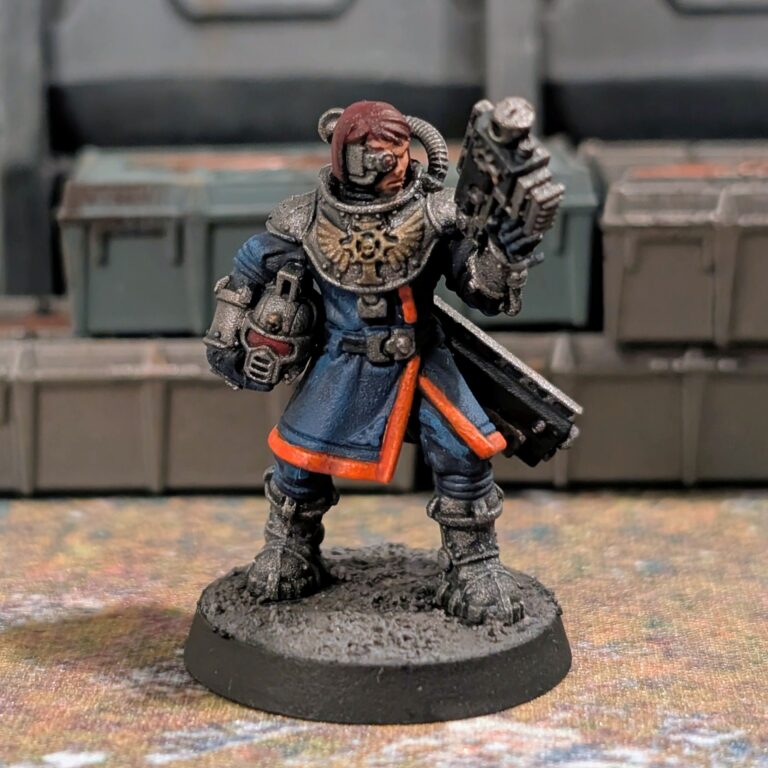
Human 1 – “Hammerfall” Elyza
Roll results
Background: Long-term space mission
Motivation: Escape
Class: Enforcer
Leader (chosen after rolling all characters)
Elyza was the leader of an Imperial Navy breacher squad, a veteran of several boarding actions that had repelled hostiles from her vessel. However, more and more she has felt the urge to settle down and unload her shotgun. When the ship was attacked in orbit over Daennous, she took her chance and fled when the evacuation order was given. After crashing on the seventh moon, she didn’t report to the Navy base and remained MIA. Lying low, she scrounged some parts and was able to salvage the wrecked freighter to get it space worthy. She doesn’t know where she’s heading, but she won’t be going back to the Navy.
I had a breacher squad on sprue kicking around: the plan was to paint them up as chapter serfs for my Storm Guard, but that project was so far down the backlog it didn’t seem likely to happen. Plus, if I want to do it in the future, I can source a few extra breaches or get a whole new squad.
I built Elyza with a bolt pistol (handgun) and shotgun: weapons I’d rolled up in character creation. Hopefully I’ll be able to replace the handgun with a hand cannon: much more appropriate rules for a mass reactive pistol. All the models in the Crew have some blue and orange to tie them together. The blue on her (and on everyone else, unless mentioned otherwise) is Night Lords blue, drybrushed with Alaitoc Blue, and a lighter drybrush of Teclis Blue. The orange is Magmadroth Flame over Wraithbone. The silver is Leadbelcher with a Two Thin Coats Oblivion Black Wash, and the gold is Skeleton Horde over that. The base is simply Astrogranite, Two Thin Coats Battle Mud Wash, and a Dawnstone drybrush. I don’t remember the colours I used for the skin and hair: I typically mix various skin tones and colours to make something unique, and then do a wash or two to tie any highlights together. Unless otherwise mentioned, these are the same paints used throughout the Crew.
The goal with all the painting was to be quick, each model done in one or two sessions. They’re not my best work by any stretch, but it was a nice break, using colours I don’t normally use and trying contrast paints more, a style I’ve often struggled with. Doing one or two models at a time was also encouraging as I got quick progress and the nice achievement of completing something, even though my hobby time was limited.
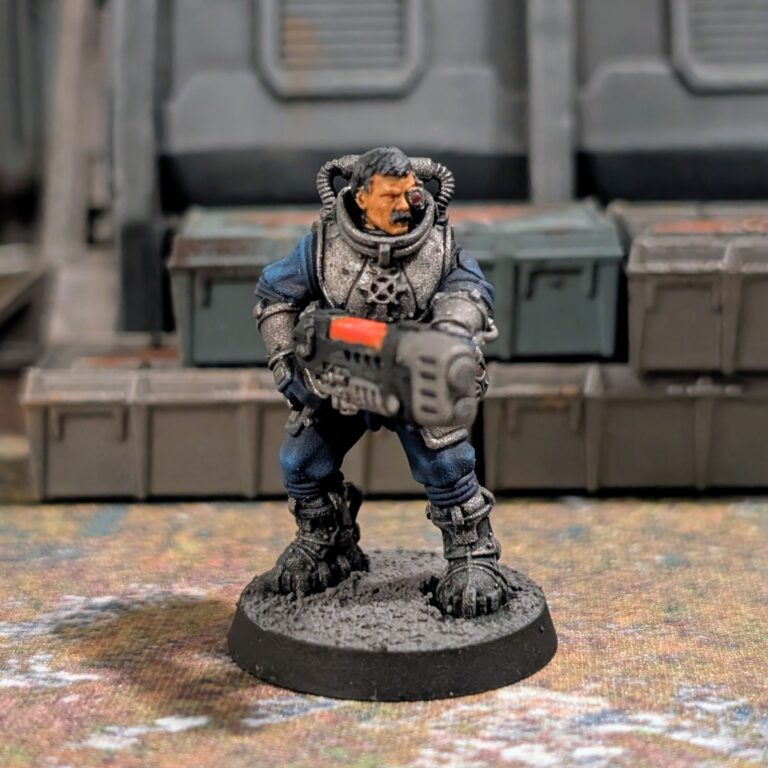
Human 2 – Kratos
Background: Mining colony
Motivation: Political
Class: Troubleshooter
A former union steward at an asteroid mine, Kratos joined the Imperial Navy after the mine ran dry and the local disbanded. He brought his “servitor” along with him and soon found himself under Elyza defending their vessel in boarding actions. Kratos became a dependable soldier and Elyza entrusted him with the squad’s special weapon and promoted him to be her number two.
I felt like “miner” and “politics” equals “union” rather than some down on his luck politician. As Elyza’s number two, he would have helped keep the rest of the squad in line before the crash.
I actually rolled up the plasma gun in a trade task in the first pre-battle campaign stage (after character creation), but hadn’t built the characters yet, so Kratos got it: his seniority in the breacher squad affording him the privilege of carrying a relic weapon. Kratos was painted in the same batch as Elyza and used the same colours.
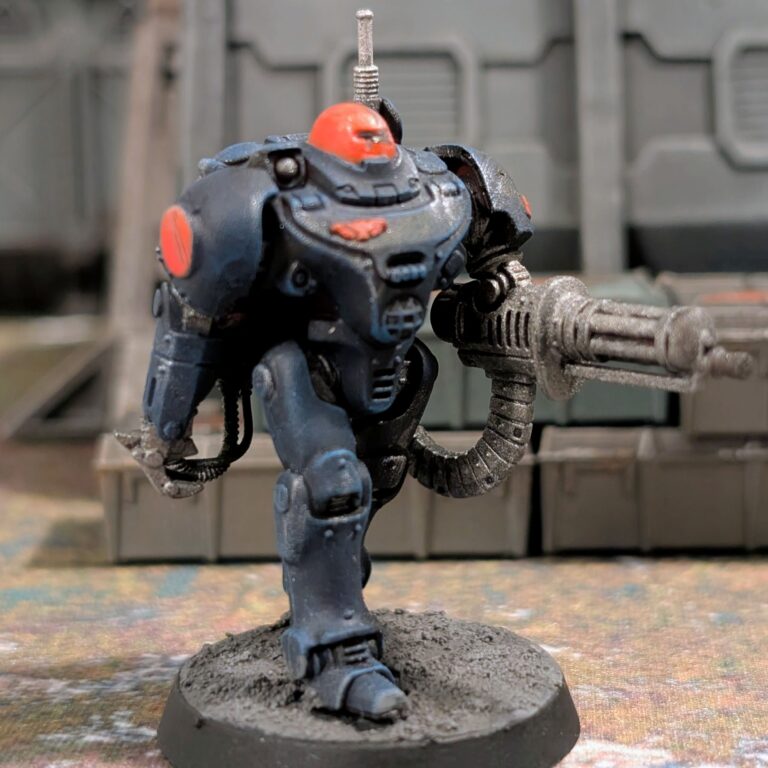
Bot – DÆK-444 “Dak”
Dak was part of Kratos’ mining crew. The mine higher ups had assured Kratos Dak was a servitor with organic components deep inside and Kratos never questioned it…though Dak had more personality than any servitor Kratos has ever met. When the mine closed, Kratos smuggled Dak out and he was retrofitted for boarding actions. Dak is loyal to Kratos, though his programming has some odd personality quirks.
You don’t roll for robots in 5PFH, they all come standard. Dak was painted with the same colours as the breachers, though with a little Leadbelcher drybrushed across the chassis for wear and tear. The first few games have seen him wielding a basic rifle rather than any sort of cannon, but I’m hoping to eventually roll one up.
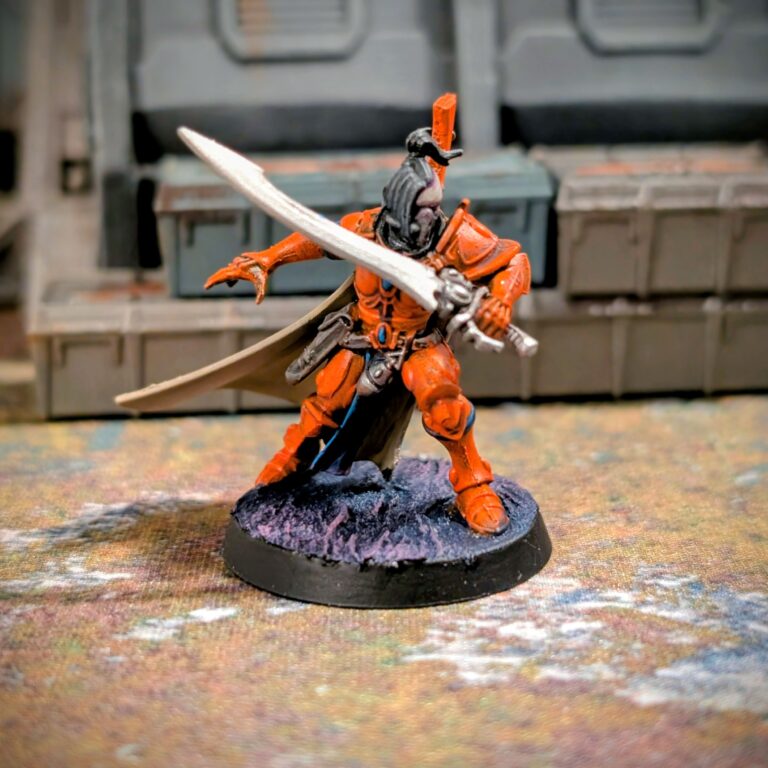
Precursor (Eldar) – Aldra the Melancholic
Background: Lower mega-city class
Motivation: Discovery
Class: Trader
Though originally a Craftworlder, Aldra was captured in a Drukhari raid and brought to Commorragh in chains. She eventually escaped slavery and began to trade in secrets and prophecy. When she heard a docked Corsair ship was taking on fresh crew, she immediately joined up and left Commorragh behind.
What Aldra is chasing is unclear, but she has hired Elyza and her Crew for something. Has she learned a prophecy that she is trying to unlock or prevent? Is she doing this for herself or at the behest of her Corsair captain? Is she just trying to get home? Only time will tell.
I have a primed squad of voidacarred and selected one to paint up (though I could always do another if her loadout changes). When rolling up crew details, they became “lovable rogues” “hired by Aldra”. I’m not sure there are any “lovable” characters in the 40k universe, but having Aldra drive the narrative is very interesting.
Feral (Kroot) – Rhekk
Background: Peaceful, high-tech colony
Motivation: Power
Class: Scientist
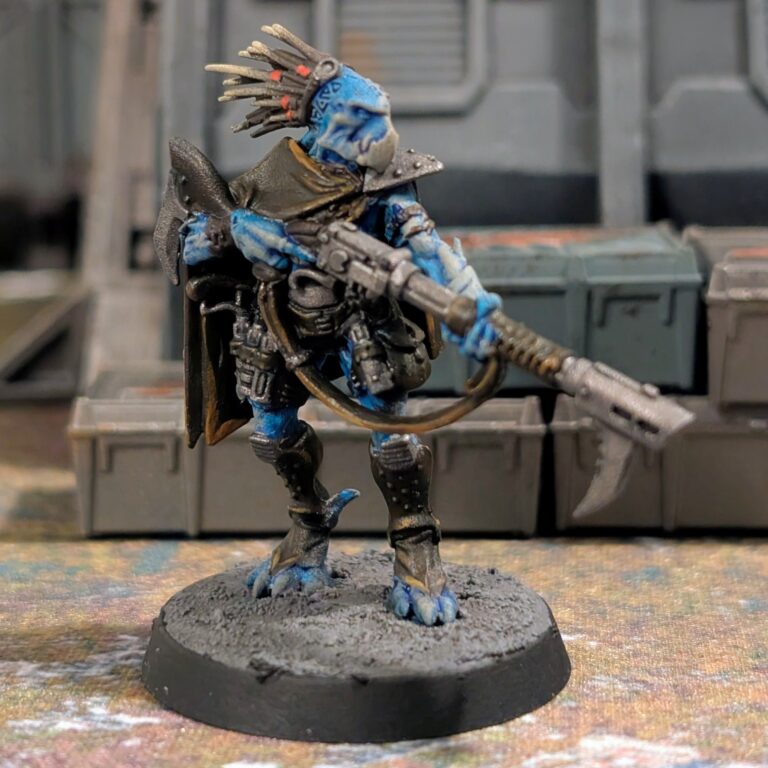
A geneticist, Rhekk lived on Bork’on, a centre for learning in the T’au Empire. Though the high technology of the Empire afforded Rhekk many opportunities, the leaders of the research centres always looked down on Rhekk’s “indulgent meals”. Eventually he learned that to truly unlock the potential of his research, he would need to strike out on his own and leave T’au space.
Rhekk was recruited by Aldra to join Elyza’s Crew. He doesn’t interact much with the humans, even during battle often taking an overwatch position away from them. But Elyza has learned she can count on the strange alien to watch her back.
“Scientist” was a bit of a weird class for a Kroot, but I’ve learned the key is to lean into the randomness of the game and think about the “whys” and the “what’s” of the die rolls. What science do Kroot care about? Oh, well that actually makes this obvious…
Jacen suggested the Kroot would take on the colouring of his prey, which would have evolved to blend into the terrain. For the life of me, I couldn’t find out the climate of Bork’on, but the colour scheme for that Sept is blue and white, which worked with my Crew’s colours and I made the executive decision that Bork’on sept colours reflect the planet’s climate. I used Talassar Blue drybrushed with Rakarth Flesh for the skin.
Human 3 – Sabbatha
Background: Isolationist Survivor
Motivation: Faith
Class: Trader
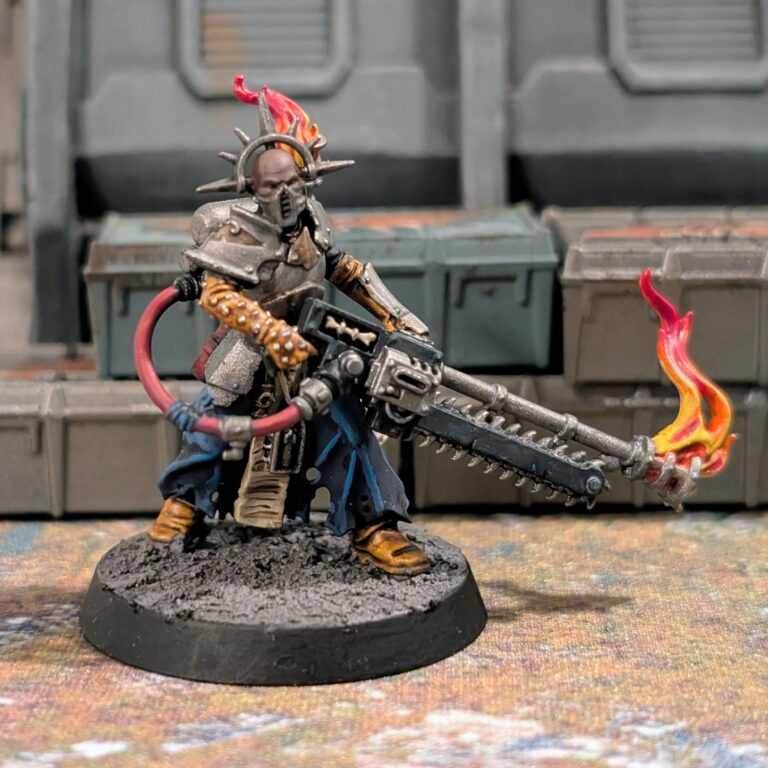
“Sabbatha” is one of the most common names in the Emmeradha Subsector where the sector’s principle cardinal world Sabbath can be found. But Sabbatha grew up on Requiem, a far-flung grave world at the edge of the sub. She dreamed of following in the footsteps of her world’s saints and making a pilgrimage across the sector. Scrimping and saving, she eventually found her way on a bulk transport.
Loaded to the gills with naive pilgrims willing to part with their life savings, the transport did not stop at any holy sites but made its usual run to the Reach where it deposited the passengers on a moon of Daennous.
Faith is a common theme in 40k, and there are a huge number of Shrine Worlds in the Pilgrim Sector. The principal ecclesiarchy world in the sector is Sabbath, an immensely holy site and common destination for pilgrimages. Therefore, I imagine “Sabbatha” is one of the most common female names in the sector, especially on religious planets such as Requiem, where Sabbatha was born and raised.
I’ve included an appendix at the end discussing Requiem in detail, as I think it’s pretty neat. For Sabbatha herself, her background rolls meant she contributed a bunch of quest rumours to the Crew’s pool, which I’ve interpreted to mean she’s been touched by destiny and will be a central figure in the story. She was painted similar to Elyza and Kratos.
The Edge of the Sector
The servitor waddled ahead of Elyza, “Unified Orbital Technologies” tattooed across the back of their neck. The heavy gait was softened by the snow and grass but still caused them to sway from side to side as they walked. This far out on the Sector’s rim, the Mechanicus didn’t maintain a dedicated presence, instead hiring out routine tasks to sub-contractors like UOT…who then further contracted out to crews like Elyza’s.
“Gotta love a baby-sitting gig,” Kratos muttered under his breath, his plasma gun humming on standby.
“Don’t like it, go back to the Navy,” Elyza said over her shoulder, catching her number two’s smile before she turned back. He fell into step with her.
“I get why we’re doing this, but what does it have to do with her?” he asked. Elyza didn’t have to ask who “her” was: he meant the alien. The Eldar. The Witch.
Elyza only shrugged. “Like I said, you can always go back to the Navy.”
Kratos was about to say something but instead shoved Elyza to the ground.
“INCOMING.” Dak’s voice was a high volume, mechanical screech as he began to fire.
Elyza shook off Kratos’ hand and leapt after the servitor, which still stoically strode towards the uplink.
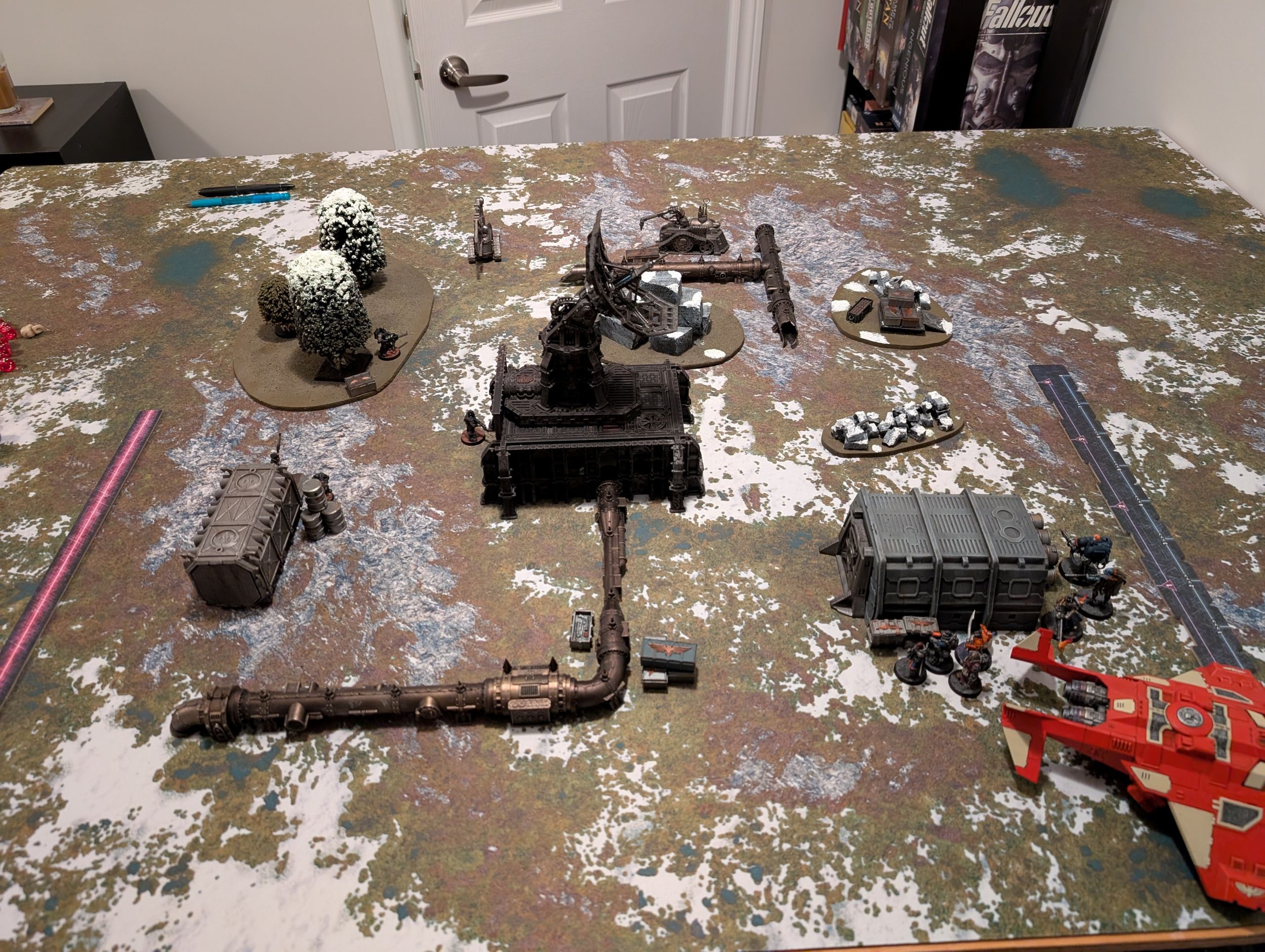
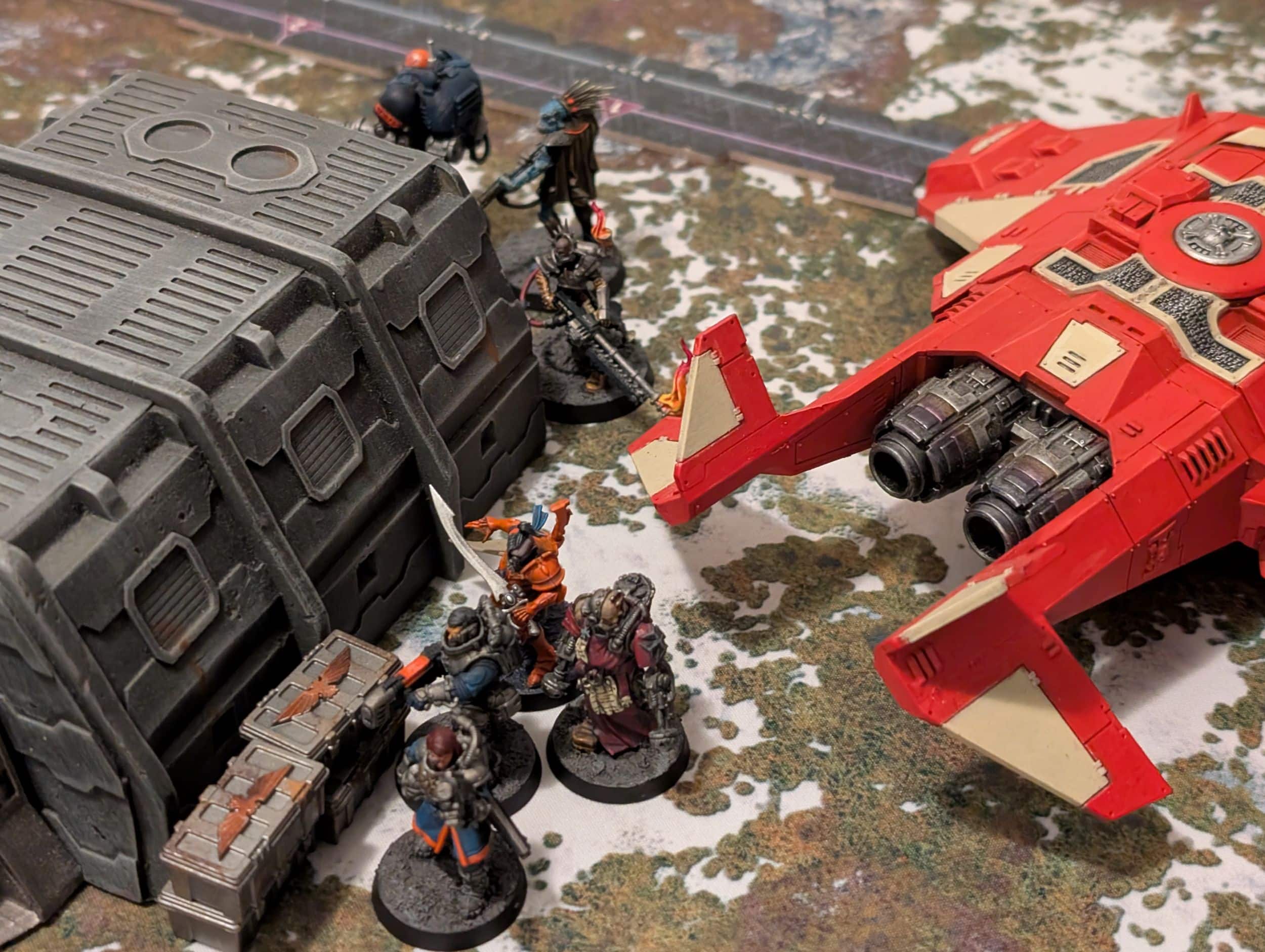
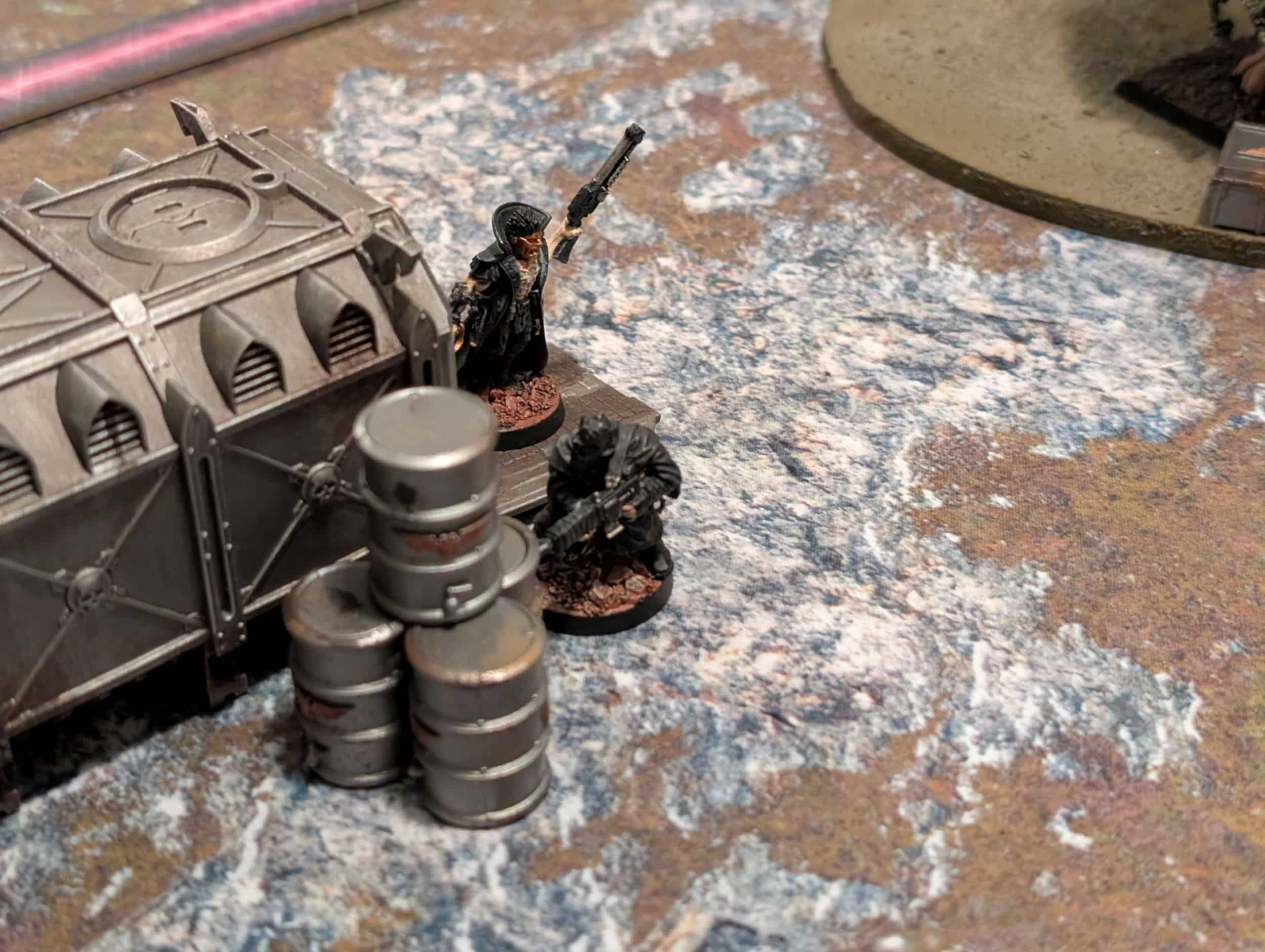
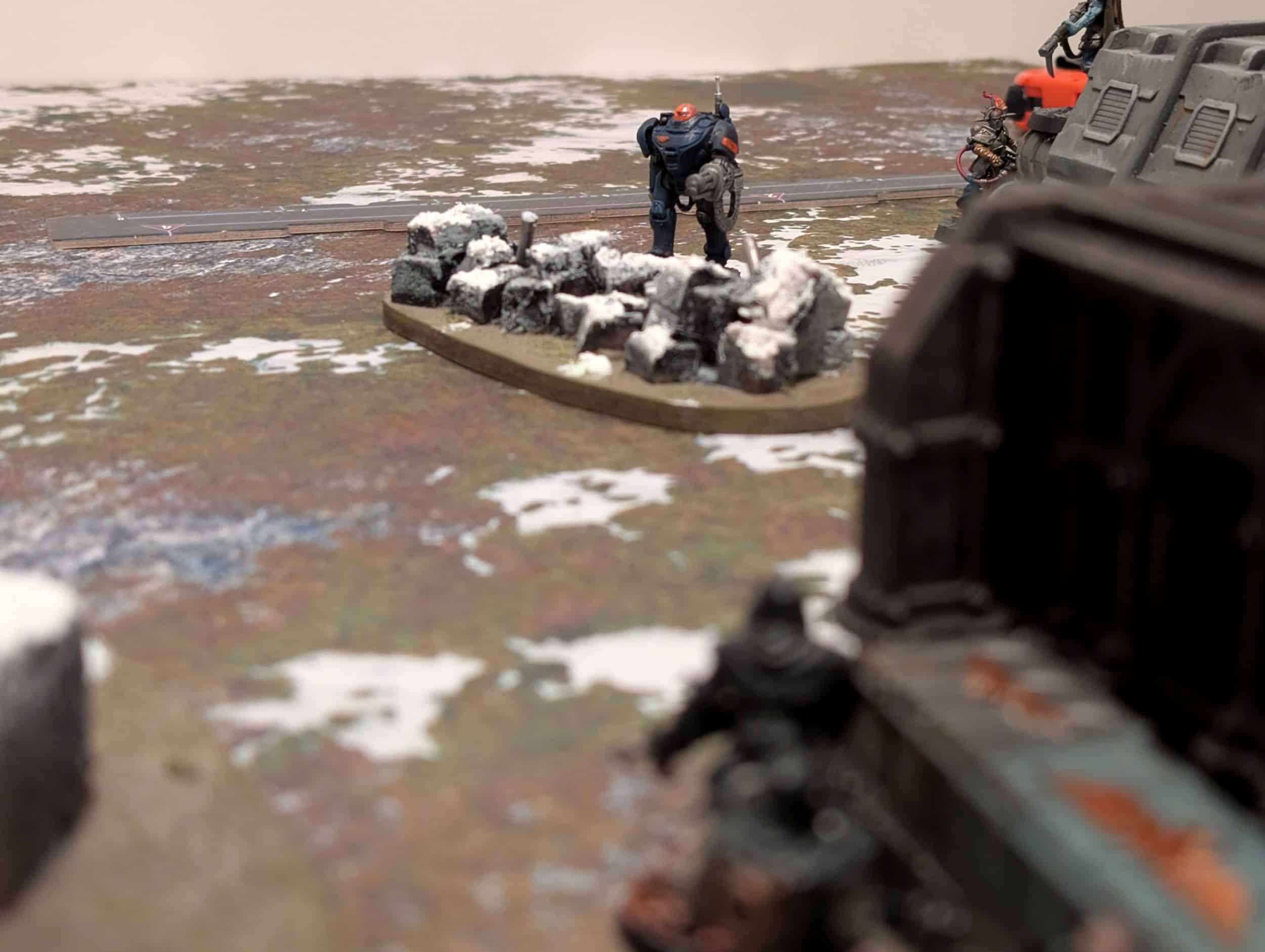
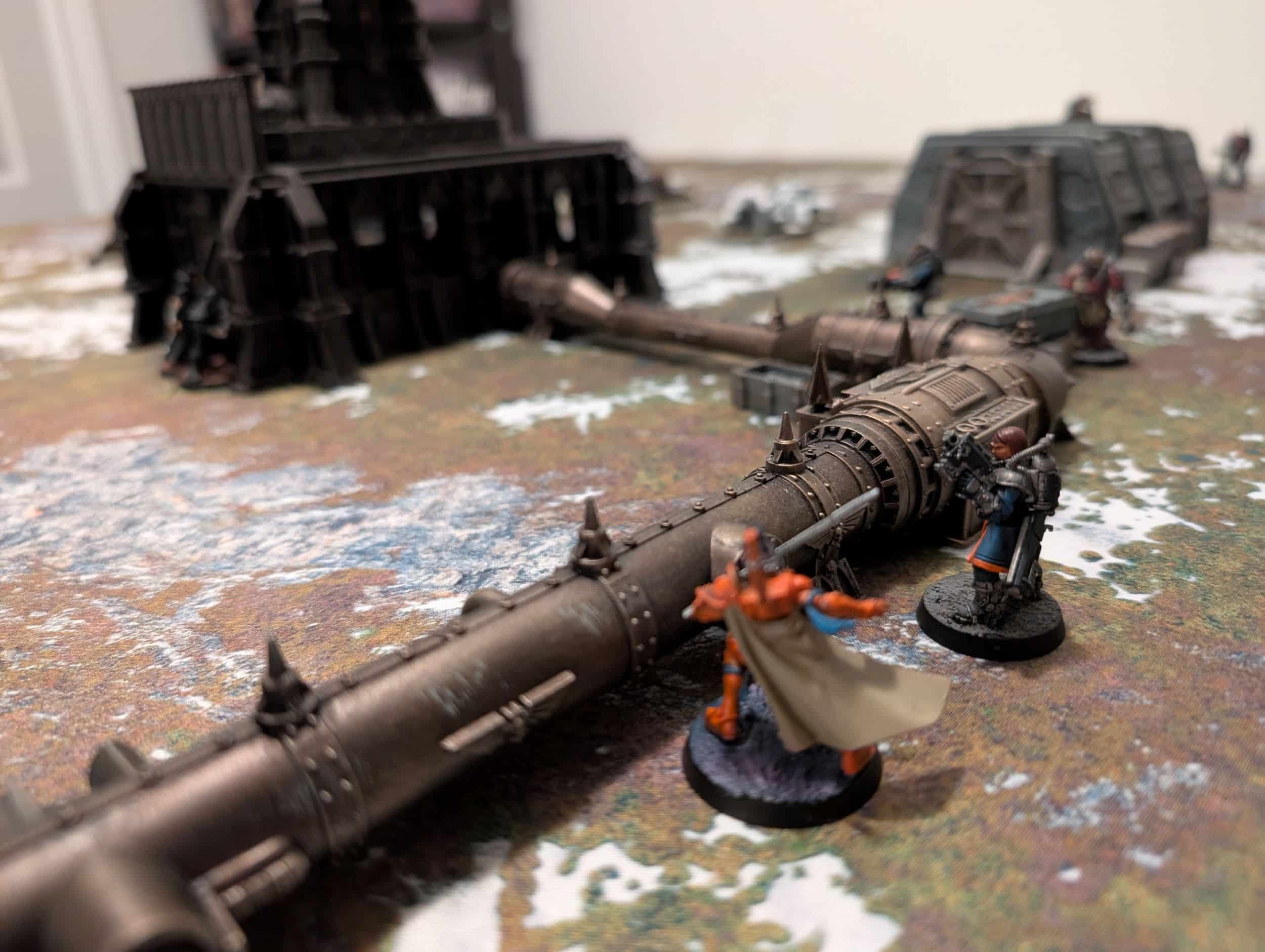
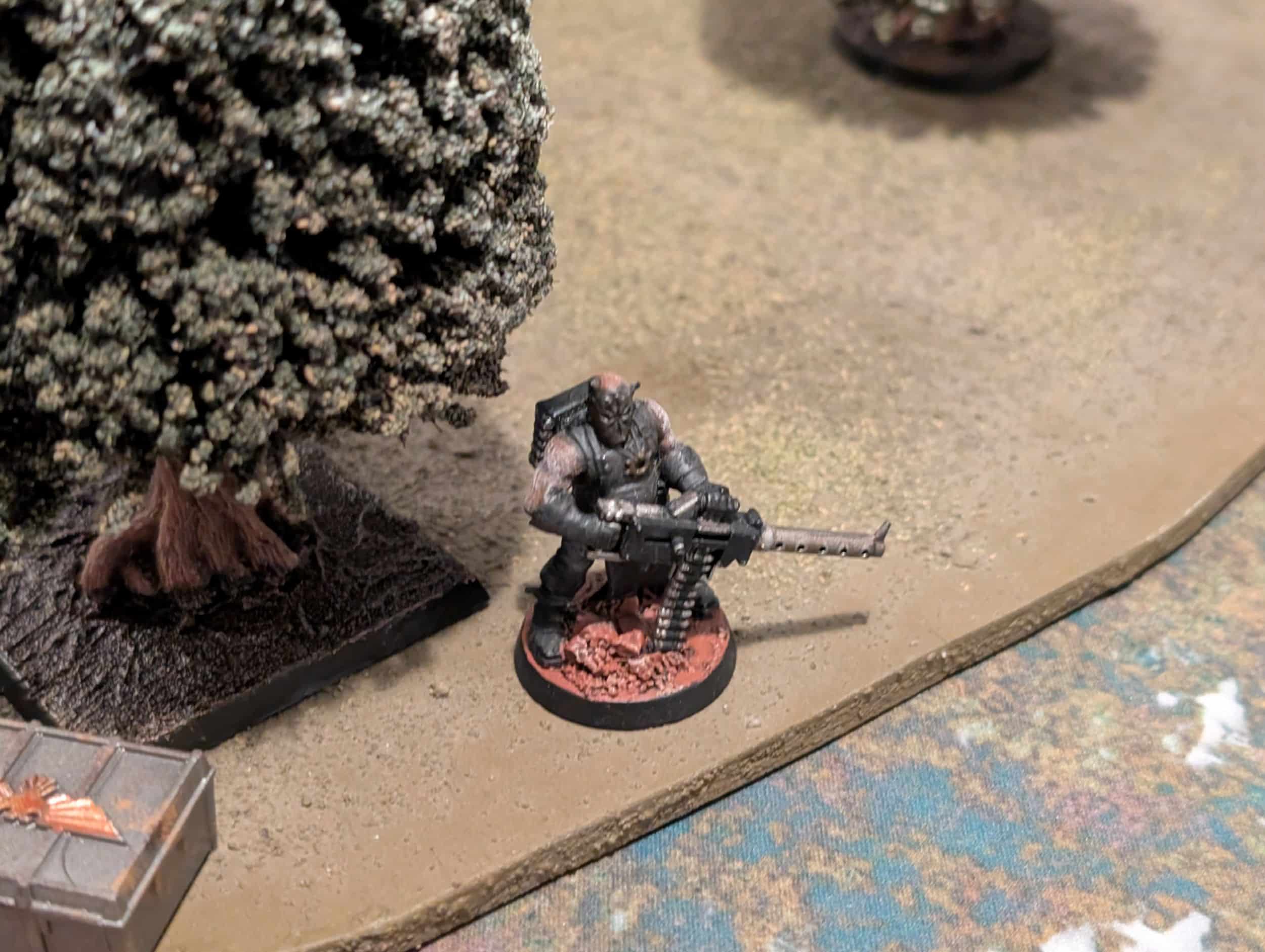
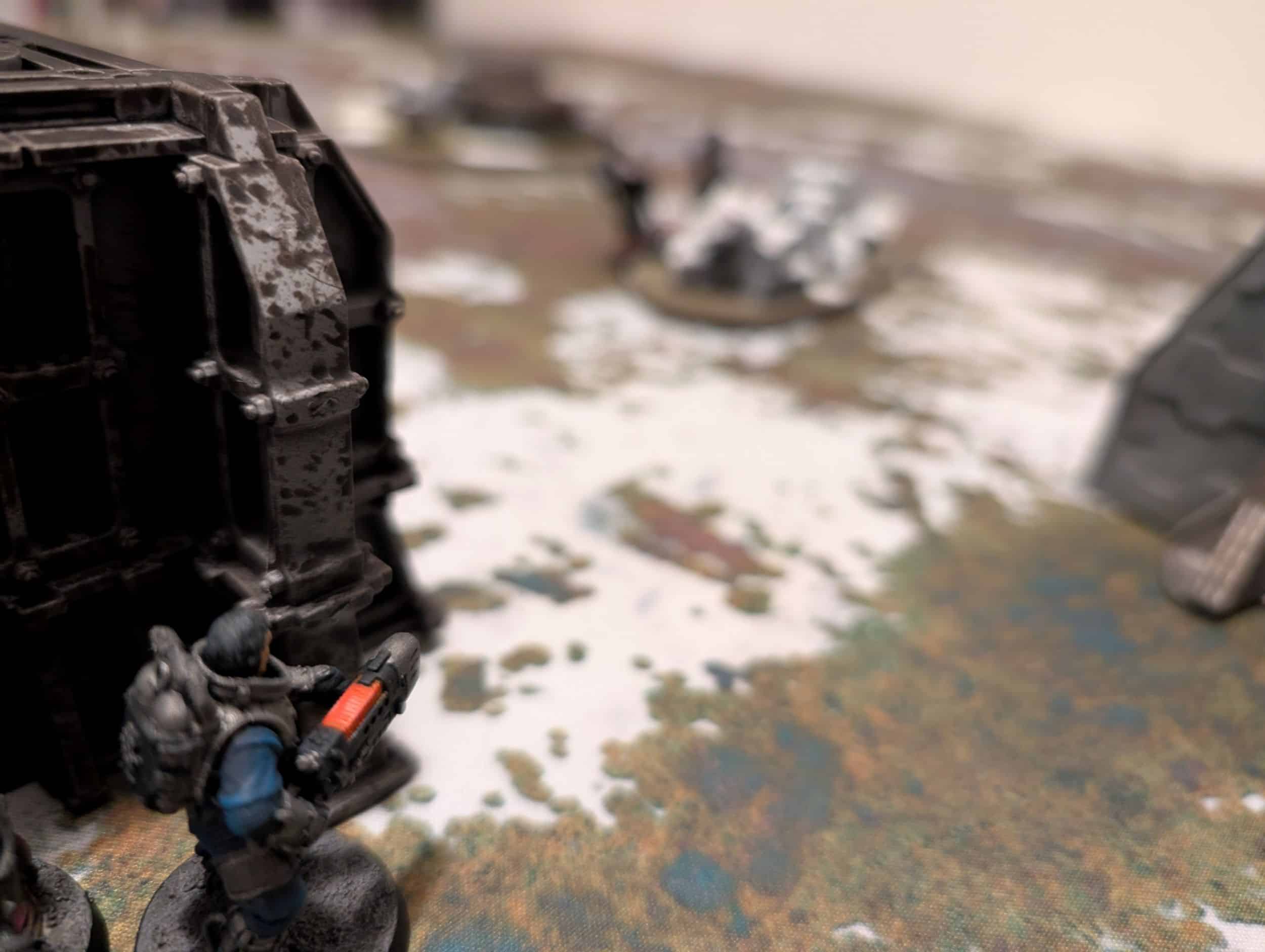
The first campaign turn saw the Crew escort a NPC servitor to the centre of the battlefield and then spending a full turn to upload a firmware update to an Adeptus Mechanicus relay station. The patron I rolled for this job was “private organization”, and while megacorps and the like are a common sci-fi trope, they don’t really work for 40k. However, with Daennous being in the Reach–a far-flung subsector on the edge of the Pilgrim Sector–I thought that the Mechanicus may not have a serious presence and might outsource some basic tasks to locals, such as monitoring Ad Mech servitors.
Aldra got into a bad scrap and went down during the mission. Turns out a brand new elf with a sharp stick isn’t great in melee. In the post-game sequence, this ended up costing me the entire payday from the job and she was out for the next 6 campaign turns. I interpreted this as the Crew paying off the doctor to treat a near-human xenos and, though the doctor did all she could, Aldra still fell into a coma. I can pay credits to speed up her recovery, but me rolling terrible for credit rewards becomes a bit of a theme (seriously, I started with two Traders who give additional credits at character creation and rolled a 1 for each).
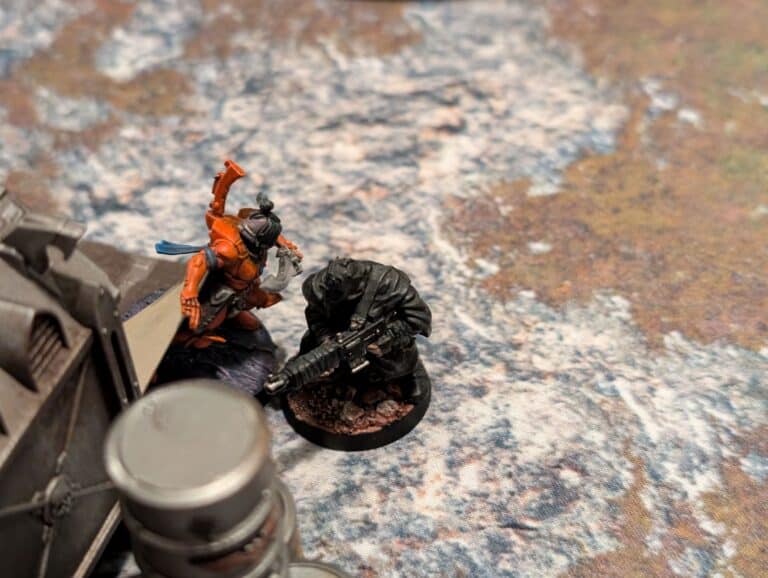
“What is it?” Elyza asked, putting down the gun barrel she’d been cleaning as Rhekk stood up sharply, sniffing the air. He snatched his rifle and moved towards the door of the shed that served as their makeshift barracks.
Kratos snorted. “What’s got into–”
“Quiet!” Sabbatha hissed. “Do you hear that?”
At first Elyza heard nothing, just the gurgling and beep of the machines hooked up to the Eldar behind the nearby curtain. Then a rustle beyond the open shed door, the swoosh of wind, a tree branch snapping.
“Repel!” Elyza shouted, falling into Navy orders. Her chair fell back as she jumped to her feet, grabbing her shotgun from the table and racking the slide as she ran for the open door.
Her team took positions around their shanty compound: Rhekk and Sabbatha by the garage, Kratos and Dakk by the barracks, and Elyza between them at the door of the armoury. They came out of the trees: strange xenos swooping on bat wings and clutching daggers. Their bearded faces were scrunched into grimaces and frowns.
“Repel! Repel! Repel!” she shouted again and again as her shotgun roared.
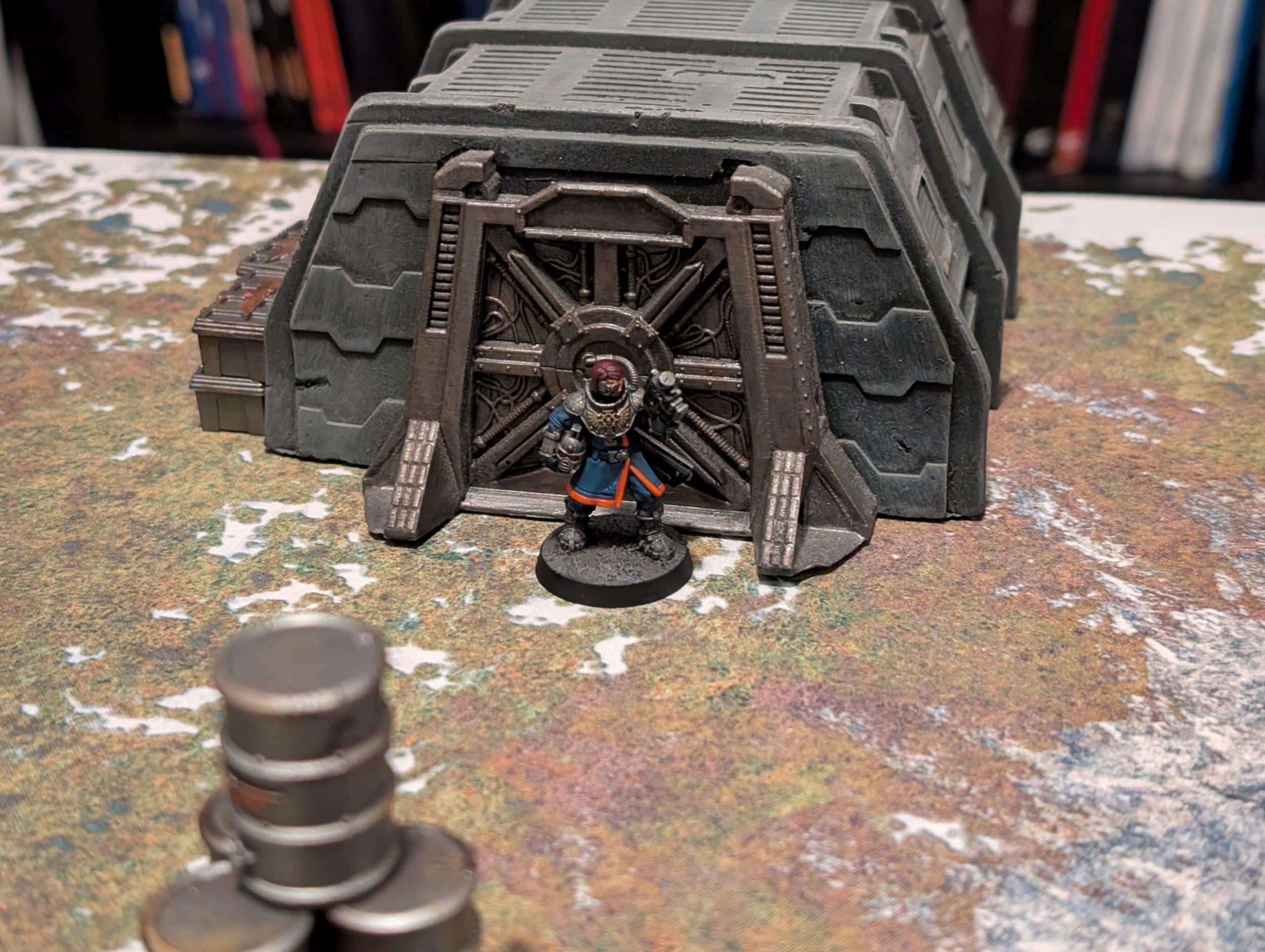
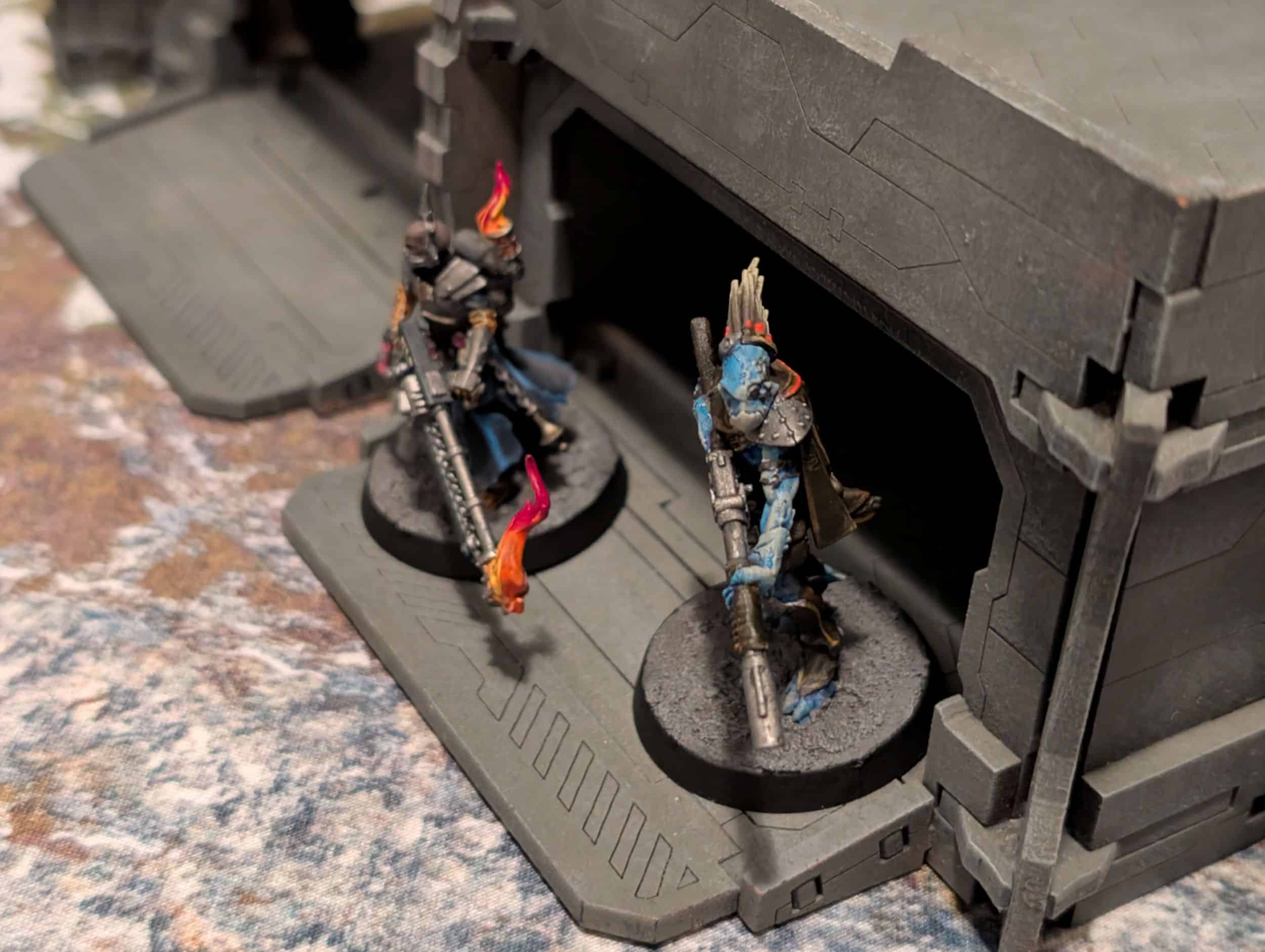
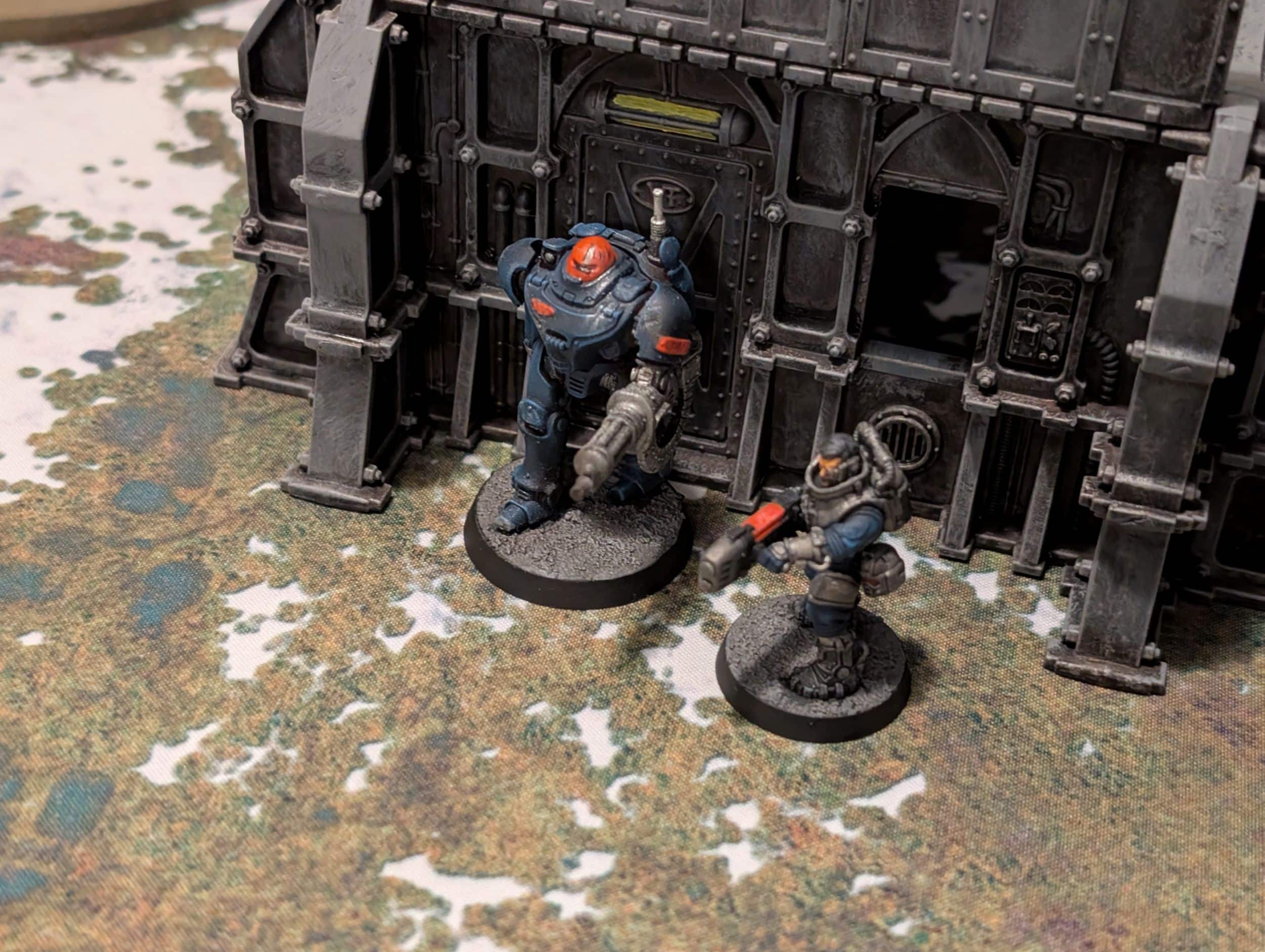
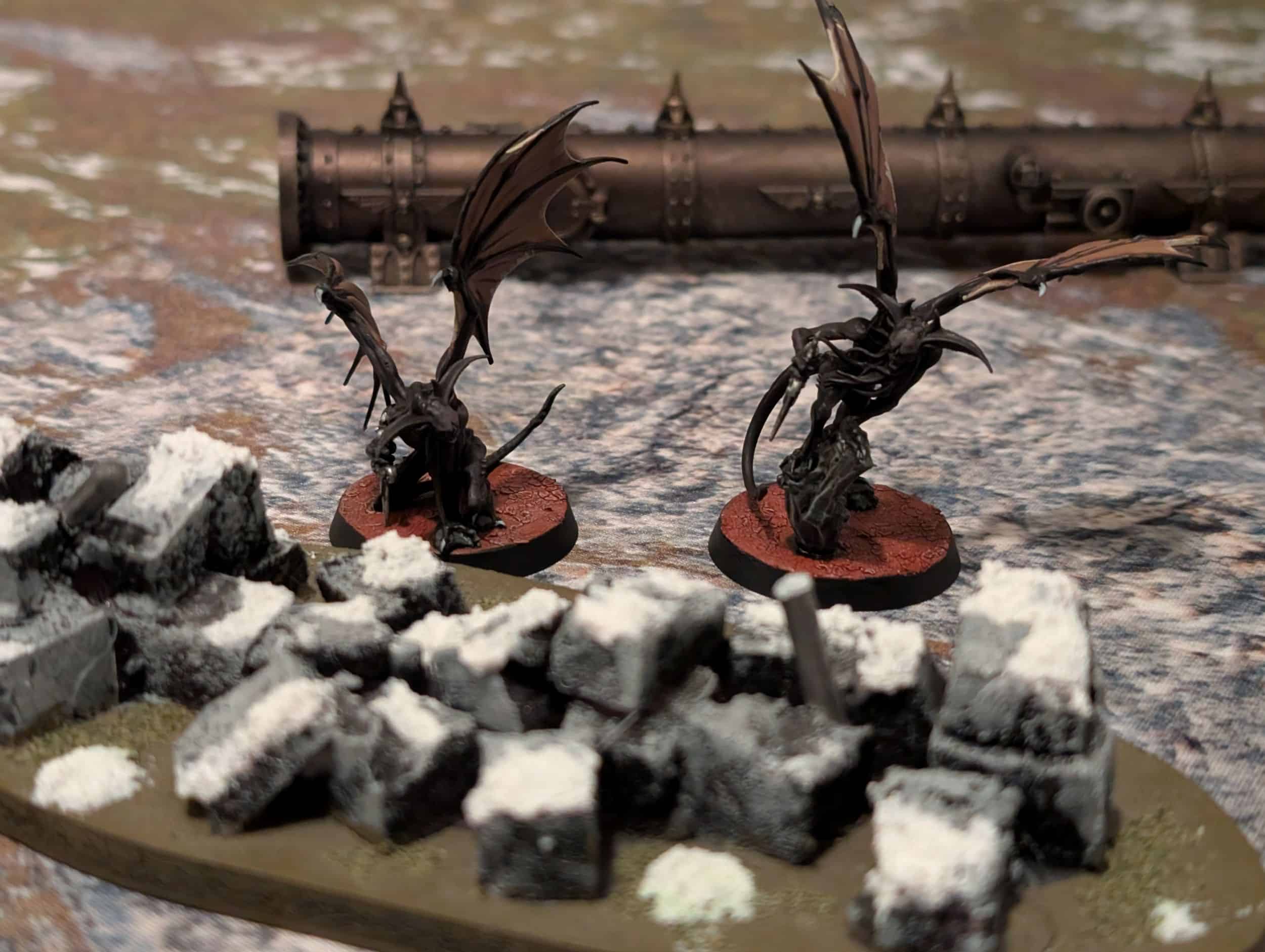
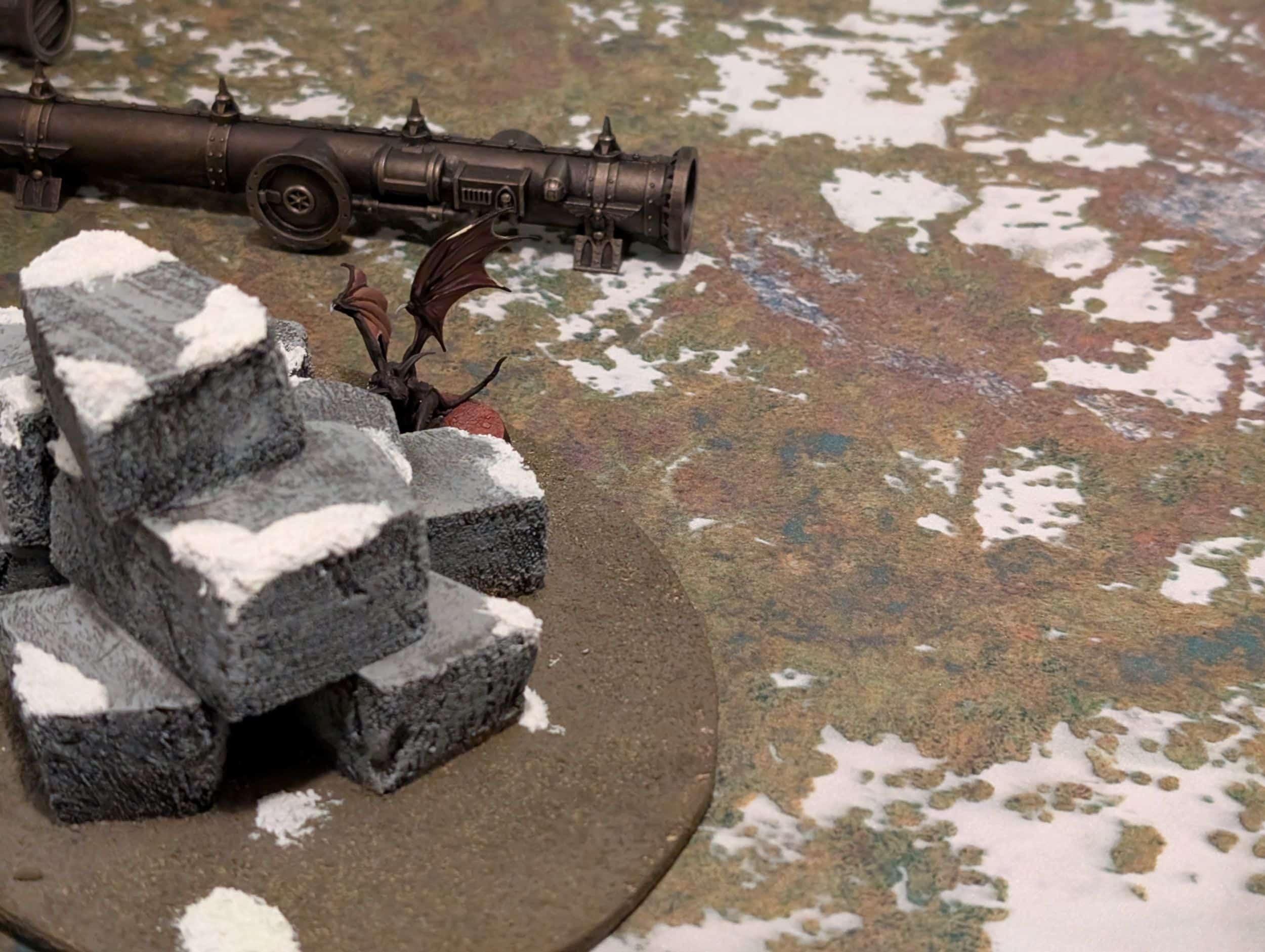
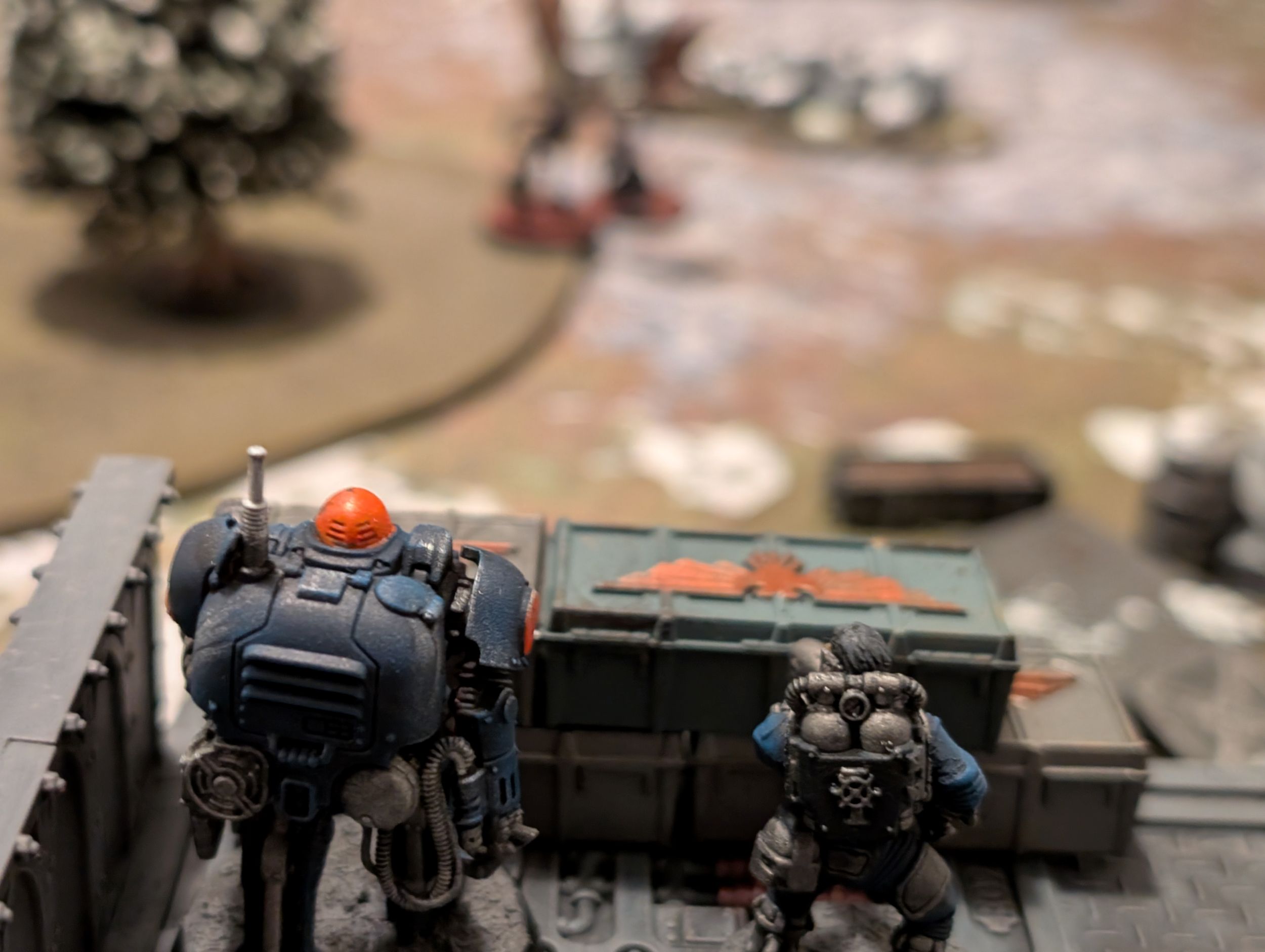
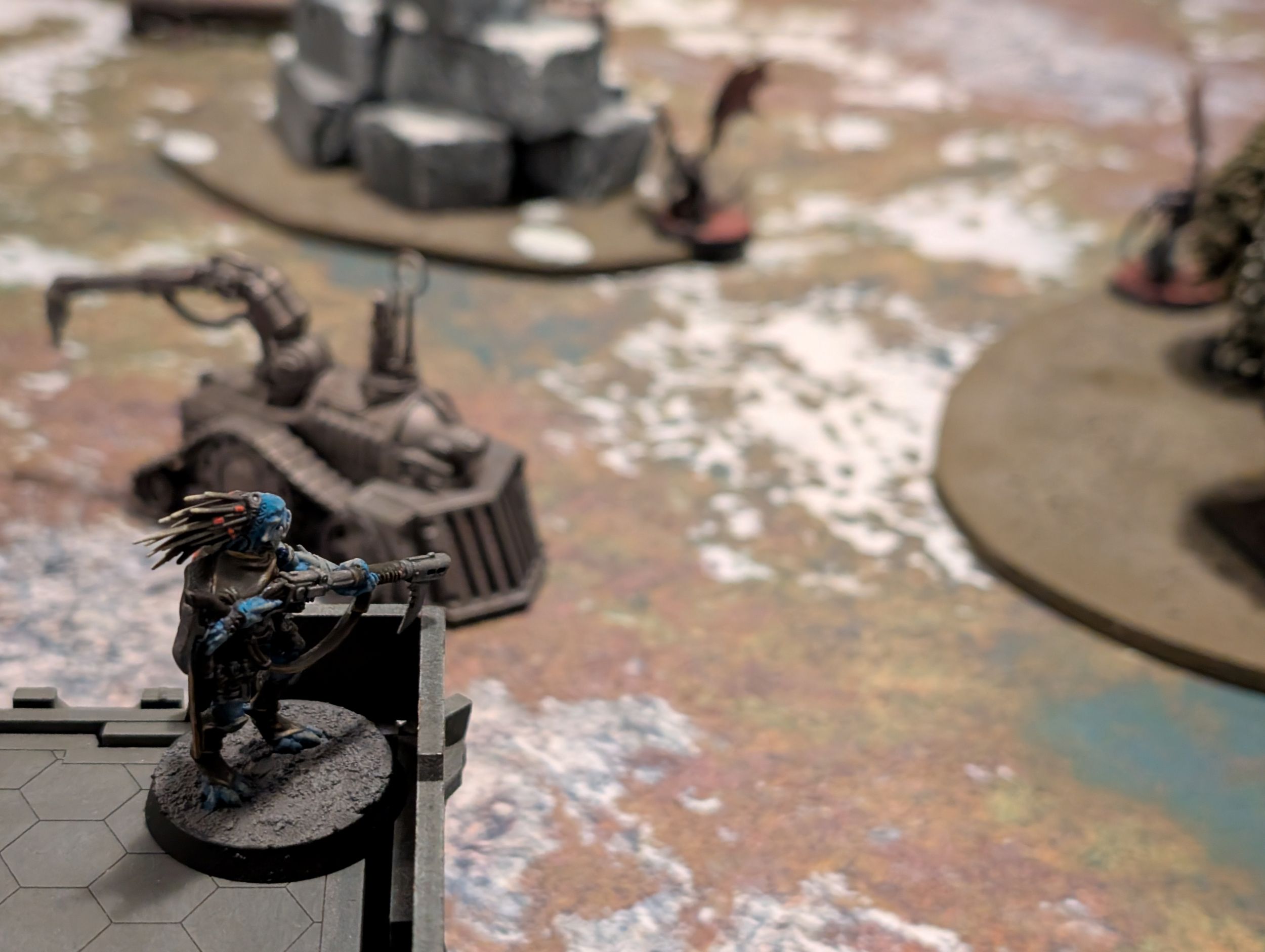
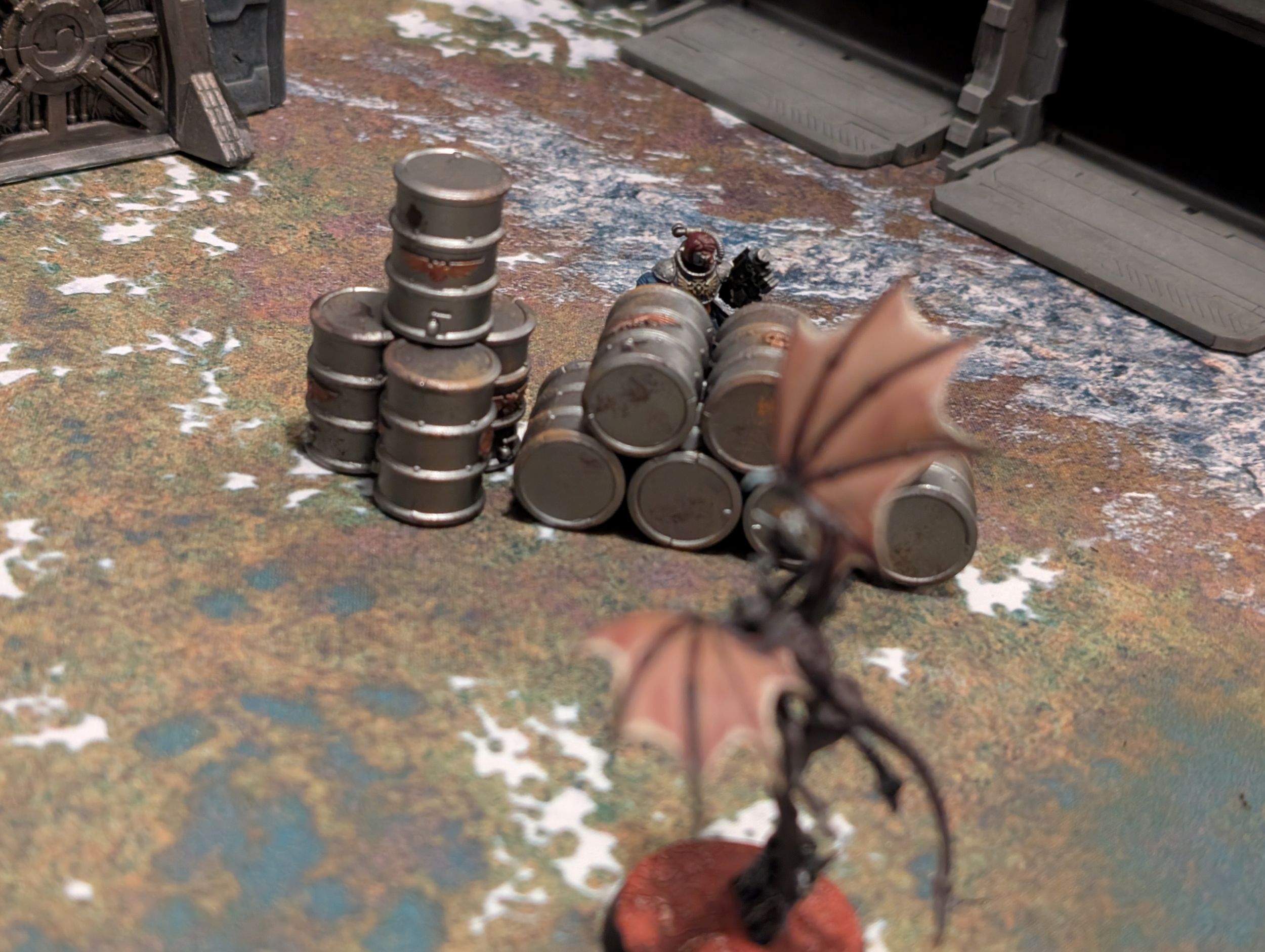
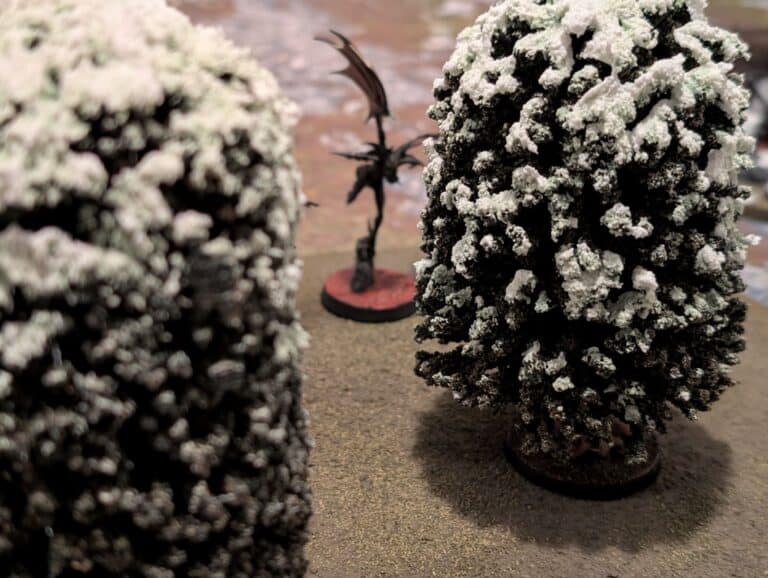
I don’t have a lot of critter models, but when I rolled up “carnivore chasers”, Chaos Furies sprung to mind. This was my first quest mission and the objective was a simple “Fight Off”. Though most of the Crew wouldn’t recognize daemons, this signals to me that the forces of Chaos are interested in the Crew, coming after Aldra as she lies dreaming in her coma. Unless they are after something or someone else…
Seriously though, I don’t know why daemons are attacking the Crew. But all these pieces were falling into place and I became very excited to see what happened next. Though I’m both player and GM in this game, the dice are leading the narrative and I’m just interpreting the results as best I can.
“Where’s the servitor?” Kratos asked as they boarded the shuttle. He still had a black eye from his scuffle with Dak.
Elyza shook her head. “No servitor this time, just this dataslate.” Kratos raised an eyebrow.
“They didn’t want to risk Adeptus hardware,” Sabbatha answered. “Not with the Society near.”
“The ‘society’?” Rhekk asked. “Does that mean something more in Gothic?”
Sabbatha turned to him, giving the alien a disgusted look. “Gang land. We’re entering cannibal territory.”
Rhekk nodded, seeming oddly satisfied.
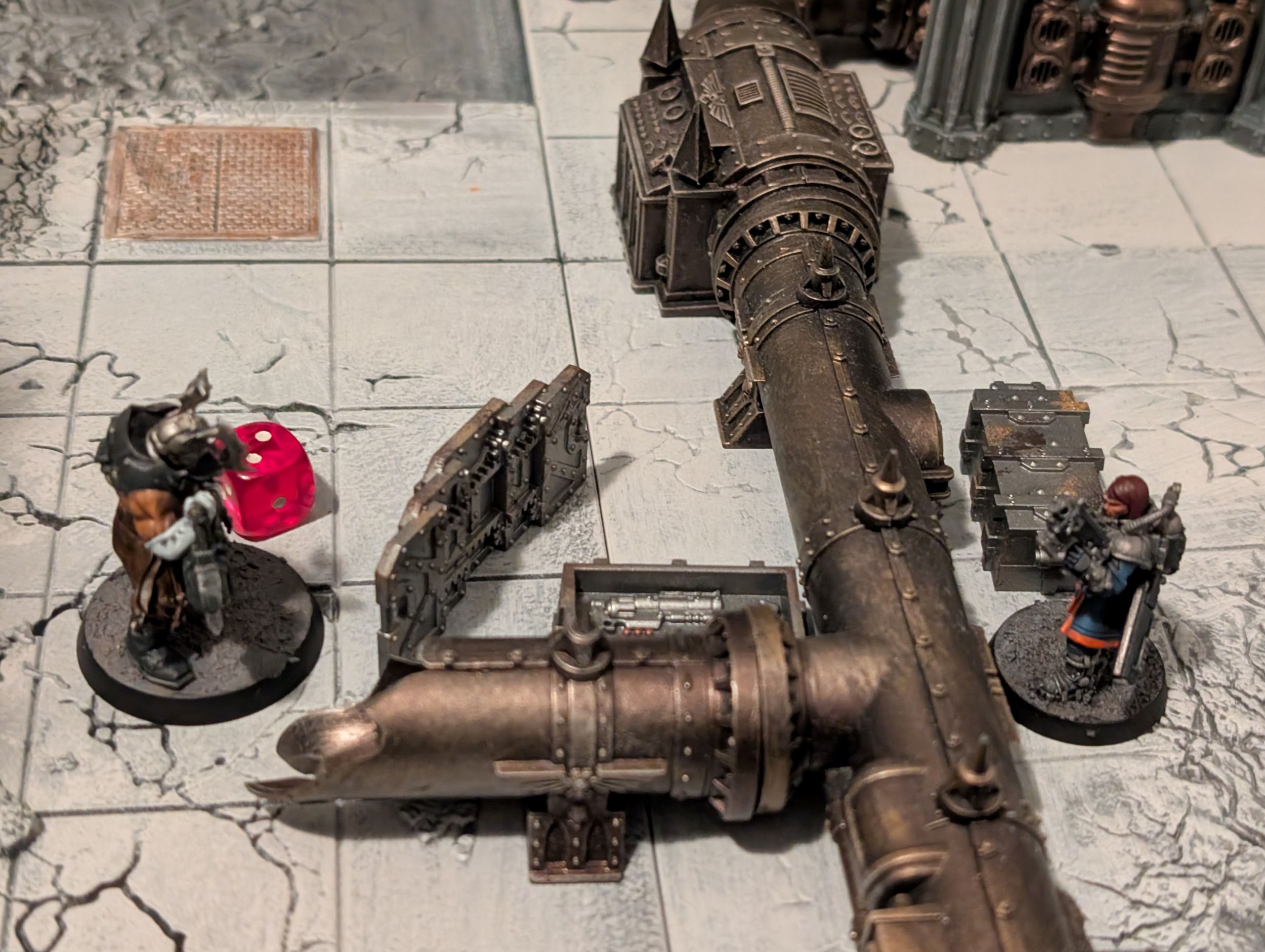
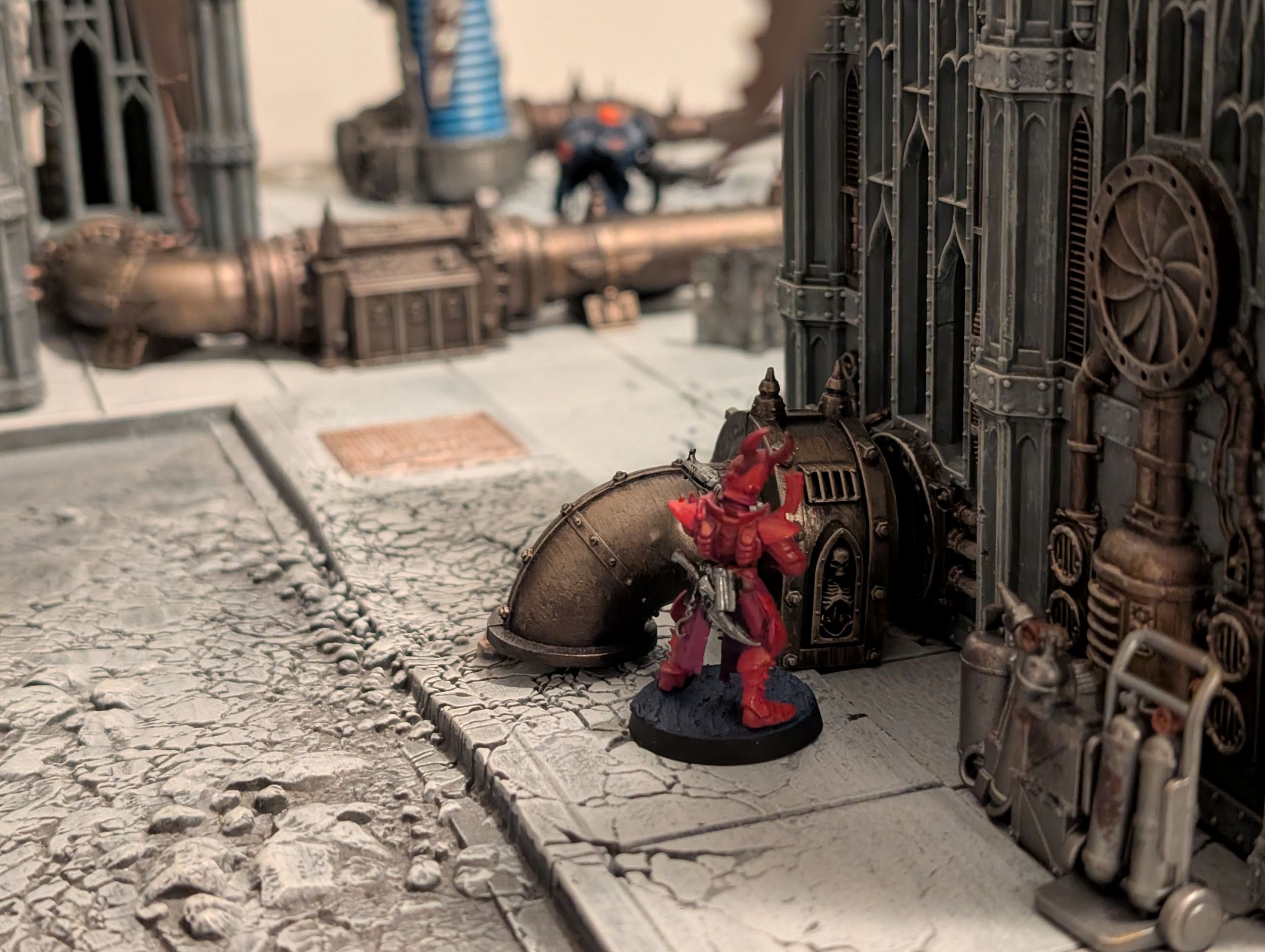
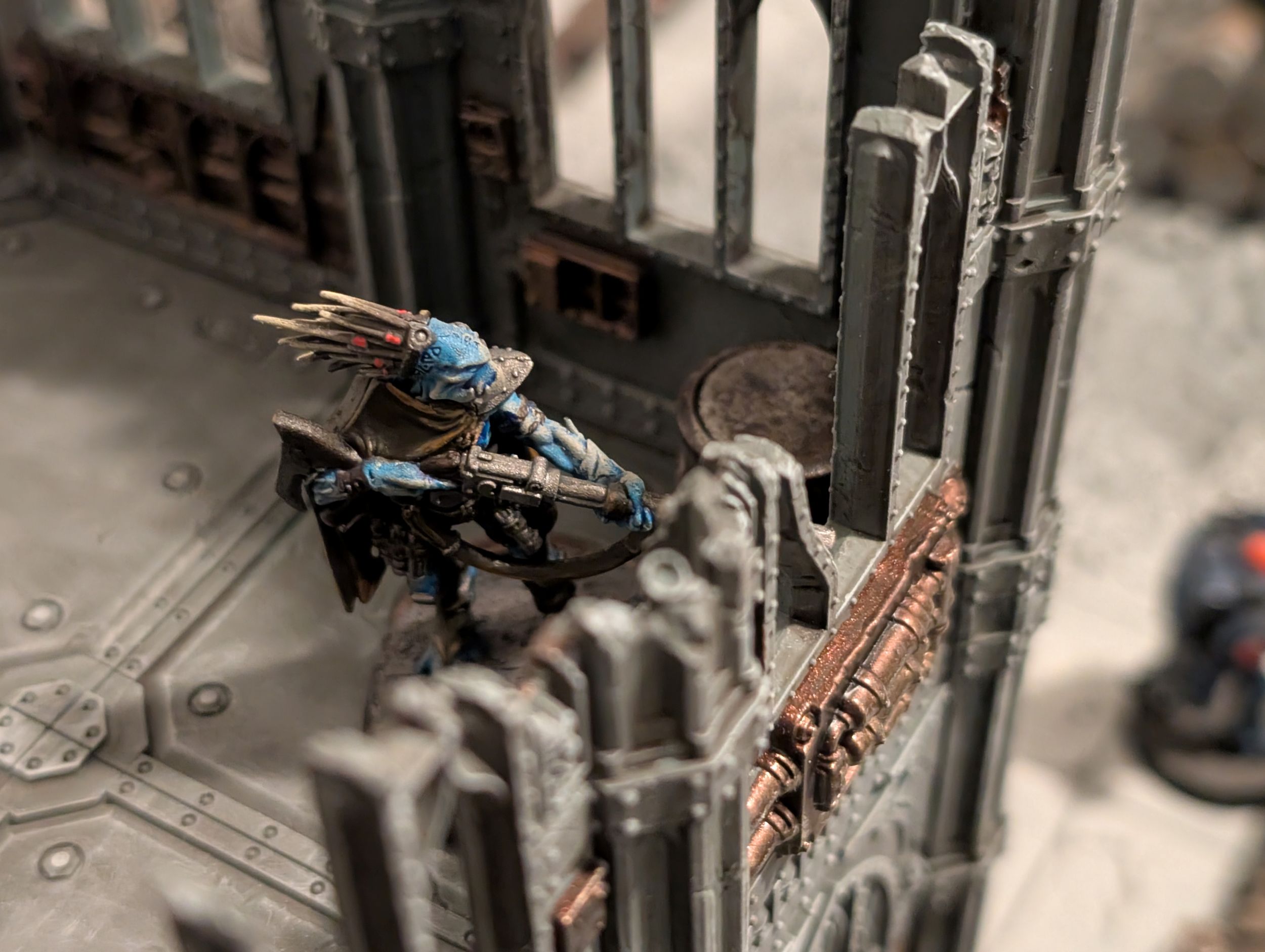
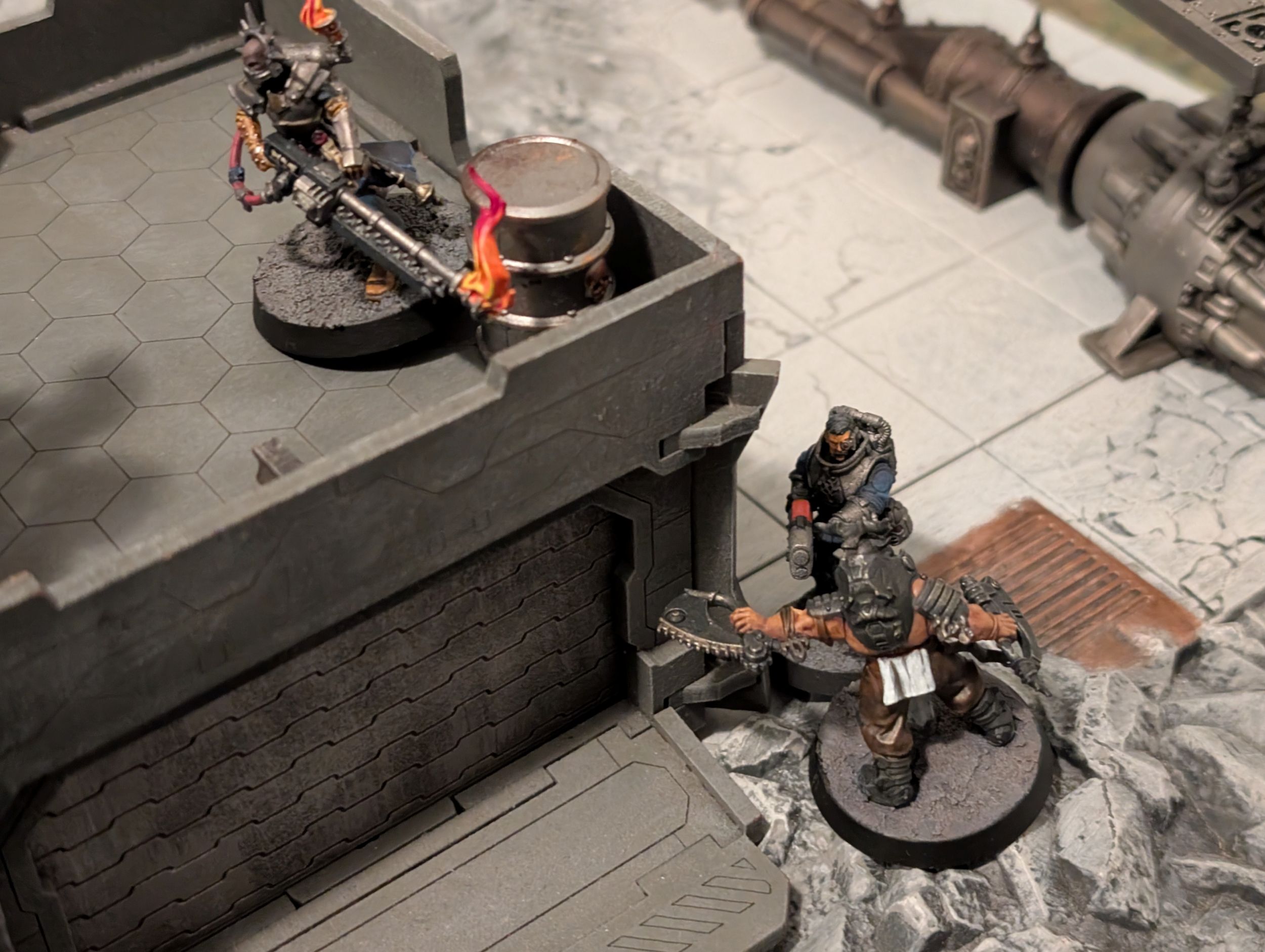
Kratos has a black eye ‘cause I rolled up his scrap with Dak in a post battle character event.
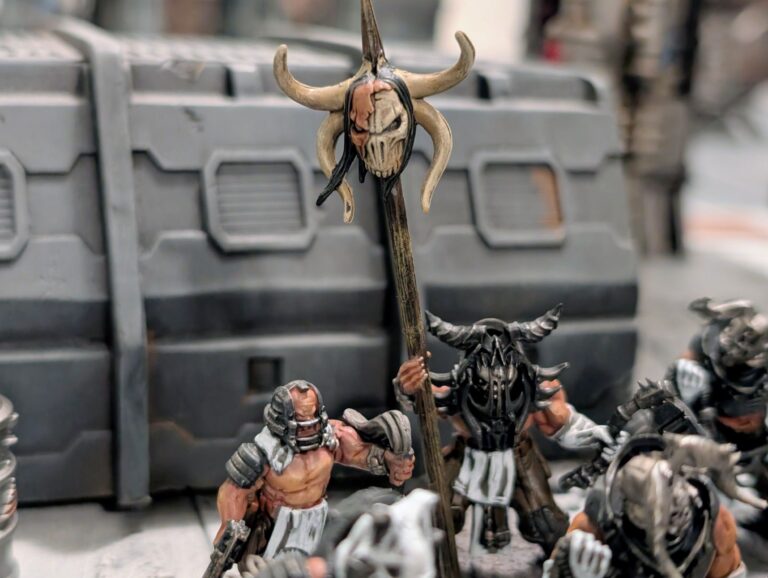
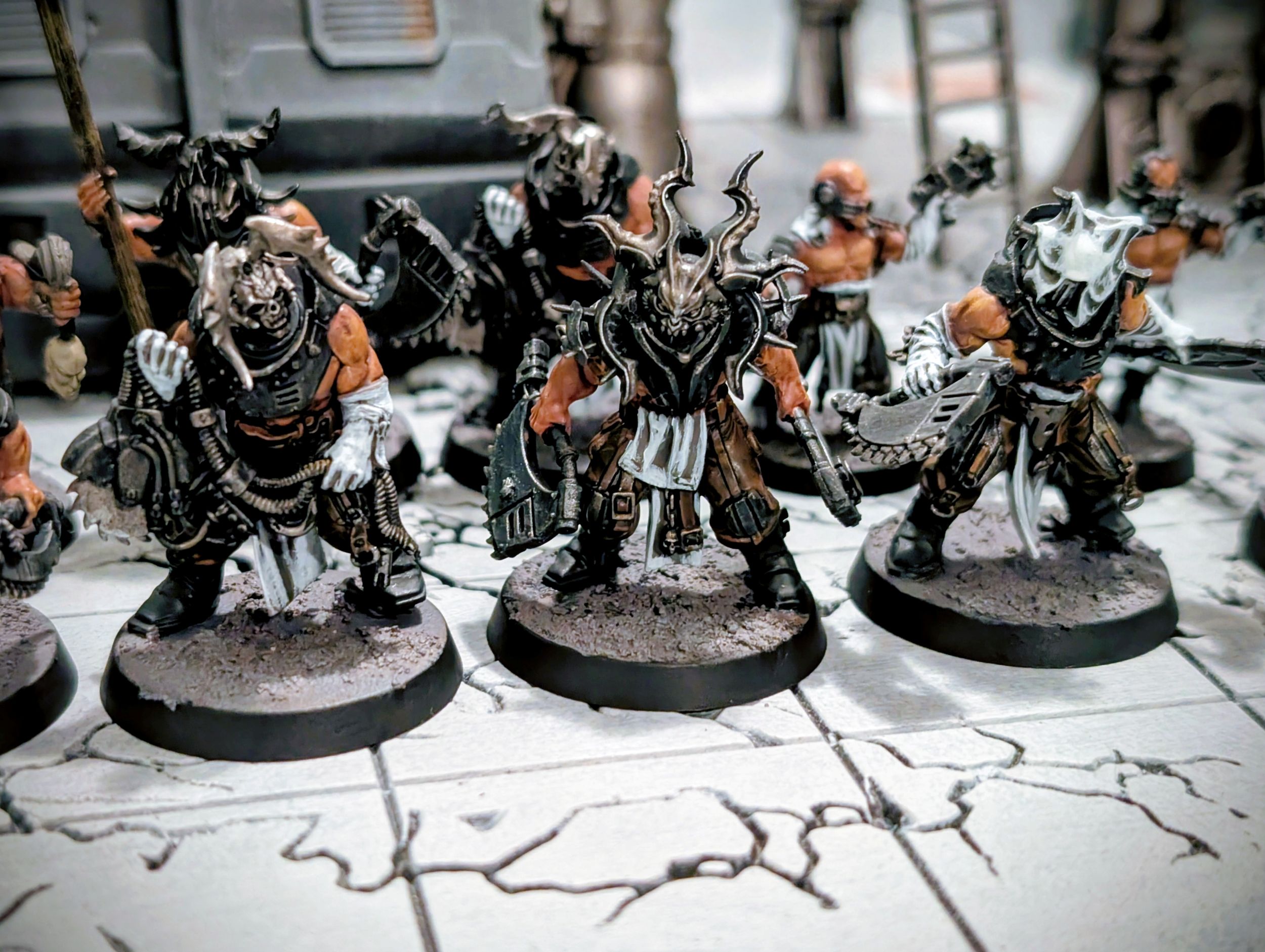
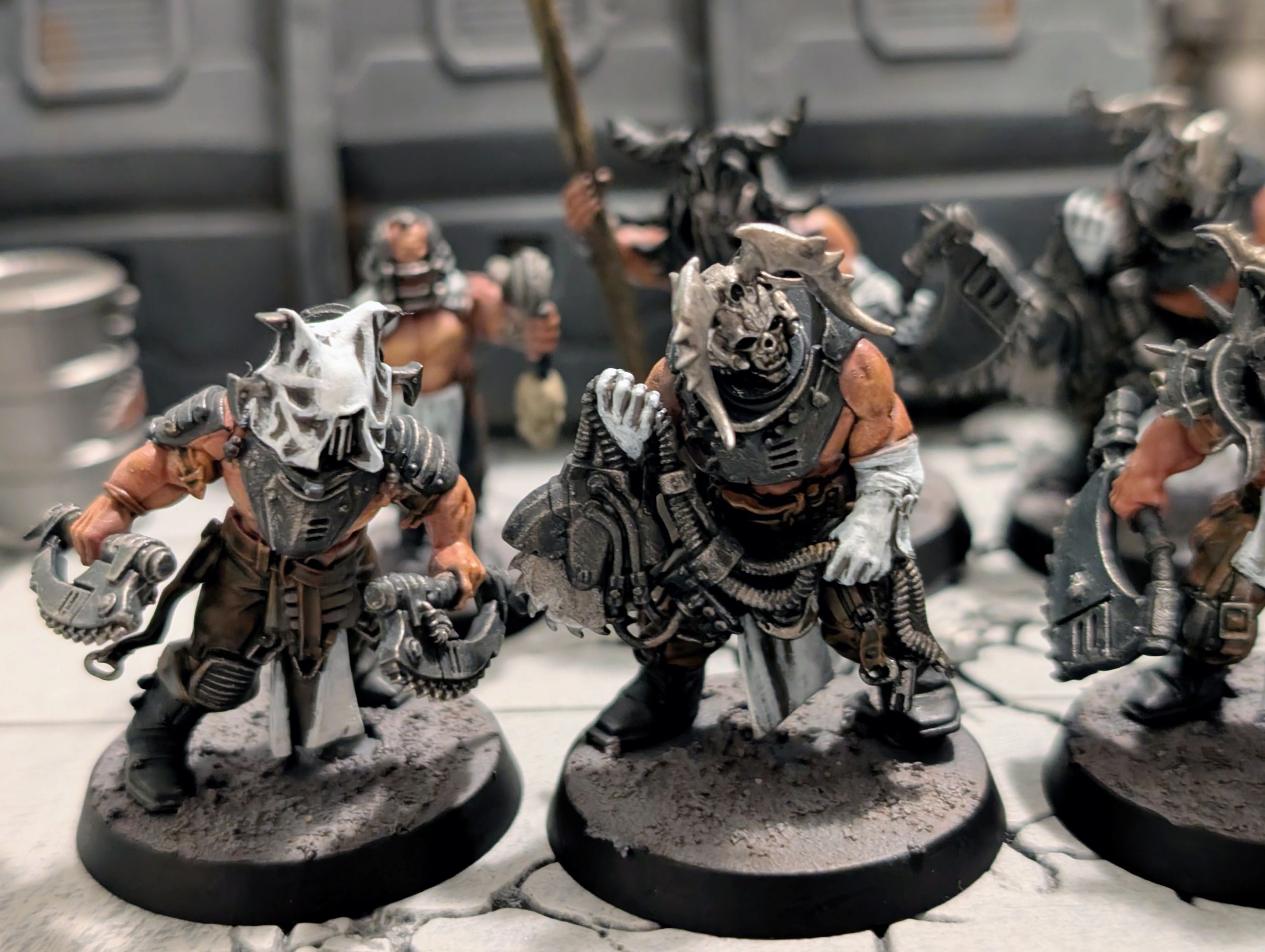
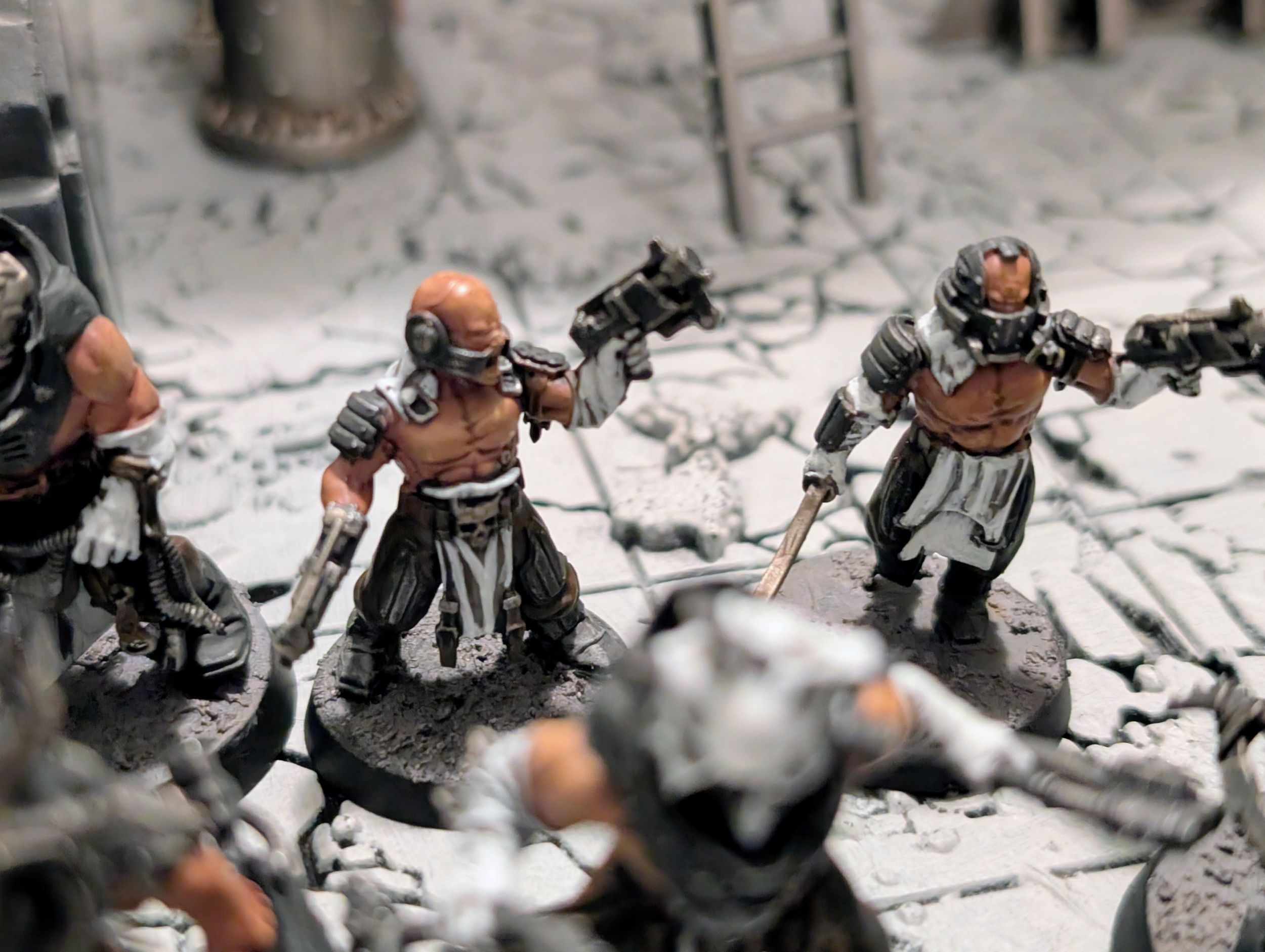
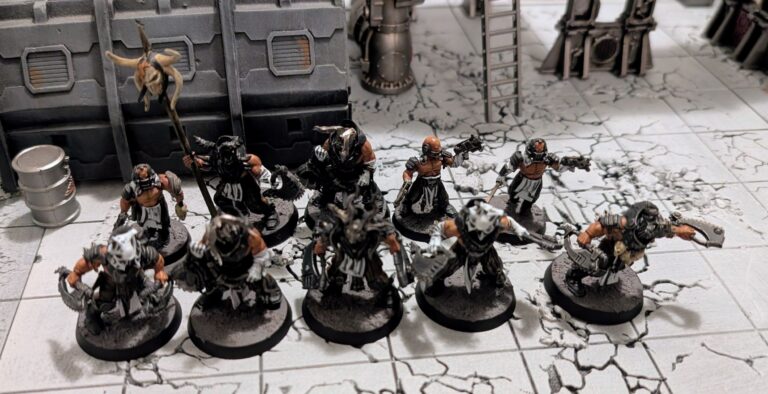
I rolled “‘Roid Gangers” for my turn 3 enemies, being another job for my Crew’s corporate patron. I’ve had the People Peel Pie Society (my Corpse Grinder Cult gang) built and primed for a while (okay, years at this point) and thought they’d make the perfect ‘roid gangers. Goliaths would’ve been a little closer, but the hulking cannibals worked just fine.
I only needed 6 for the mission, but painted all ten in the batch. For the skin, I drybrushed Wraithbone over the black primer and then used the skin tone contrast paints I had on hand, mixing it up between the models. For the armour, I based it Corvus Black, drybrushed Leadbelcher, and washed with Two Thin Coats Battle Mud Wash. Weapons were the same though I picked out chain teeth, blades, and a few other details in Leadbelcher. A few of the masks I also highlighted with a brighter silver. The white cloth was based Mechanicus Standard Grey, washed with Battle Mud, and highlighted with Vallejo Ghost Grey (I think, may have been a different Vallejo off white). Bases were done with Astro granite, Battle Mud Wash, and drybrushed with Dawnstone.
The original plan was to flick them with Blood for the Blood God, which would make a nice contrast with the white cloth, but I chickened out. I can always go back and add it: maybe if I run them in a Necromunda campaign I can start flicking them with red as they gain kills.
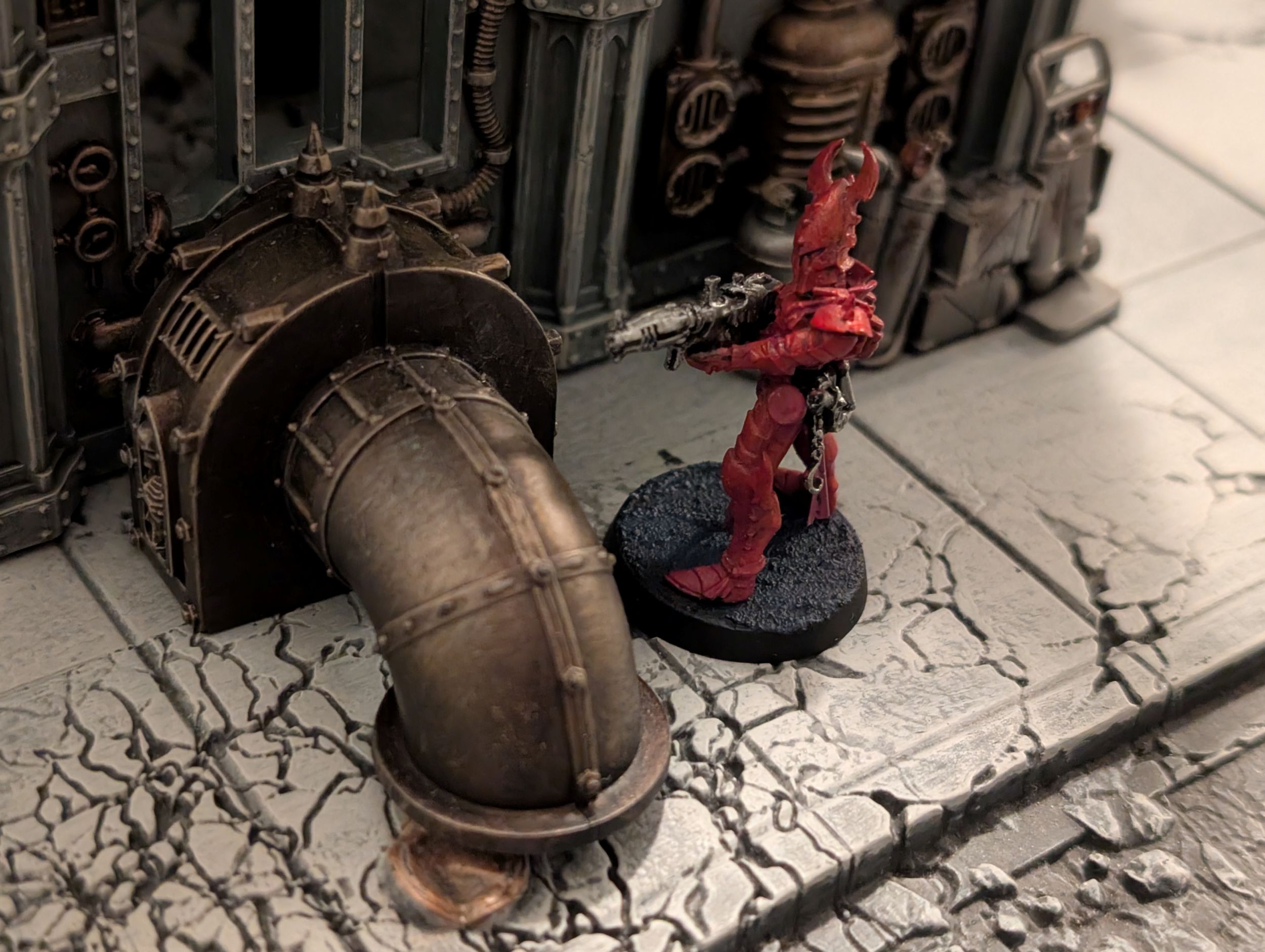
I rolled scrap pistol and blades for the gangers armament, but made the executive decision to change this to ripper swords to represent all the chain weapons. I also rolled up a “Hakshan investigator” for an interested party aka another enemy, this one with a plasma gun. This I interpreted as a Drukhari hunting for Aldra, which I had an already painted Kabalite with blaster to represent it.
In retrospect, I probably should’ve left the pistols on the gangers as this became another shooting gallery mission where the enemies ran into the guns of my Crew. Dak was taken out by the Kabalite (and subsequently avenged by Rhekk), and Elyza dueled a ganger, but otherwise the Crew wasn’t in a great deal of danger. Though the memory of Aldra getting taken out very fast melee still has me hanging on every die roll…
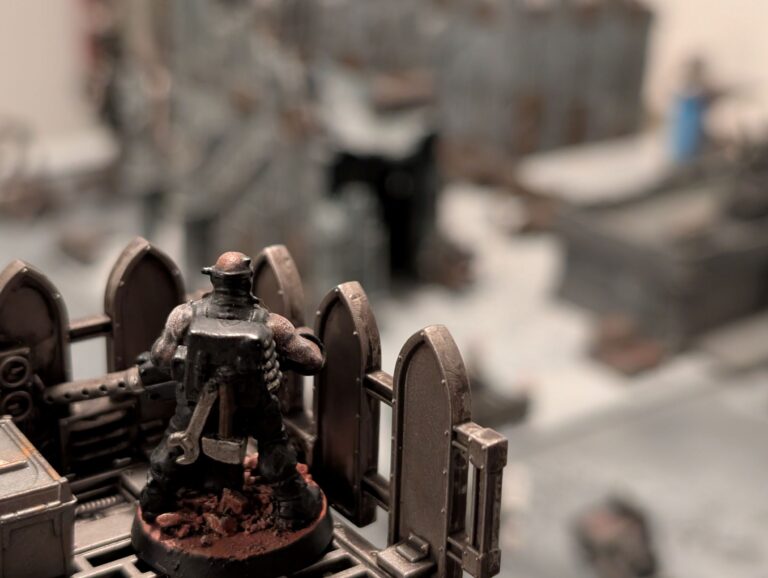
The sun was coming up as Elyza slammed the dataslate into the dirty terminal. The screen woke up and binaric characters began spilling across the screen. She reloaded her shotgun as she watched Kratos drag Dak to his mechanical feet, wondering not for the first time about the pair’s strange relationship. Rhekk had climbed down from his vantage overlooking the alley and approached her.
“We have company,” he said, pointing over her shoulder. “And he’s brought friends.”
She spun around and saw dark shapes running along the gantry across the street, the dawn light glinting off their autoguns. Below them, his mask still scorched from the plasma burn courtesy of Kratos, was the Society leader.
“Cover!” Elyza shouted. “Cover now!” Stubber rounds kicked up dust as she dove behind a crumbling pillar.
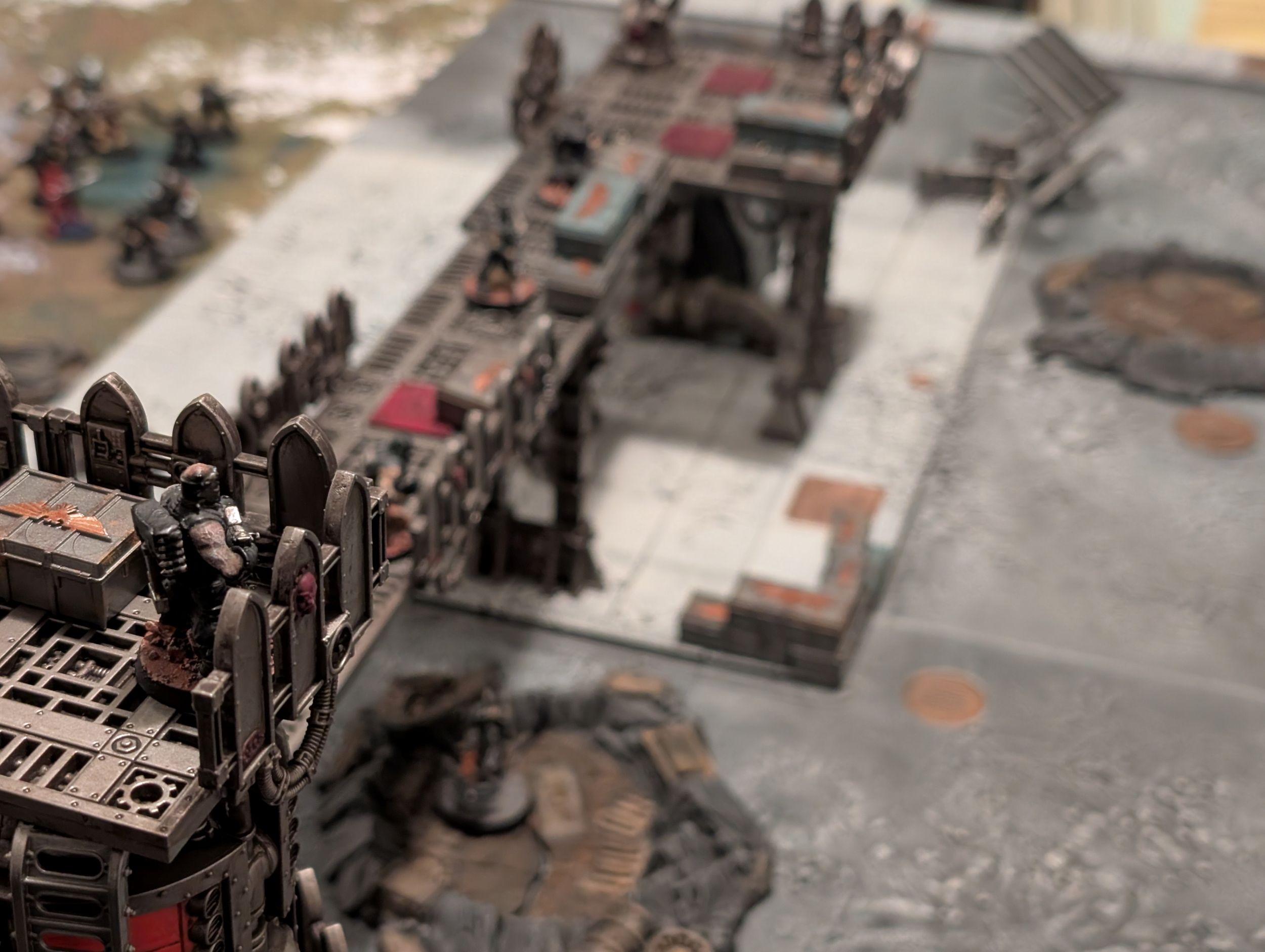
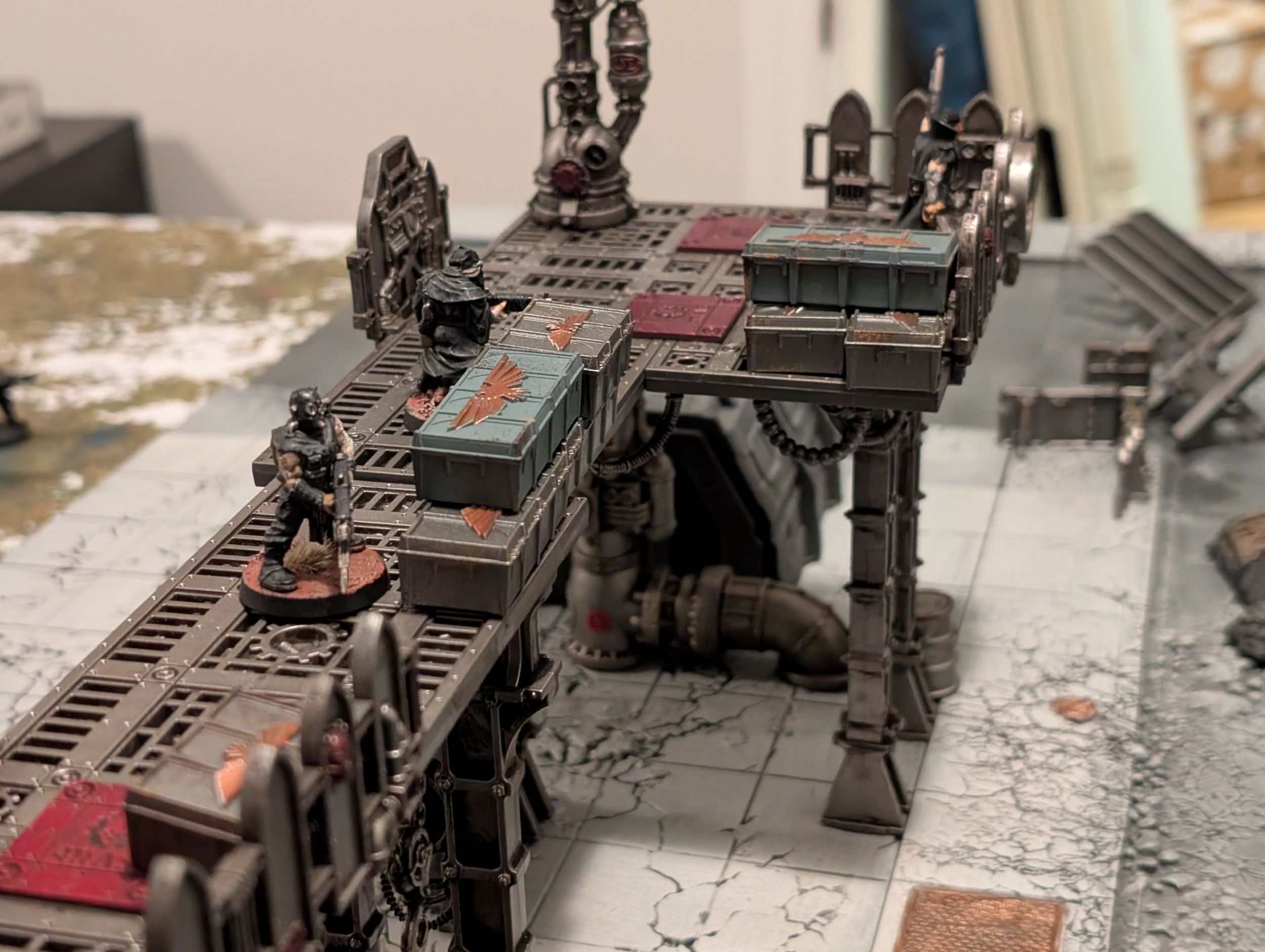
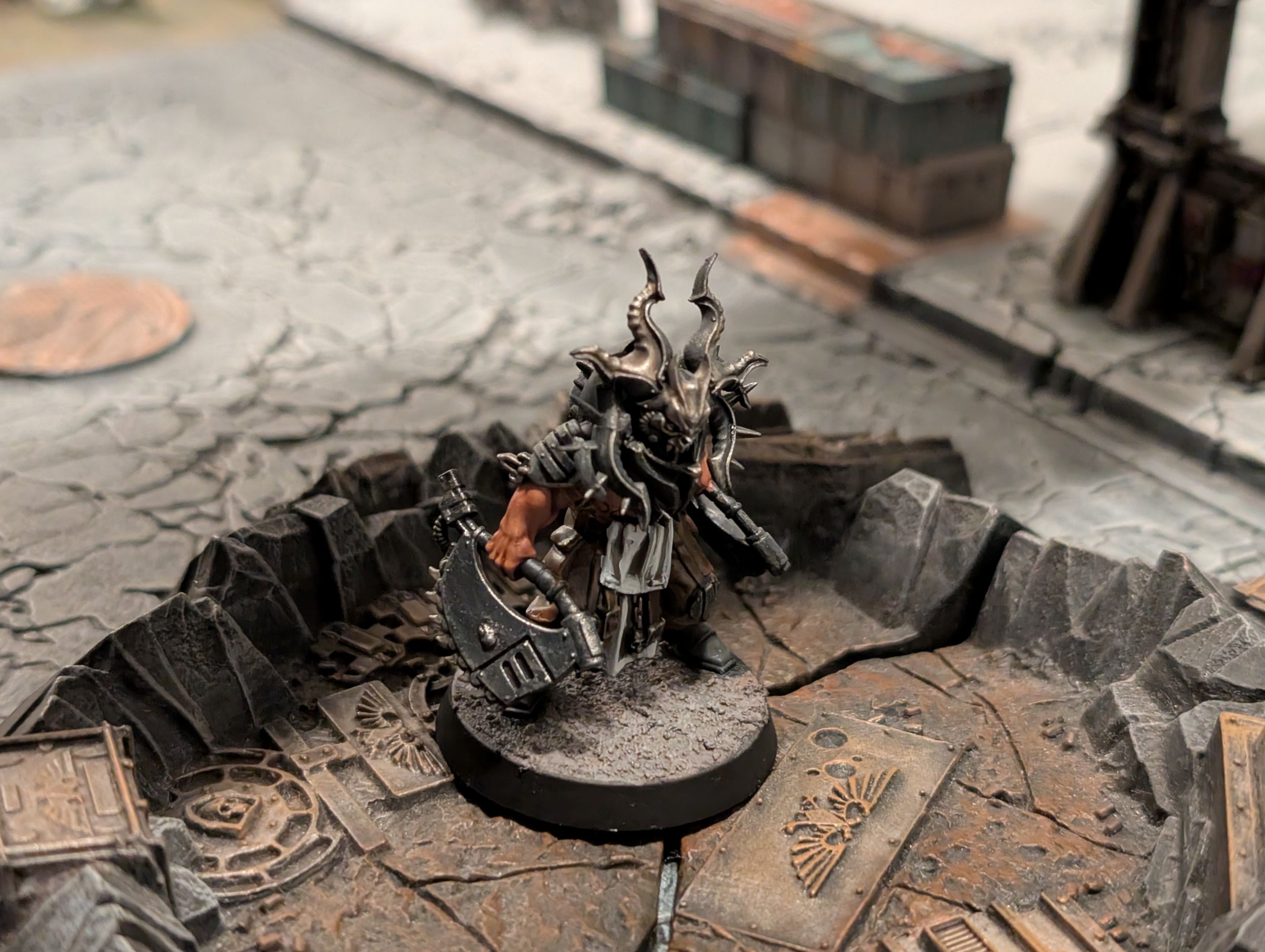
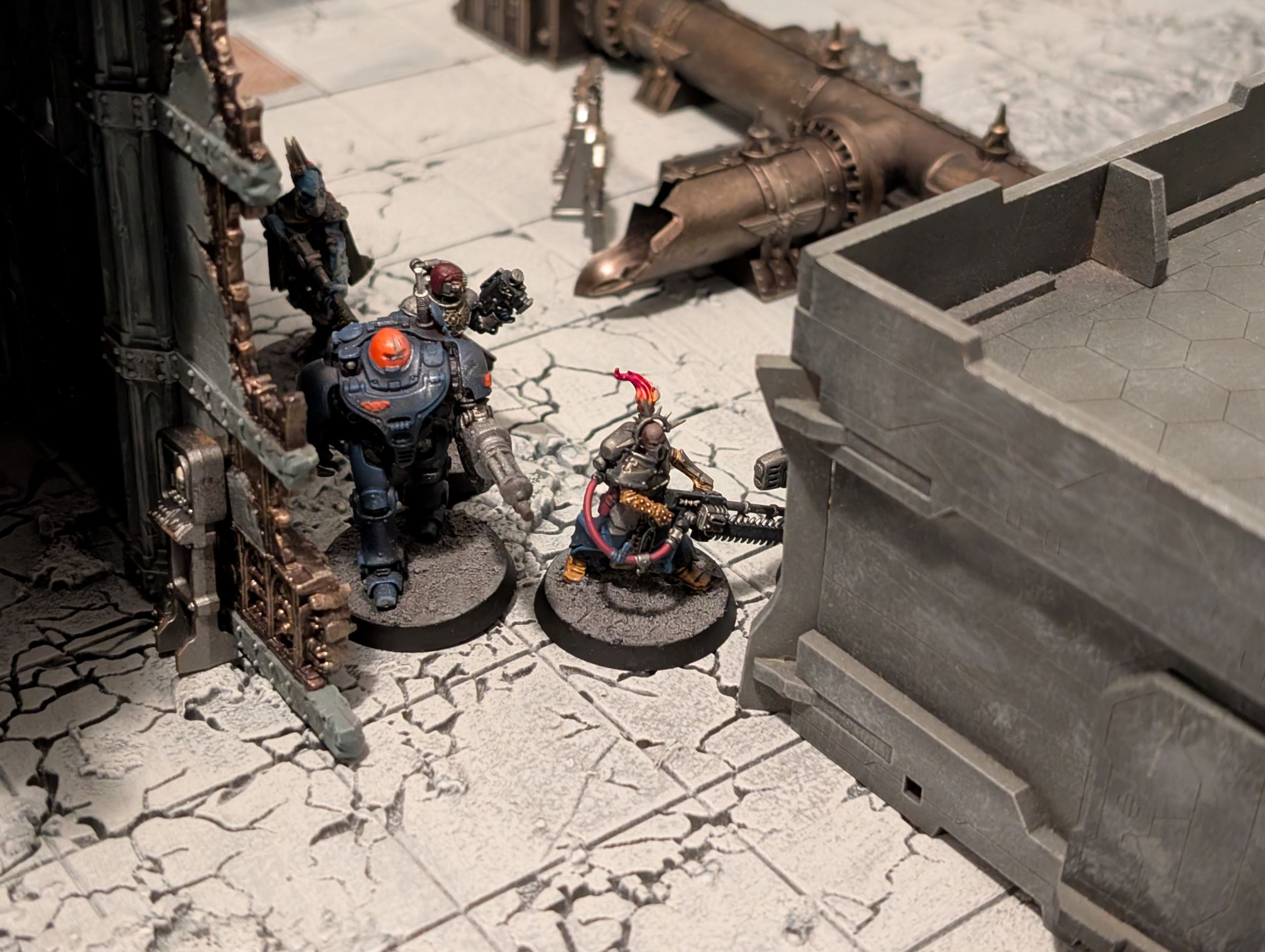
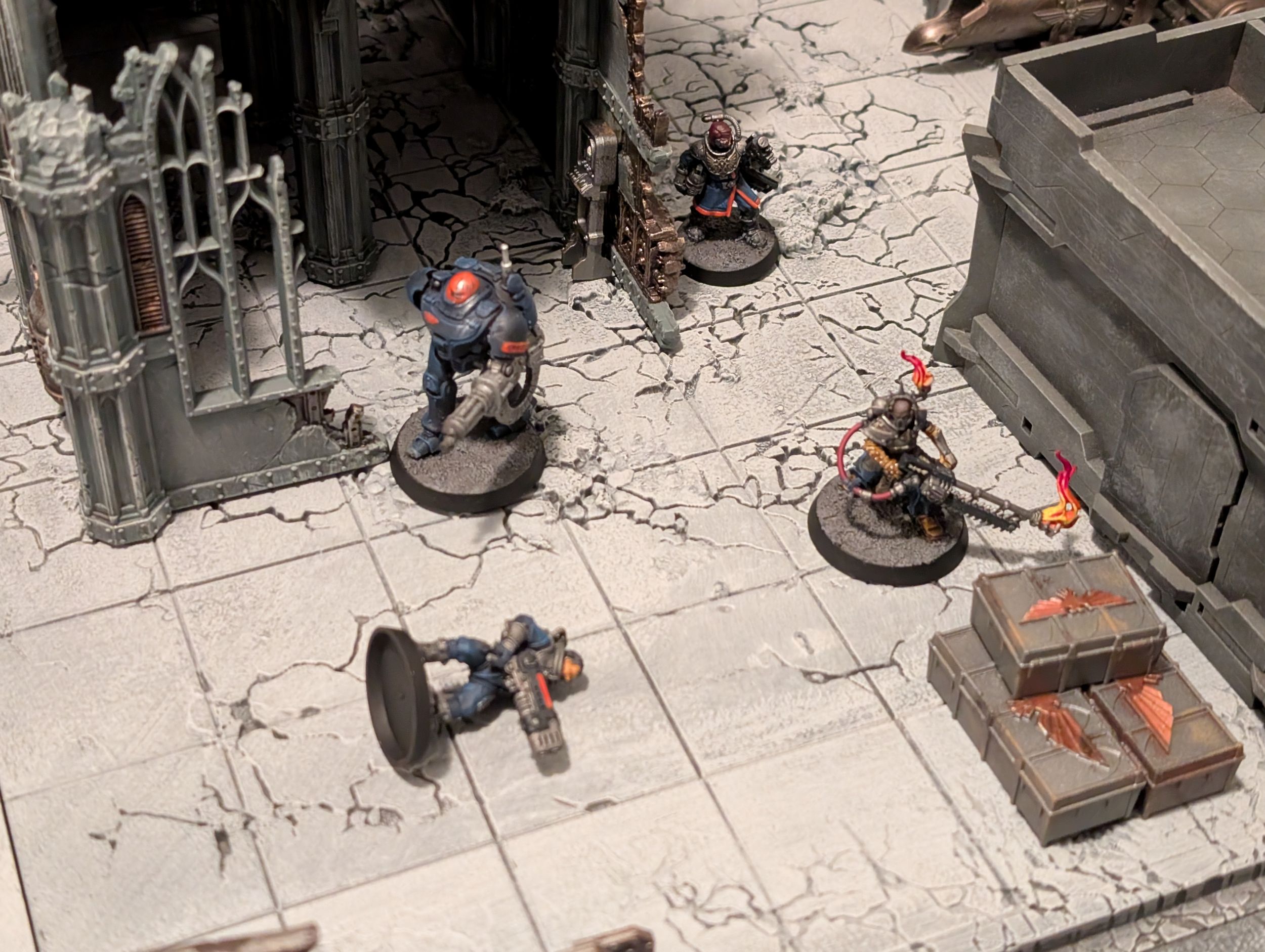
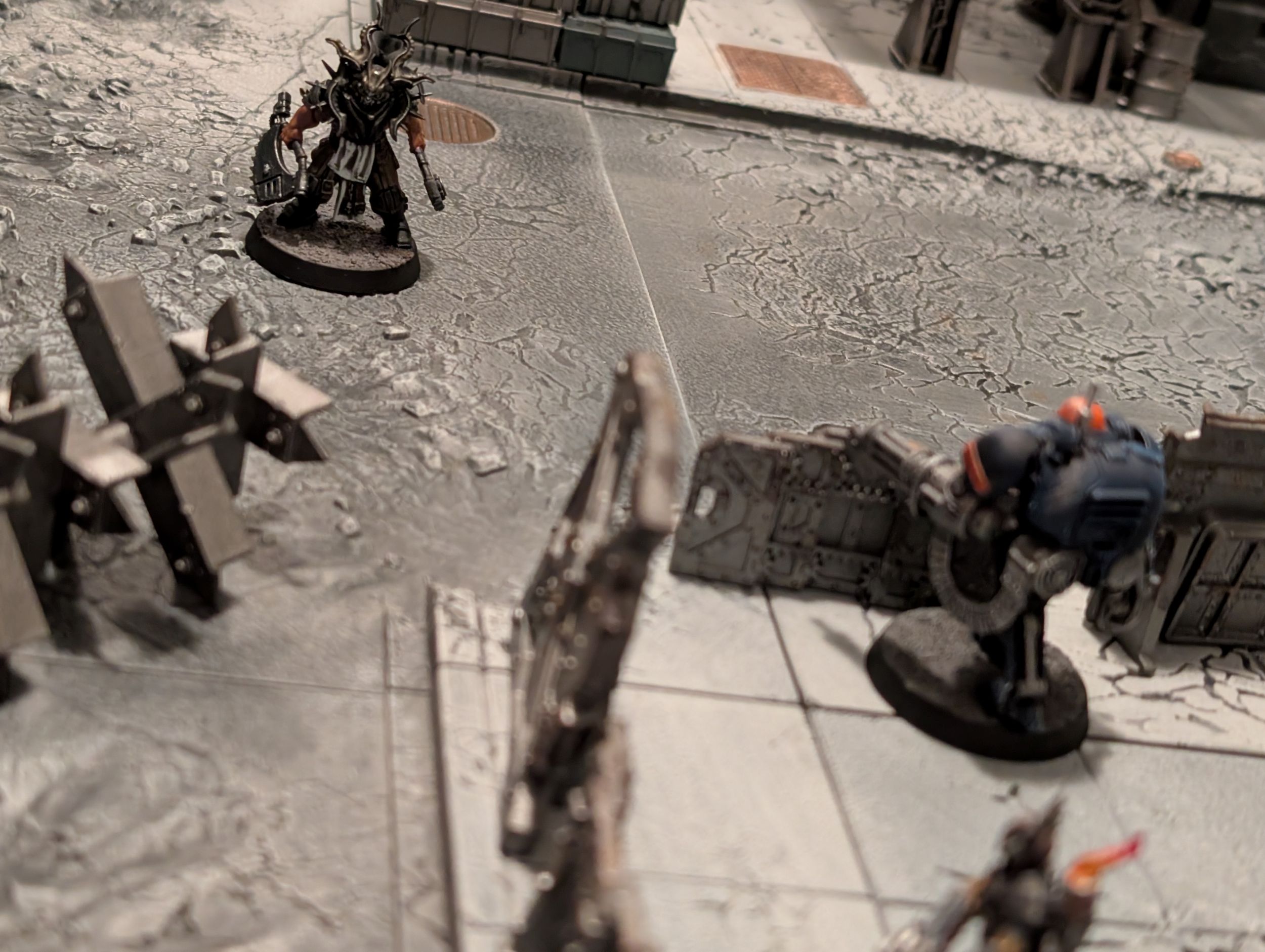
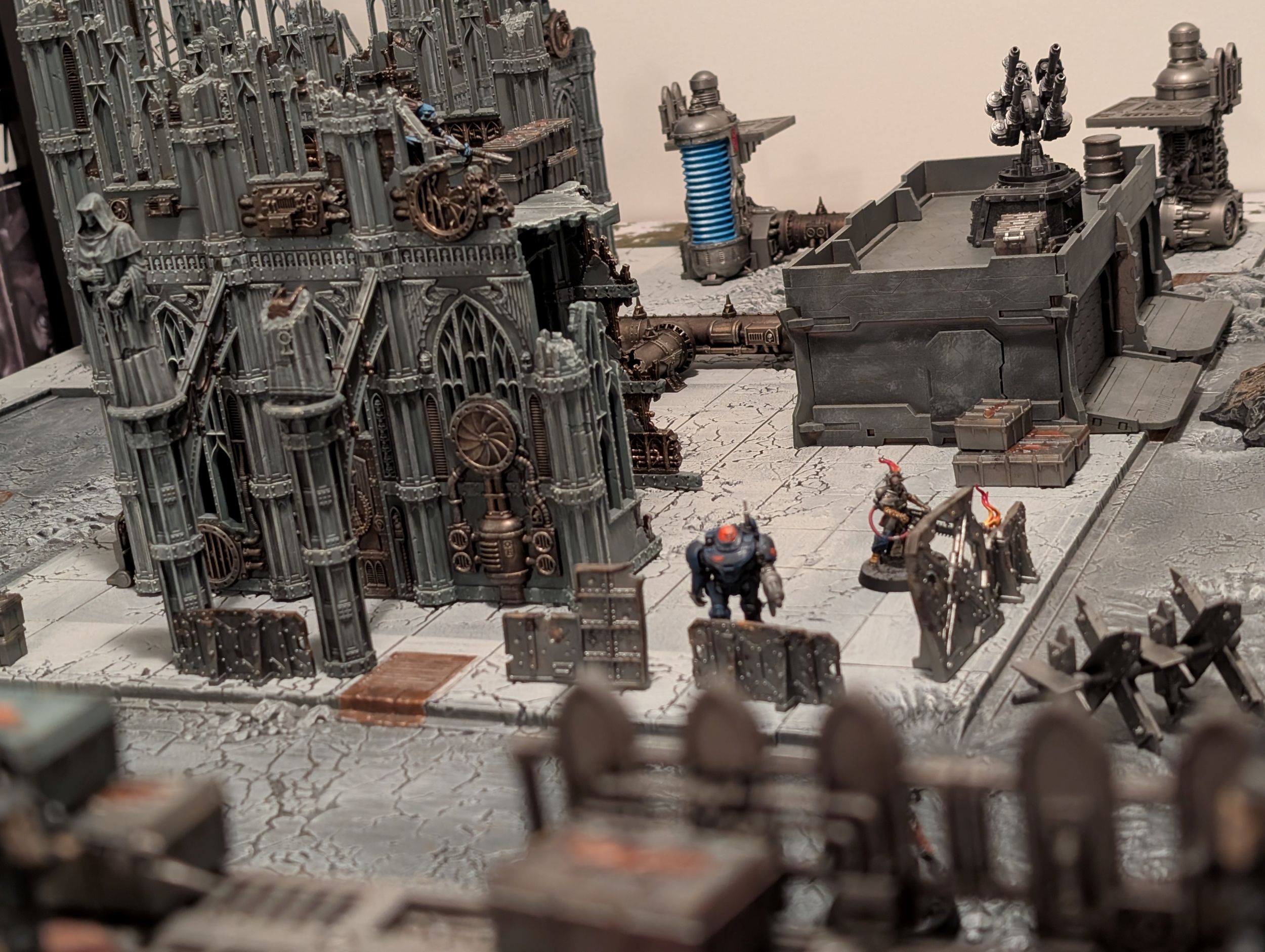
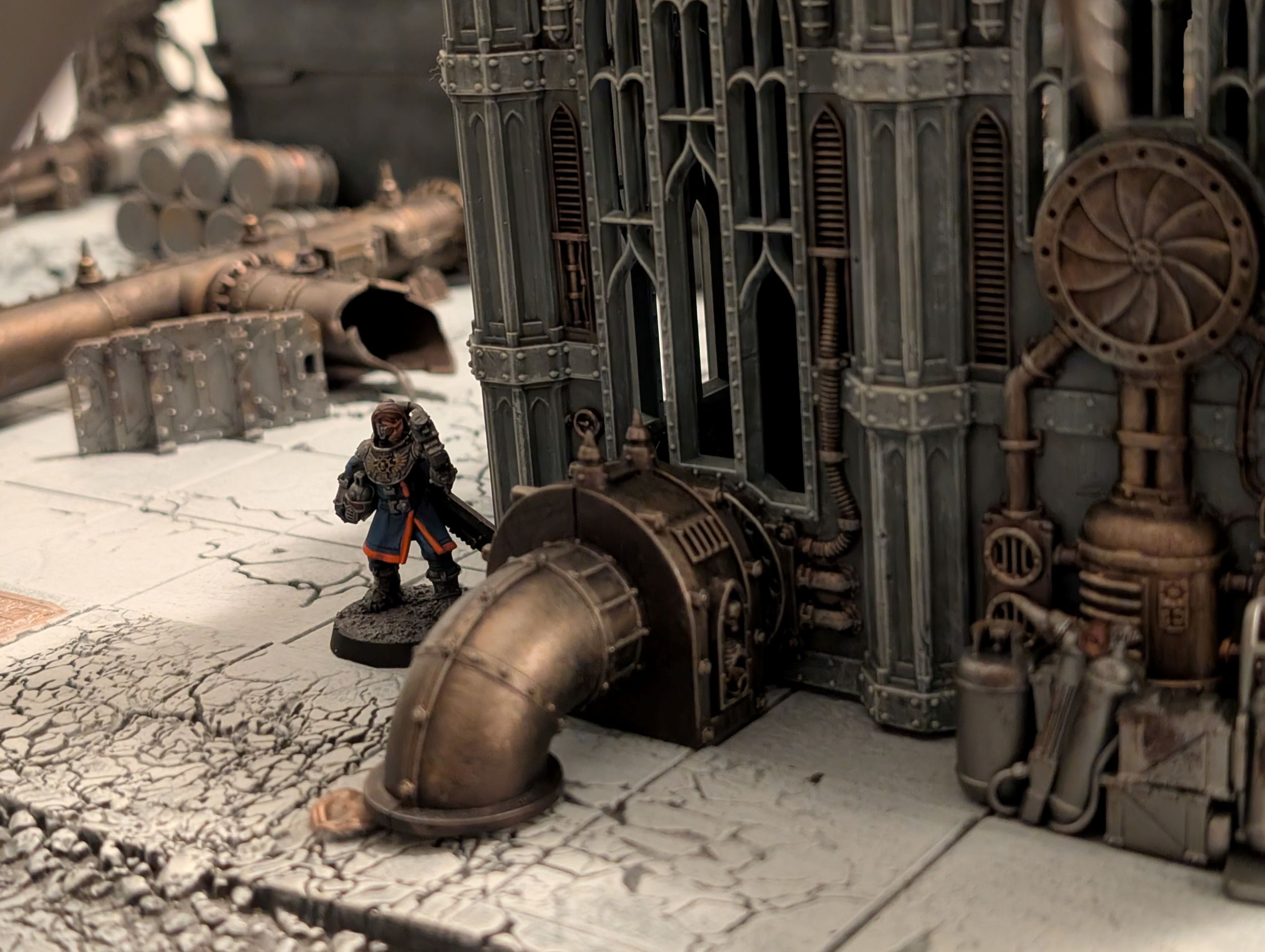
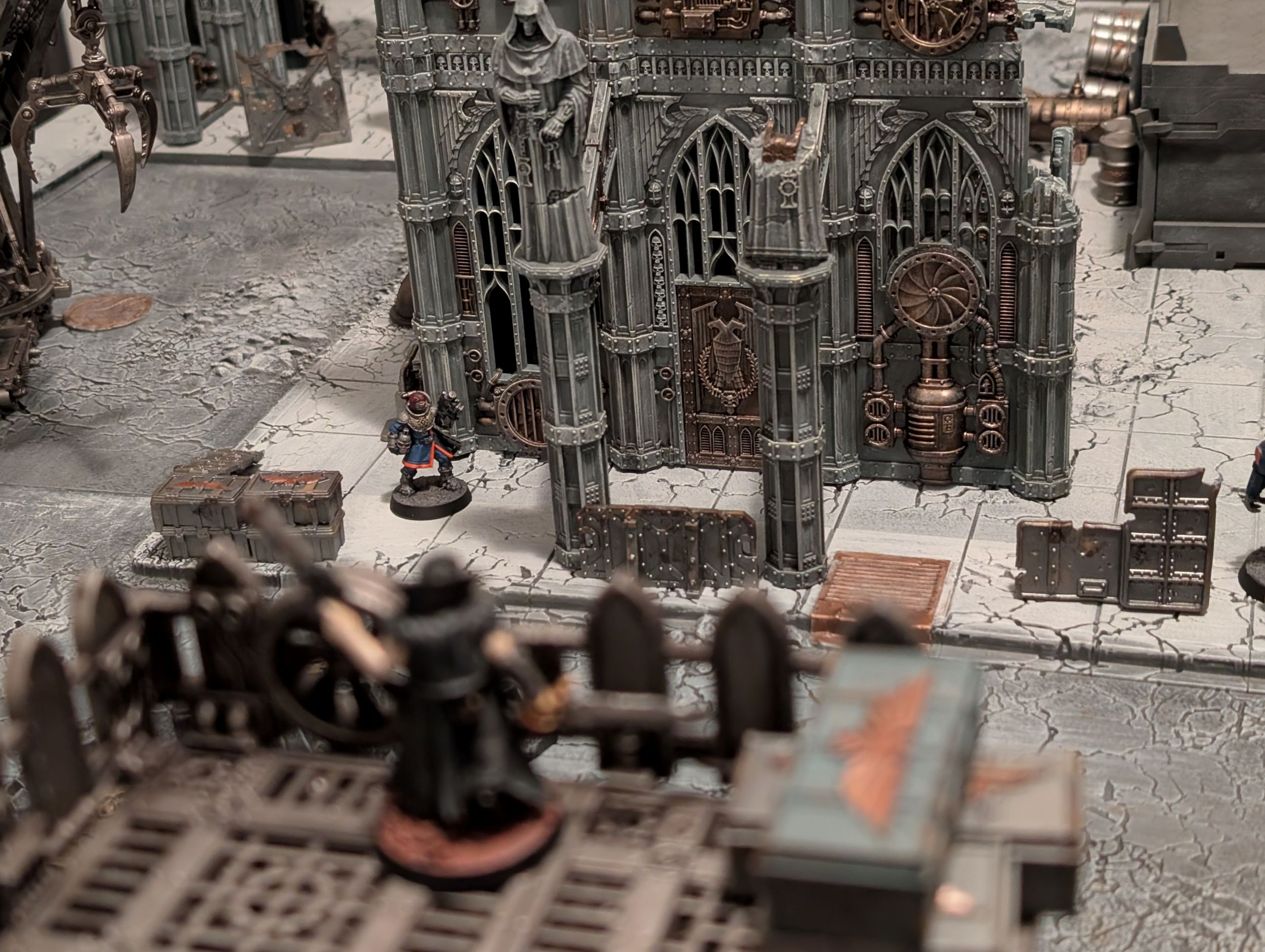
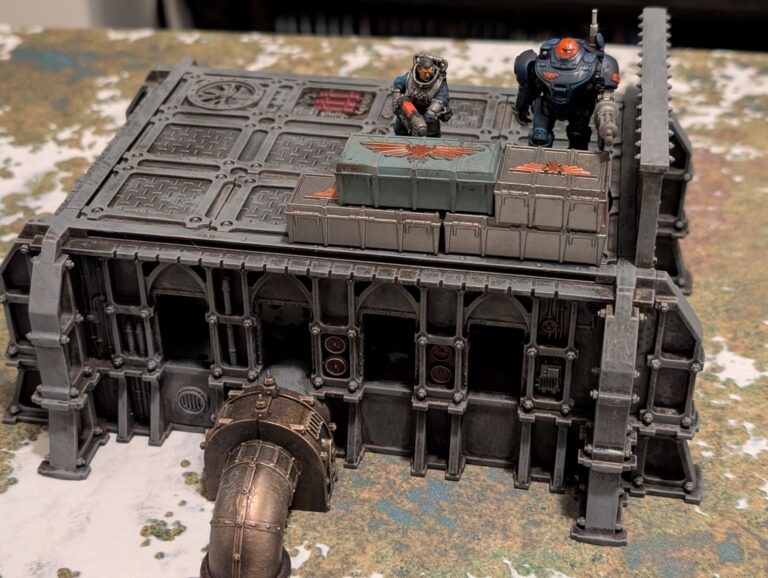
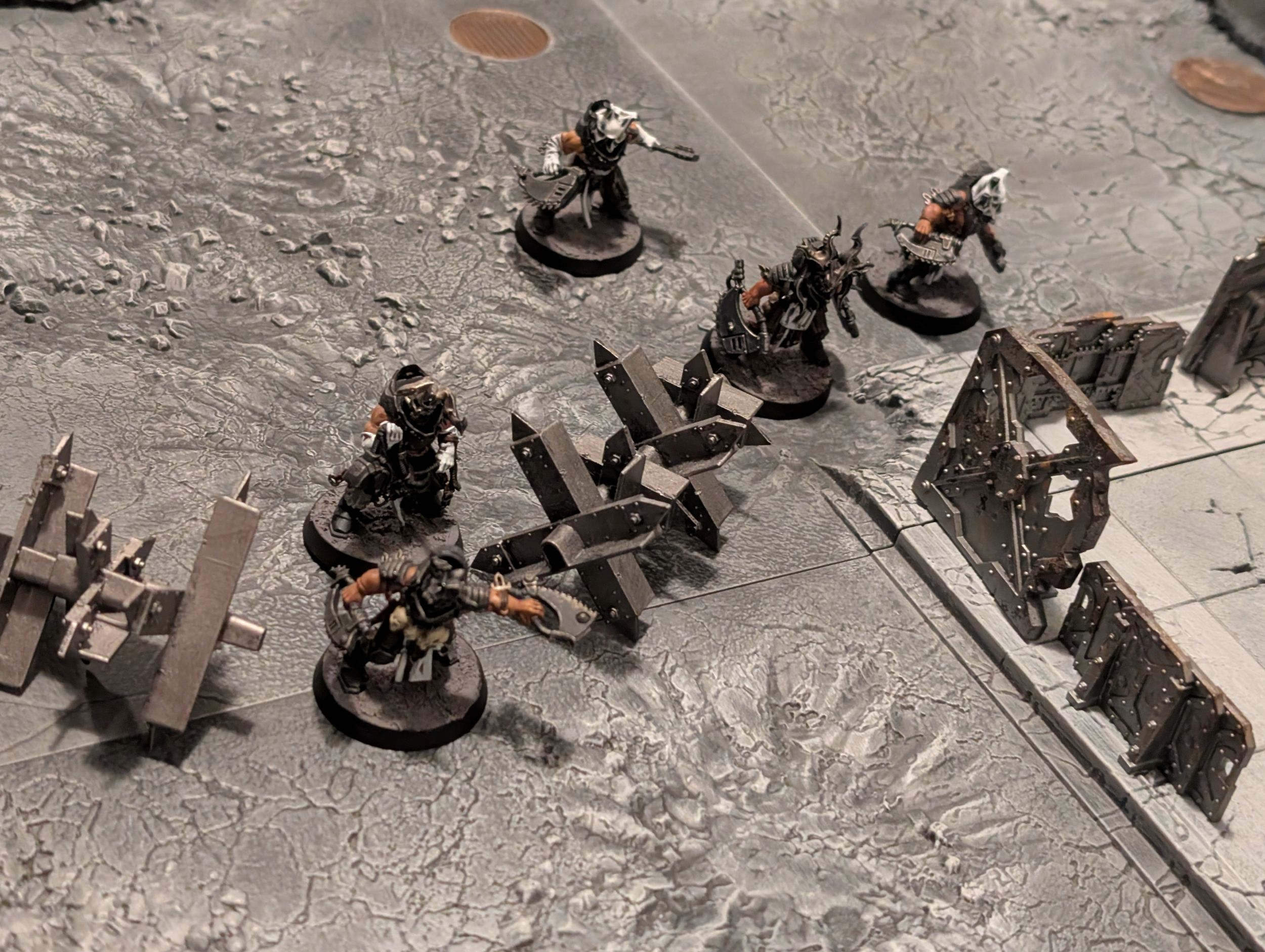
For turns 3 and 4 I used a 4’x4’ city board I’d set for a game of Inquisitor28 (more on that in a future post). 5PFH uses a smaller board, max 3’x3’, but I liked the terrain and just used part of the board for turn 3.
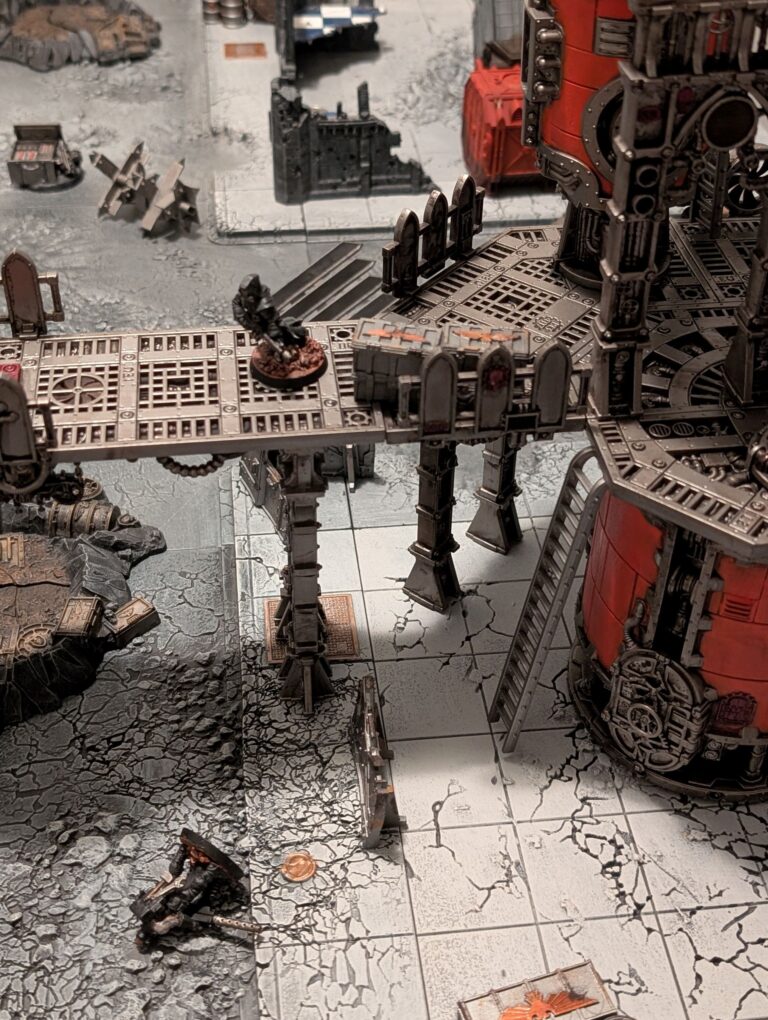
I’d rolled a campaign event which had me adding a new Rival every turn and their numbers had finally caught up with me. The Rivals hunting me this turn were “gene-renegades”, and, since they were already painted, I used my Dark Vengeance cultists (I’d already used them in turn 1 already, but who’s counting). For the mission, I rolled “Brought Friends” as the condition. Mechanically, this meant the Rivals had one more model, but I’d also rolled a “K-Erin Warrior” for an interested party, being a real tough and scary berserker character.
This all amounted to meaning the Society leader from turn 3 had slunk away and called in a favour, bringing in another gang to take out the troublesome Crew. As I still had the board set up, I just shifted to a different 3’x3’ section and set up my Crew being ambushed after uploading the dataslate.
“How’s Krate?”
Elyza looked up from the ship’s cogitator. Sabbatha was standing at the hatchway.
She shrugged. “The slug hit him like a thunder hammer, but his armour took most of it. He’s awake and will survive, but if you ask him he’ll make it sound like he went toe-to-toe with an Astartes.”
Sabbatha nodded, smiling slightly. She was about to turn away when she hesitated. “What are you working on?”
Elyza didn’t look up. “Reviewing the Navy route logs of possible transport off-rock.” She waved Sabbatha over. “This one’s a bulk freighter heading coreward to the Argus sub, these three are Navy ships touring the Reach.”
“I assume we’re avoiding those?”
Elyza nodded. “This one’s a munitorum transport heading on a resupply run to Credo.” She looked up to see Sabbatha’s puzzled expression. “A shrine world in the Gulf, currently locked in a multi-faction war that the Imperium is decidingly not winning.”
“What about that one?” Sabbatha pointed. “The Emerald Light?”
“That’s a Rogue Trader heading…nowhere…” She frowned, pulling a star chart towards her and flipping through the pages. Then she began to laugh.
Sabbatha cocked an eyebrow.
“Very clever, very, very clever. Their nav coordinates are all in code. It doesn’t make sense unless you already have access to the restricted knowledge. Smart, but dangerous: the Navy has access to these charts. You see, if you take these coordinates and remove the numbers…They’re heading to Carnivora. And, I think, so are we.”
Carnivora was the setting for an old campaign, a planet stolen by the Dark Eldar “World Thief” and turned into a nightmarish playground for all the forces of evil. The Imperium counterattacked, and won, but they never initiated Exterminatus in the final apocalypse game, and the Imperium can hardly put the planet back…
So there Carnivora sits, on the edge of the Sector, the forces of the Dark Eldar kingpin broken creating a power vacuum where the various factions vie for control. I picture the planet as a kind of free state, where anyone can go and scrape out a living or become a petty warlord. Of course, the world is ruined, the crust literally shattered in places by the trauma of the transporting ritual.
But for those looking to escape the eyes of the Imperium, what better place to hide.
Many parsecs from Porrall
As mentioned, I’ve played four full campaign turns at this point. I’ve enjoyed the gameplay: it plays smoothly, and the system of rolling on many charts works really well. One take away I’ve begun incorporating into my games is to start taking the occasional liberty with the die rolls to fit my miniature collection. I try not to do this with the story, instead trying to make the random events fit the plot, but adapting an enemy loadout or deployment zone to fit the narrative and models just adds to the game.
Obviously a solo RPG/skirmish game would have been great to discover five years ago during pandemic lockdown, but for someone with limited gaming time it’s worked out really well. I can set up the board one night, come back and roll a few turns the next night, wrap up the game a week later, and then do all the between game stuff on my phone commuting to work. Is it better than rolling dice with a friend? Hell no. Real flesh and blood human interaction unmediated by screens is one thing that really sets wargaming apart from other nerdy pursuits, and I that’s definitely missing from this (though there is a co-op mode in the book’s appendix). But for when I have limited time, 5PFH is a great game and watching the story come to life has been a lot of fun.
If you enjoy reading our blog or if there’s something you’d like to see more of on here, why not drop us a line at contactus@wrongsideofthemaelstrom.com? We’d love to hear from you.
Appendix – Requiem for a World
Requiem was just a stub in my group’s sector wiki when I started this project, and I used Sabbatha’s random background of “Isolationist survivor” as a guide, deciding the planet would be sparsely populated. “Requiem” means (and, yes, I chose the name long ago without knowing the definition, sue me) “a mass for the dead” (Miriam-Webster), so Requiem naturally became a funereal world. I picture a pastoral world of rolling hills, short, twisted trees, expanding mists, and tombstones, monuments, and mausoleums marching in crooked rows for as far as the eye can see.
Requiem has a reverse tithe: rather than exporting soldiers or material, it accepts corpses for burial. As I mentioned in a previous post, Jared Diamond’s Guns, Germs, and Steel is an excellent guide for world building and I use the ancient history he outlines as a template for building a society: mainly, by asking the question of how that society gets food.
There are three distinct classes on Requiem: the funeral class, mostly clergy who perform the rites and stone masons who create and maintain the gravestones and mausoleums; the sheppard class, who tend to the flocks of livestock, provide food for the population, and manufacture clothes and other necessities; and the pilgrim miners, usually offworlders who sell themselves into servitude to earn their final resting place by harvesting stone in the mines.
Bibliography
Berkowitz, Reed. “A Game Designer’s Analysis Of QAnon.” Medium. 30 September 2020. <https://medium.com/curiouserinstitute/a-game-designers-analysis-of-qanon-580972548be5>
Tweetug. “Emergent Narratives: A Different Kind of Storytelling.” Medium. 4 April 2025 <https://medium.com/@sundryscribes/emergent-narratives-a-different-kind-of-storytelling-f4f343abc1e8>