An interview: Doom of Molech Campaign, Part 1
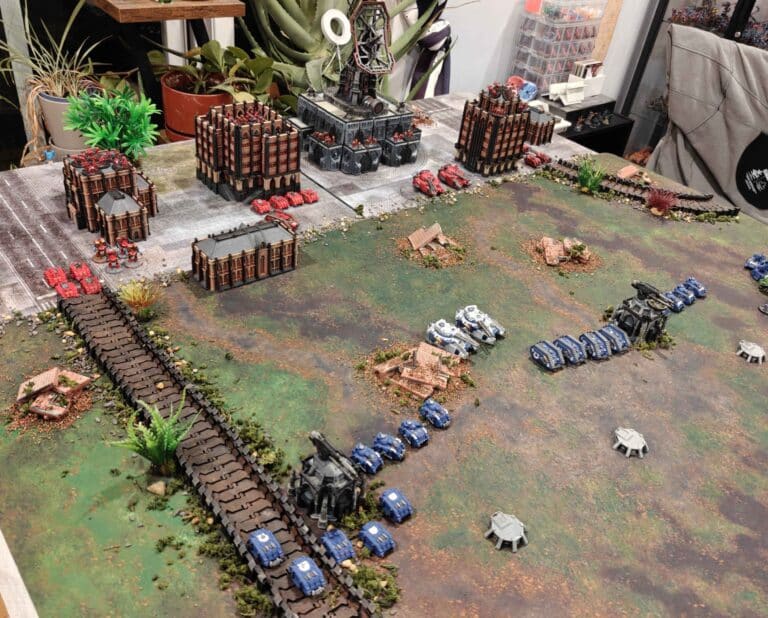
Ian: I’ve seen some of the pictures of the games you’ve done: can you give me a quick overview? Like, what was the goal? How many games did you play? How many players were involved?
Noah: Yeah, so the format was a 1v1 campaign. We originally planned to play five or six games, but we ended up only playing four games: two games of Adeptus Titanicus and two games of Legions Imperialis. Things got cut short because the timeline got adjusted, and as we’ll get into in the hobby section, some of the units that were expected to be ready for the campaign were not painted, so we spent a day painting instead of playing, and that meant we had to adjust our final game total, which is all good. But yeah, it was a 1v1.
Ian: You’ve been on the epic-sized train for a while now. What’s drawn you to that scale or those games?
Noah: When referring to epic scale, you end up comparing it to 40k in general and 28mm scale. Now that I’ve played some games of Epic, you really feel how crowded a game of 40k feels on a table. That whole it feels like a parking lot joke that people say feels more true than ever. There’s so much less room to manoeuvre in the larger games, and you don’t notice that until you play a game with more space.
Also, because everything is significantly smaller in the game itself, it allows for creating engagement at a larger total scale. It’s easier to tell a story at a smaller scale, because I can create a more interesting battlefield, the individual elements are smaller.
So if I need a centrepiece terrain piece, I can paint it up in two, three hours. Where at the larger scale, not only would that take up a significant amount of the total table, but it would also take me many, many more hours to paint, build, and the cost of it in total would just be higher.
So it feels more accessible and collecting a large variety of terrain at this scale is possible without taking up like half a garage, which is nice.
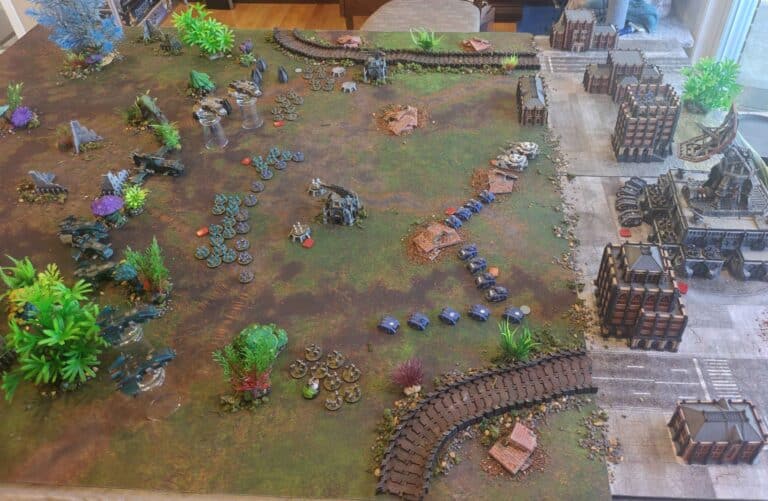
Ian: How much painting did you do leading up to this? Everything in the pictures appeared to be at least battle ready, including all the terrain.
Noah: The terrain that was tan, black, and kind of red was all painted up by me, and I’d say I spent about 30 hours painting that terrain, including creating the city tiles that were used within the game. I certainly could have put more time or less time into the terrain.
Ian: What went into creating the tables and planning them and setting them up?
Noah: We are recreating essentially historic battles within 30k. Creating the setting is fairly simple because we’re using missions out of the campaign compendium for Titanicus. They already have suggested table layouts. So when we chose the missions that we wanted to play, that set the tone for what terrain we wanted for those tables.
And honestly, the reason we started at Molech–it’s not the start of the Heresy where we maybe should start–but Molech is a planet with a lot of jungle on it and I already have a set of jungle terrain at 40k scale that I was able to use for this campaign, which made us able to create a variety of battlefields while our terrain collection grows.
Ian: So are there any particular techniques you learned specifically for this project or any tips you could pass along?
Noah: Yeah, so I did a bunch of FDM printing. This is the first real project that I’ve used an FDM printer on, and that was a very helpful tool for terrain. At this scale, everything’s so small, the lower level of detail doesn’t matter as much.
I also did a bunch of painting with sponges, which is something I saw Midwinter Minis do originally. I don’t know if he was the first person to do it, but he’s the first person I saw doing it.
You use soft makeup sponges and the sponge is trying to create very soft textures across the surfaces, which works really nicely on terrain and other surfaces that have a lot of depth of detail. Because you’re able to sponge on at different pressures, you can create different layers of paint quite quickly. I did a bunch of sponging with soft sponges instead of like a coarse sponge that you would use to get like a chipping or a weathering effect.
Ian: Oh, I see. So it’s not so much weathering, it’s more layering the sponge.
Noah: Yes, essentially, it’d be layering and closer to the kind of effect you would get through like, not a dry brush, but a heavy over brush. It’s a lot smoother. Because over brushing and dry brushing on FDM terrain doesn’t always look the best, because it kind of accentuates those layer lines. Where the sponge doesn’t pick up those areas heavier than others.
Ian: Okay, cool. So getting more into the specific game, you mentioned that you started on Molech. What was the narrative of the game?
Noah: Yeah, the Doom of Molech is a campaign that exists within Adeptus Titanicus already. We took two games from there to form our narrative.
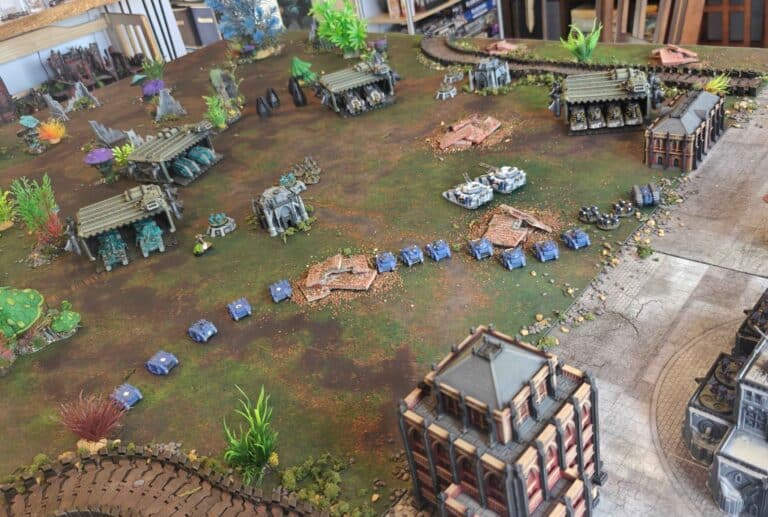
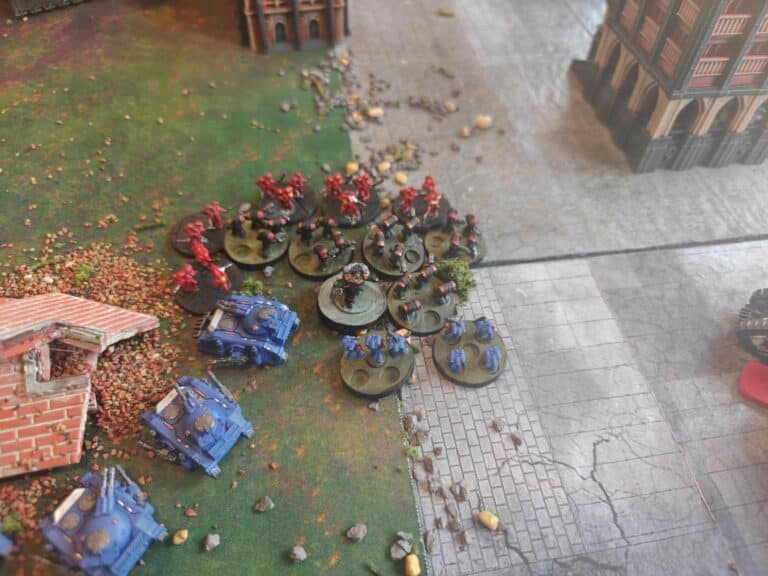
We started with a Legions Imperialis game that was meant to represent Horus’ assault onto the planet. So the first game involved a drop pod assault onto some orbital defences. And then they were able to land a bunch of bulk landers with their heavier guns to then assault and take over an HQ building that was coordinating the planetary defences on the planet.
That was on one part of the planet. And then after that, the Warmaster successfully got his troops onto the planet. Then we did “Delaying Action at Avalon”. Now, in the background, Legio Mortis does a quick advance into the city. And then the Loyalist Titans ignore high command and stay behind to do kind of like a last stand to allow the Loyalist forces to escape the city without just getting mowed down by the Traitor Titans. So we ran that, which played very well. And then our third mission was meant to represent the Knight engagement that happened after Horus came back from the warp gate. So the whole reason they go to Molech in the first place is because that’s where the Emperor went and got some special powers and created the Primarch Project and whatever, that’s where he made the deal with the Chaos Gods.
Horus goes through that same warp gate and gets infused with a bunch of Chaos bullshittery. On his way out of that gate, the Scions of House Devine just kind of happen upon him and they try to kill him. This is represented by kind of like a centre objective that was Horus surrounded by a bunch of Knights. And it ended up just being a king of the hill mission where the Loyalist and the Traitor forces were both trying to basically dogpile the centre objective.
And whoever controls it at the end of the game kind of dictated if the Sons of Horus managed to save their Primarch from the assault or if he gets overwhelmed and taken out or in this case injured for the rest of our campaign. But the Sons of Horus managed to save their Primarch, which is what happens in the books too.
Then our final game ended up being the siege of Lupercalia. It’s called Into the Jaws, but it was a mission in the Titanicus campaign compendium. It is a Legio Mortis assault in the city of Lupercalia. They assault the walled city. We had the Loyalist Titans defending the city and they had to make an advance across the board. And they got bonus points the further into the city they got.
We ended up doing kind of like a meat grinder rule for the Loyalists to balance things out. Whereas the Traitor Titans that died come back on their board edge at the start of the next turn and continue the attack. Because the mission was not terribly well balanced out of the book. Those were the four missions we played. We had two more planned, which was going to be the Death of a God, which is a mission that happens right after the attack on the city wall. It was going to be a linked mission, happening right after each other on the same board. The board was basically going to roll, we were going to add more tiles to the end of the board and then continue playing. That’s when House Devine betrays the Loyalists and stabs the Imperator Titan in the butt and it explodes within the Loyalist lines. Which allows Mortis to break into the city and it creates a bunch of chaos. That mission got cut.
The final mission was going to be the Burning of the Lupercalia, which is written as a Titanicus mission. We were going to play it as an Imperialis mission: the Traitor forces are in the city and they’re destroying the city. It was going to be a game based around how much of the actual city gets destroyed by the Traitors and the Loyalists are trying to repel the Traitors. The Traitors are trying to not only kill the Loyalists, but also raze the city to the ground. That, unfortunately, got cut. There’s always the opportunity to play that again.
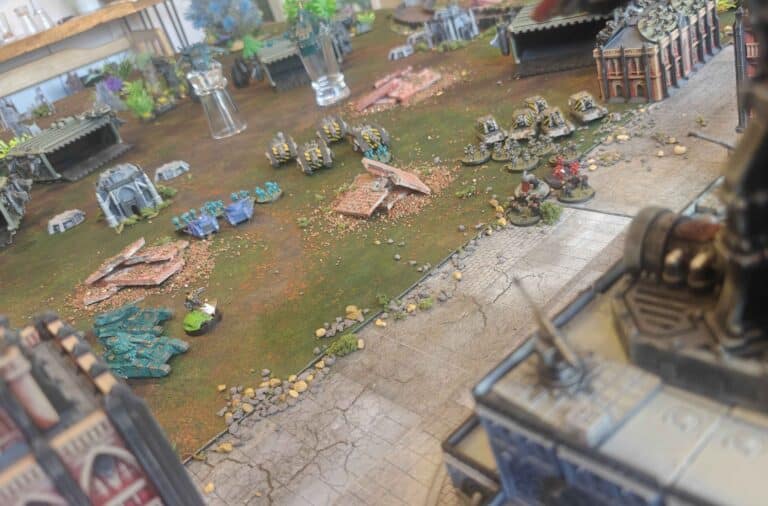
Ian: So you mentioned balancing the mission with the recycling forces. Were there any other house rules you used?
Noah: Yes. So I was learning how to play Legions Imperialis. Unfortunately, from my understanding, the game is not in a great place balance wise. So we house ruled how combat works. Kyle had a set of house rules for resolving combat, which simplified the existing system significantly. And then we didn’t use any of the specific Legion traits. Because from Legion to Legion, the traits are mismatched in terms of power. We just didn’t use any of those: that also made things a little simpler, less to keep track of.
We also changed how laser blasters and turbolasers work within Titanicus. Instead of having the shieldbane rule, we gave them the beam rule for draining. Which gives them a bit of a different role on the battlefield, and makes them more worthwhile.
Ian: The shieldbane reduces the save, but what does beam do? Just remind me
Noah: We did beam for draining, the way you get shieldbane for draining. Beam, instead, when you shoot, if you use beam, you automatically hit with all your attacks. And you get to hit a specific location. And then it carries through and can hit things behind it.
So if a gun had three shots and a beam value of one, it would hit the first target for three. And if there was another eligible thing behind that, it would hit the next thing for two. And if there was a third thing in a line, it would then hit the third thing for one. It changed its role to be a better finishing weapon than a shield stripping weapon that unfortunately doesn’t really strip shields. Which I know you’ve experienced in playing them. It’s a little underwhelming.
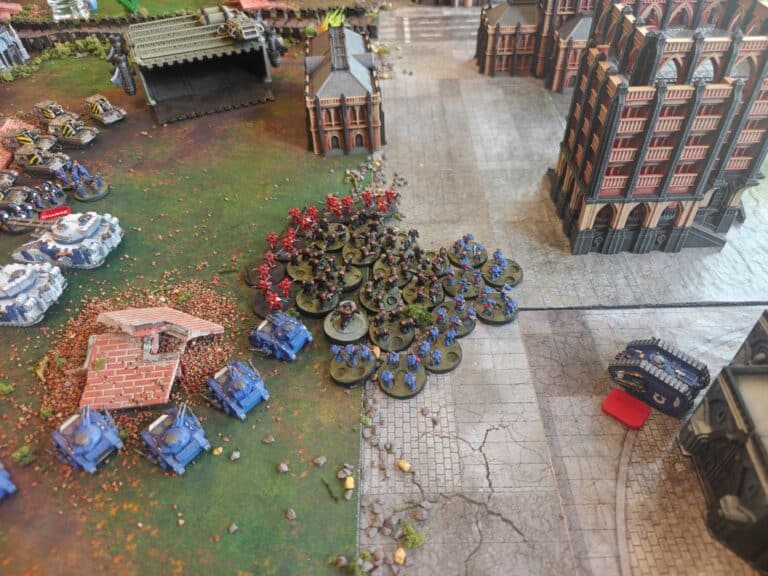
Ian: Yeah…How did that work out? Did you feel that was more powerful?
Noah: It’s certainly more powerful. It definitely played better. We were using it in a mission where there was infinite reserves as a meatgrinder rule. So that part of it, plus this change, didn’t work out super great. Because it allowed the Titans that came back on, that were essentially free bonus points, to come in and shoot long range without having to roll to hit.
And they didn’t have to worry about heat on their reactors. The Titans that came in later in the game didn’t have any heat on their reactors, so they were safe to do draining. I don’t think that was an issue with the beam rule. That was more of a meatgrinder quirk. Something I definitely want to play with more and figure out if it needs to be tweaked a little bit more.* But it’s something I’ve heard about on the internet from other people in the Titanicus community.
Ian: Cool. So I recall there was a picture, I think it was Perturabo as an epic scale miniature. Did you use Primarch rules? I know you mentioned using Primarchs more as objectives but what about actually using them in the game?
Noah: Horus and Perturabo were in the original assault, the first game. Legion Imperialis doesn’t have rules specifically for Primarchs. But instead we gave them the rules of Knights. So they were essentially taken for free as bonus points for the army list. And we weren’t playing evenly pointed games. So the points were kind of irrelevant.
But we gave them the stats of Knights. So Perturabo was whatever a regular Knight is. And then Horus was a Knight Cerastus Lancer. Knights are quite strong in Legions Imperialis, but they’re very expensive. So it made the Primarchs very powerful on the table. Especially because they were able to attach onto units of Terminators, which gave them ablative wounds. We knew they were very powerful. That was the point, it was fine.
Ian: They were appropriately powerful?
Noah: Yes. They didn’t feel wildly powerful. They are certainly very good. We adjusted things on the fly, when it came to reserves and stuff. To try and balance things out. The first mission we ended up restarting, because the defenders had way too many points, the first time we did it. We did one turn and it was like, “Okay, there’s clearly no way this aerial assault is going to work. Let’s rebalance this.” We gave the Loyalists half as many points as they had the first time. We pushed back their deployment a little bit. Which allowed the Traitors to get onto the table. And then we adjusted things as we went. So we kind of set an amount of reserves that we thought would be appropriate for the Loyalists to have. And we could tweak that as the game went on.
If the Loyalists were going to be too weak. We’ll just discuss that. And we’ll just give them additional reserves to allow more things onto the board on the Loyalist side. And if we felt that way about the Traitors, we can either give them more reserves or we can increase the game length. The Traitors have a significant point advantage and just have to get to the objectives. The challenge with so much coming in was getting the timing right. We planned a four-turn game. And ended up deciding to allow the game to extend to a fifth turn on the dice roll of a four plus. And the game did not extend, and that meant the Loyalists won. If the game did extend on that four-up, then it would have been a Traitor victory.
The orbital assault was always going to be successful, it was just did the Loyalists manage to delay them enough? Did the civilians and their other forces retreat appropriately in time? It ended up being a very, very, very close game because we adjusted things. After every turn we did a post-turn wrap-up, and I took some pictures, to discuss how we each felt about the state of the game. And if things had to get adjusted in either direction so that we both continue to have a lot of fun.
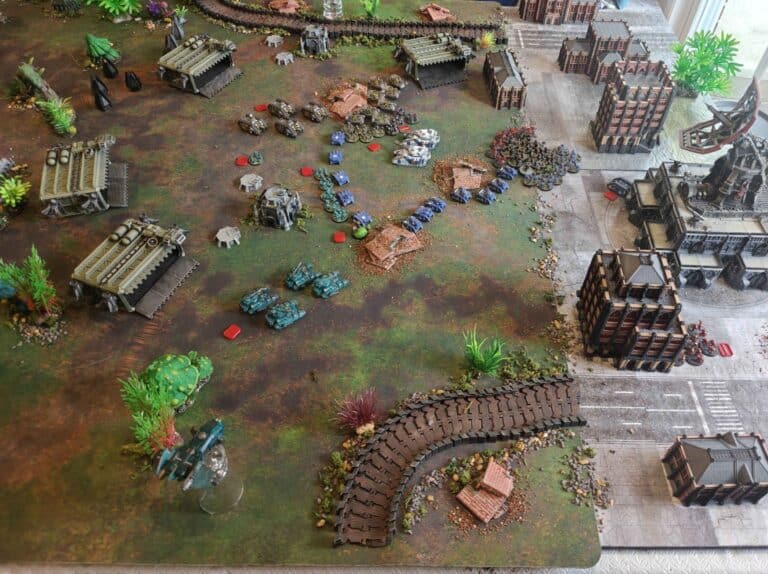
Ian: I think that’s kind of like quintessential to a homebrew or narrative game like that, making sure it’s close. What tips would you give someone who’s trying to do the same thing?
Noah: The use of reserves really helped in this situation. Having more forces available than what was on the table was very helpful: knowing that if we needed to tip the scales in either direction, we had additional models available to do that. We were both willing to change the way the scoring was working to be more favorable to one player or the other, or change the availability of total models. Because when you’re playing with defences, and you’re not playing with mirrored objectives, it can be quite challenging to figure out what’s going to be even.
This worked out because I’ve been playing against Kyle for many, many years. We’re good friends. Something like this would be a lot harder to balance on the fly like we did in an official event kind of setting because balancing on the fly doesn’t really work with many, many players or when you’re playing to win. We were both obviously trying to win, but the overall outcome of the game is for both players to have fun. We would rather have a better game than a game that ends early because one side was heavily favored based on the mission and we didn’t get the balance right.
Ian: Were there any links between the games in terms of like in-game effects or bonuses or penalties?
Noah: So we had plans for the last three games to be linked. Into the Jaws, which was the assault on the final city, and then Death of a God and then the Burning of Lupercalia were going to be three linked missions. But those last two games we didn’t get to play, we ran out of time. So there was meant to be links between those games, but that didn’t end up happening. The thing with the link bonuses from one round to the other, they kind of create a snowballing effect, which we didn’t want. Our intention here is we’re going to run these campaigns to represent certain events in the Heresy. And then the overall winners, for each of these individual events will then get some sort of bonus that will work out for our final Siege of Terra campaign.
So in this situation, we have a Loyalist victory at Molech, even though the Warmaster achieved his goals and whatever: it was a strategic victory and that’ll create some sort of bonus at the Siege of Terra.
Ian: It doesn’t even need to be bonuses per say, it could be just how it affects the story. Like if one side is losing constantly, that could represent their faction funnelling more and more resources into the conflict.
Noah: And that’s what this was. Game one, game two and game four, ultimately the Traitors achieved the goals they were trying to do. But the Loyalists were able to delay them appropriately to meet their victory conditions. Even though the Traitors achieved their goals for the campaign, strategic victory went to the Loyalists and what that means exactly we can work out at a later date.
Ian: Was there a particular highlight of the games?
Noah: Getting the landers finished. Bring able to land and deploy the tanks out of them felt super thematic. It was quite exciting to see Kyle storm the field.
We played with destructible terrain. Kyle had two Wathounds: they just reached the city walls and went apocalyptic and blew up a giant chunk of the wall and really created a hole in my line. He exploited this later in the game, which it felt great to see. I also killed my first Warmaster Titan, which was challenging. It’s a very tough model and watching it almost make it to my line and then die…It wildfired his own Titan: it was great. It’s slow and seems unstoppable, but finally shooting out its legs and watching it topple over felt awesome. It was very satisfying.
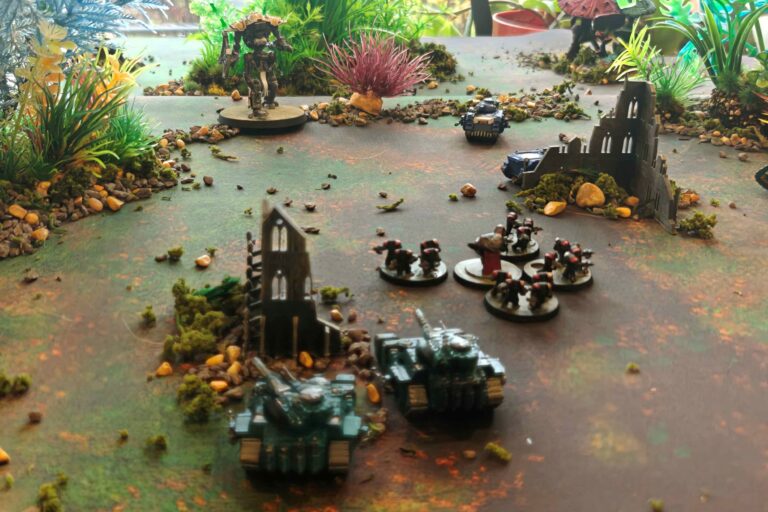
Ian: Those landers are definitely some of the coolest stuff in the pictures you sent. Did they have specific rules? Or were they just adding to the theme?
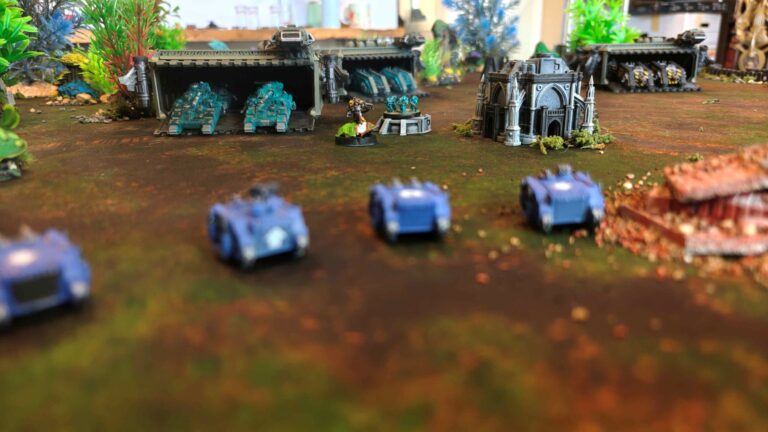
Noah: They were just adding to the theme. So there were two orbital defence cannons that we had on the table and the rules we had set up was that the attacker had to bring in any other heavy armour through these landers and the landers could basically land whatever fit inside them. Which was eight small tanks, rhino-sized tanks or two of the super heavy sized vehicles.
The rules were if he decided to land while the orbital cannons were still around, I could shoot them down on a 3+, so I basically had two rolls to try and shoot down two of the landers. But he managed to take all of those out prior to him dropping in the landers, so he got to fight with his full points. But he had the opportunity to drop in earlier and risk losing some forces. He had the opportunity to land within a certain radius. I think it was 12” of the cannons, if they still existed, and we basically scattered them like you scatter anything else with a D6 and if they would have overlapped a unit or terrain, then it was essentially they didn’t land that turn. They’d have to go back into reserves and try again next turn. All four landers managed to land with their scatters. That’s how we ran for them.
They were quite the mission to get ready for this game. Kyle sent me the files for them, or that he found online less than a week, actually three days before his arrival, and we instantly got them sliced and started printing them. The final print came off the bed, they were painted and on the table within three hours of the final print being done. But they turned out looking good enough. Certainly, I want to go back and add some more paint to them. That’s going to be a common theme for many of the things that were part of this week. But they looked good enough. This game is meant to be looked at from where you stand looking at it at the table. Getting up and close, like really tight to the models is not the objective. Looking at the total theme, and they’re part of the theme, and ultimately, they’re also terrain. Terrain needs to look good, but should not look better than the surrounding models.
I’m pretty happy with how they look and now that we have four landers, we have them for future missions. The artist also has landers for Knights, so maybe I’ll make up some landers for Knights for next time we do an orbital drop.
That’s it for now! Come back next month for the second half of the interview.
Models by Noah and Kyle. Photos by Noah.