A narrative gamer’s first impressions of 11th edition 40k
By Ian
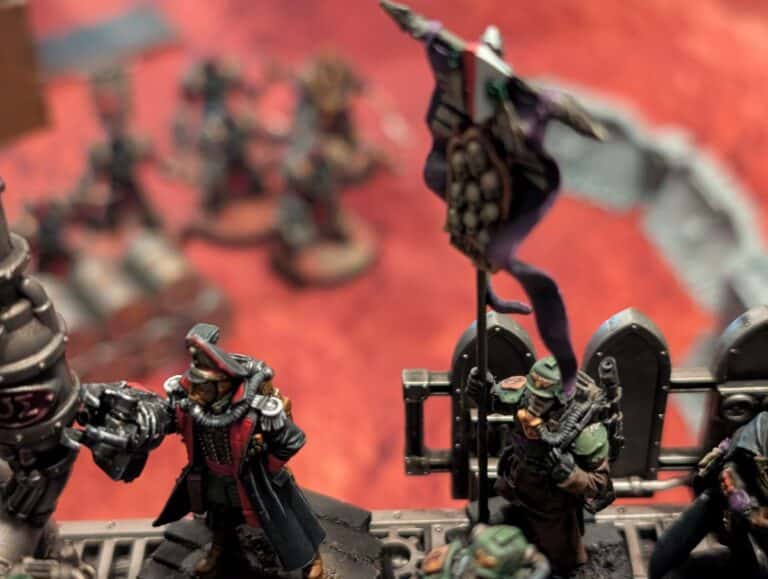
It’s that time of the tri-year again where we get a new edition of everyone’s favourite gothic space war, Warhammer 40,000. I’ve been lucky enough to play a game of 11th ed and wanted to share my thoughts on the new edition and modern 40k as a whole.
Right at the outset, I want to be clear that this is my personal opinion and may not reflect your feelings towards the game or the broader community as a whole: there sure are a lot of 40k tournaments and, presumably, most of the players there are enjoying those tournaments (at least if they keep going back). But I play the game in a very specific way with a heavy emphasis on immersion and story, which is how I’ll be evaluating the new edition.
Basically don’t take my word for it: try 11th ed yourself.
Mission briefing
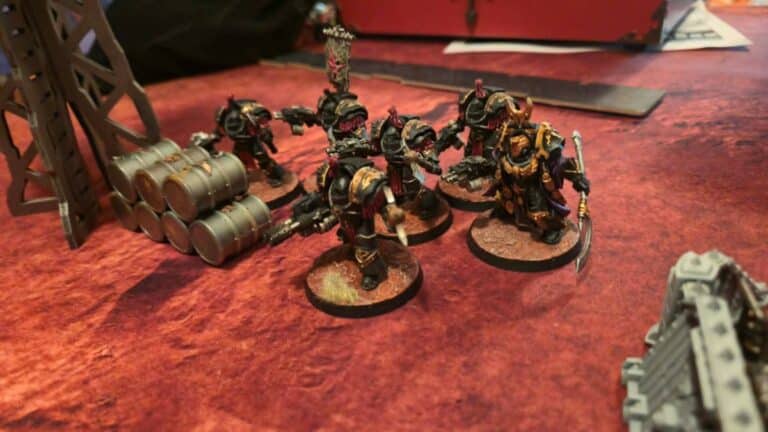
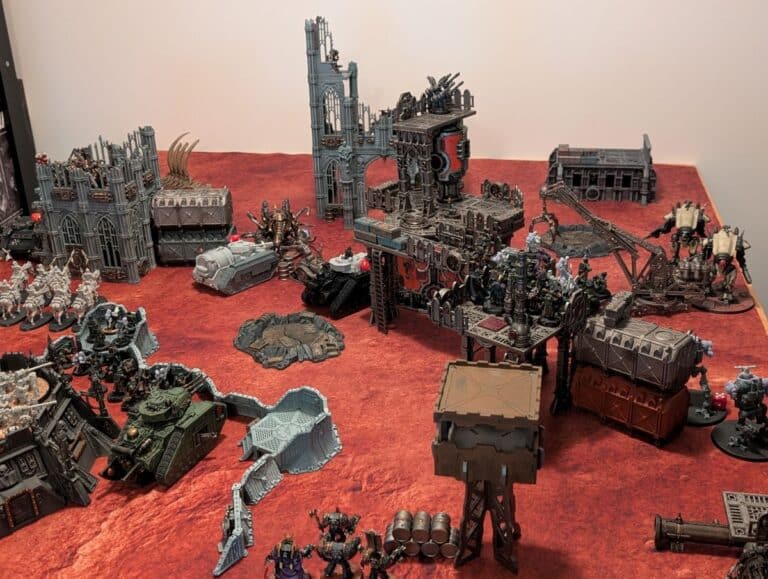
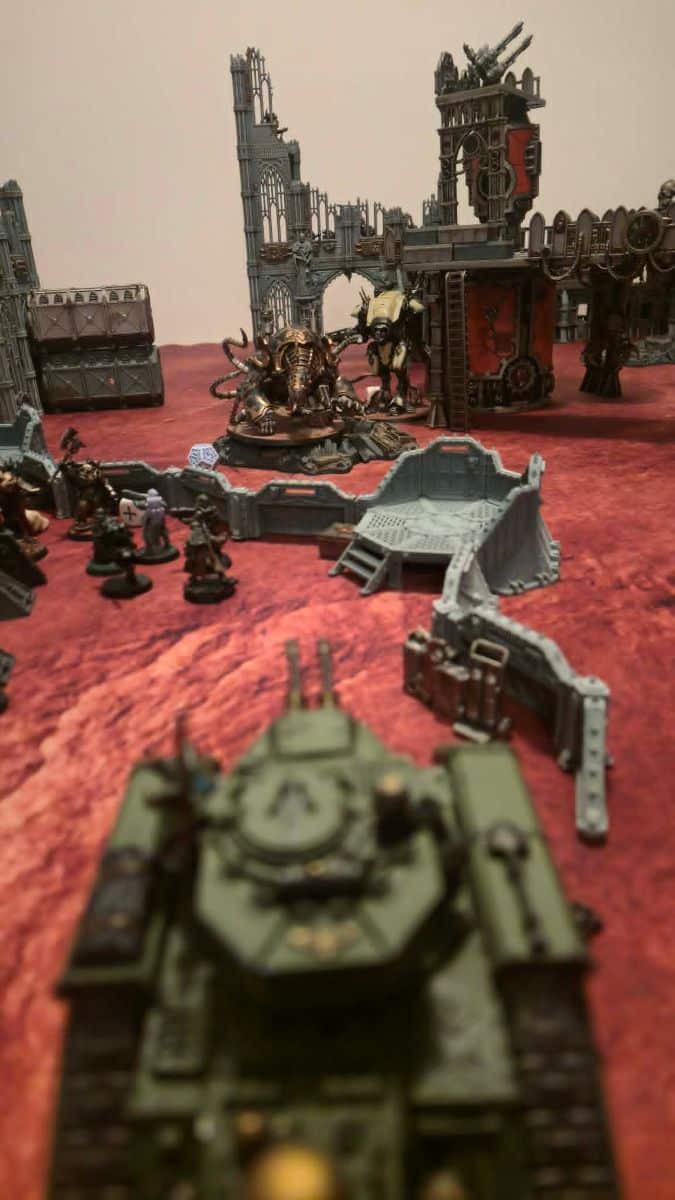
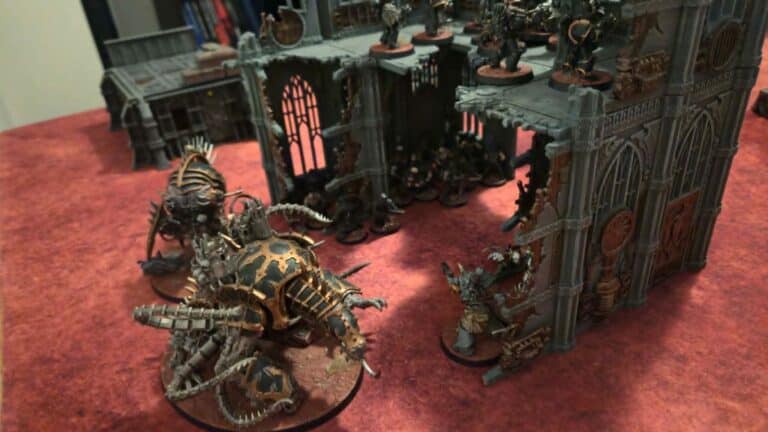
For my inaugural game of 11th edition, I played 1,500 points of my Black Legion versus Jeff and his Krieg Guard. We played the standard mission using the 40k app (specifically Priority Assets vs Disruption, the mission being Extract Relic/Locate and Deny). For terrain, we ended up using the Tip of the Spear asymmetric deployment from the 2025/26 Chapter Approved mission pack and I set up terrain as best I could to port that deployment from 10th to 11th, which made for quite a dense board.
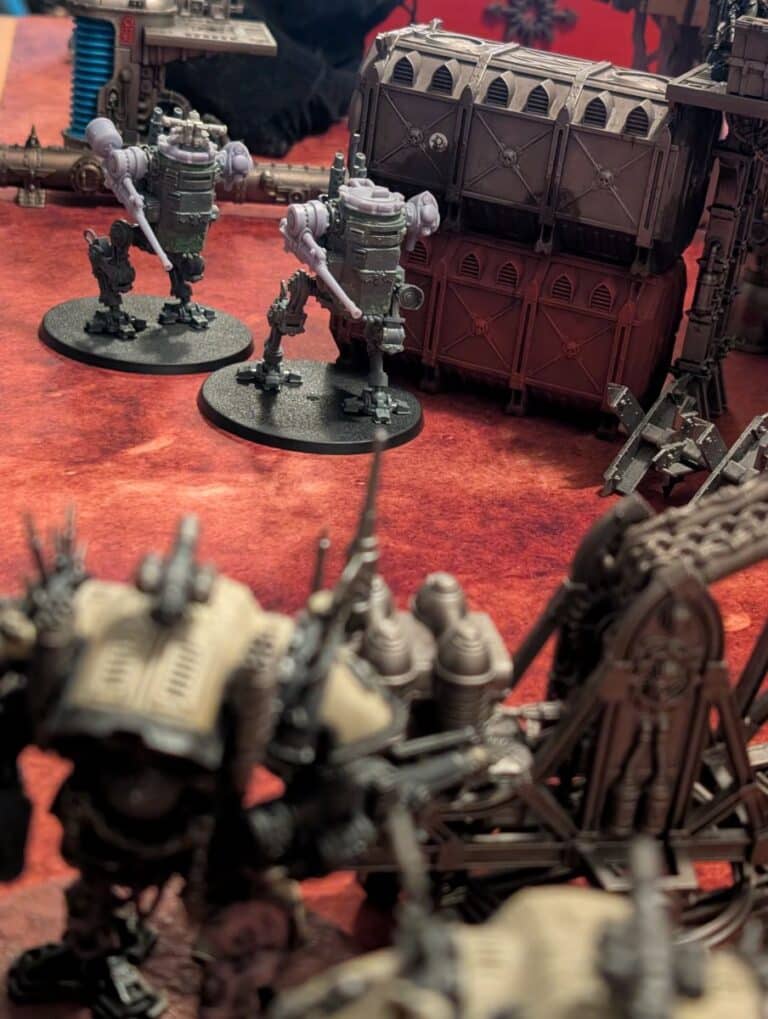
I’ll copy our rosters at the end for those interested, but Jeff and I both took what felt like very classic lists for each army. I brought a Chaos Lord and Terminator Sorcerer with a core of 20 Legionaries and 20 Cultists, backed up by some elite infantry and daemon engines, with a pair of allied Wardogs. I ran Pactbound Zealots, the detachment I played through most of 10th. Jeff took a Command Squad and Castellan, 40 Krieg Guardsmen plus a few heavy weapons, some sentinels, a Hellhound, two Russes, and fifteen cavalry. He ran Siege Regiment and Designation Force.
Finally, prior to the game I had read the core rules PDF cover to cover and read a bit online about how the force dispositions and missions work, though I didn’t specifically build my list around this.
This edition could have been an FAQ
The good news is if you liked 10th edition, 11th is more of the same. Though the core rules have been tweaked, the game still feels and plays very similarly. Obviously the codicies haven’t changed, and everything in my army seemed to play similar to before: there weren’t any units that suddenly felt underpowered nor had a complete role upheaval.
Plunging Fire, the obscure height advantage from 10th edition, came up multiple times, which functionally allows a unit to ignore the -1 to Hit penalty for cover. The fact that it could be gained from a mere 3” was also exciting, as it meant Jeff’s autocannons perched on top of the Aquila Strongpoint could even take advantage of it. I don’t know if this one rule will give the game some much needed verticality, but it was a nice rule and felt impactful without being overpowered.
The changes to charging and assault were noticed, but didn’t really come into play or affect the game: Jeff and I still announced the charge targets before rolling, as it was usually only a single unit with no other viable targets.
The long-standing tournament house rule of the first level of ruins blocking line of sight has now been formalized in the 40k core rules. Though this irked me on my initial read, we played it as is and it felt fine.
Hidden didn’t come up, though I could see how this could be a good rule for mitigating first turn shooting, or perhaps on a larger board (we played on a 5’ x 4’ table, but I feel like the game would have played nicely on a 6’ x 4’).
Though I was excited for the changes to Battle Shock, they didn’t come up and, given how quickly things die in modern 40k, it feels like they won’t come into play often.
The Old Ways
Over the course of 10th and some previous editions, 40k has been stratified into multiple modes of play. GW has had their own definitions, but I’m going to use my own, somewhat similar ones. Open Play was two friends grabbing whatever mission made sense and was easily accessible and throwing down. Though I think the Only War mission was designed for this, really Open Play could be two opponents using a White Dwarf mission, using some or all of a Matched Play deck or anything in between.
Matched Play, I would define, was two players using the current Matched Play mission pack and closely adhering to that. Tournament play took this a further step and used specific terrain layouts (which, if you’re new, were not specified in previous mission packs) and added additional restrictions such as time limits and banning Legends units.
Narrative Play would be two or more players playing a game with the intent of telling an immersive story, with a focus on thematic lists, fully painted terrain and armies, and having a background for the game to give it context. GW more recently has a design philosophy of Narrative Play being about the rules telling the story, with additional mission rules, warzone rules, campaign rules, and Crusade rules each adding additional layers onto the mission with the goal of adding depth to the narrative.
Well, I’ve got good news: if you like complicated and convoluted rules in your narrative games, 11th edition is for you!
I want to be clear that Jeff is a friend, I always have a good time playing him, and this game was no exception. But I hated this mission.
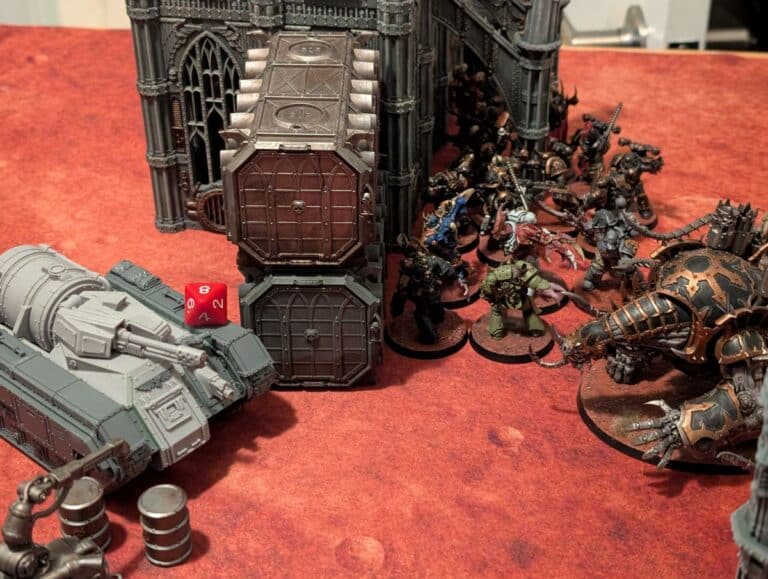
Making tournament play everyone’s problem
I get what GW was going for with force dispositions. But some feel arbitrary or don’t fit. This also removes player or campaign master choice from the equation: sure the story dictates that your army of Pactbound possessed take and hold that stronghold, but, sorry, you either change your list or go off and look for relics.
I’ve heard the argument against force dispositions for new or casual players–if you have a limited collection, your army only really has one detachment that works and you got into the game with a friend in a similar boat, you’ll be playing the same mission every game–but I think it’s also a problem for some more established players. I run Pactbound Zealots because I like marking units, and a lot of them have god-specific icons and bits modelled. Similarly, I always run Liberator Assault Group with my Blood Angels Successor because it fits my play style and it feels right for the sons of Sanguinius. But following the prescribed mode of play, I’m now locked into those force dispositions.
The problem too is that these missions are very complicated. Between the multi-part primary mission and multiple secondary cards, I had six objectives to track at one point in the game, many of these requiring actions. And while I can come up with narrative justification for some of these (maybe my possessed are eating civilians they found cowering in the ruin) others are much more difficult (no, I don’t know why my venomcrawler is operating a scanner). But even when I can come up with a story behind each of these objectives (fouteen, over the course of a game), very few of them feel natural and it’s immersion breaking.
This mode of play with random secondaries (originally Maelstrom of War, then Tempest of War, now just Matched Play, I guess?) is often disparagingly called “drunken commander” as your goals keep shifting. I remember quite distinctly enjoying Maelstrom of War back in 8th edition when it was first introduced, but the current iteration with such a large swathe of action-oriented objectives has really soured the game mode for me.
The issue Jeff and I found with the objectives was that most started and finished in one player turn. I’d draw a card, move my unit into position and/or start an action, then finish my turn and score points. Outside of a few stratagems, Jeff had no way to interact with my scoring, especially the secondaries. I understand that end of battle round/start of next player turn scoring might be difficult given how lethal the game is, but it really turns off the interaction between players…which is the whole point of the game.
And speaking of lethality, the game is still as lethal as a lascannon. The stacking of Lethal Hits, Sustained Hits, Devastating Wounds, rerolls, and everything else is still alive and well. You see a lot of talk of “trading” units in competitive content, which is what it comes down to: I use my Knight to take your Rook and your Queen takes my Knight. I don’t want to play chess and I don’t want the outcome of a unit’s shooting or charge to be a foregone conclusion. I want to play Warhammer and see my guys have random streaks of luck or disaster that I talk about for years to come. But the flattening of the curve provided by rerolls and the plethora of offensive abilities means there is much less room for those inspiring moments on the table where a lone Skitarii Ranger faces down the charge of a Knight. This isn’t a new problem, it existed in 10th too, but it certainly has not been fixed.
Finally, the other aspect which has seeped into narrative play are terrain layouts. These are presented for every mission and while I’m sure some people appreciate guidance on how to set up a Warhammer table, I’d like to play somewhere other than a ruined city laid out by a drunk who flunked out of hive planning.
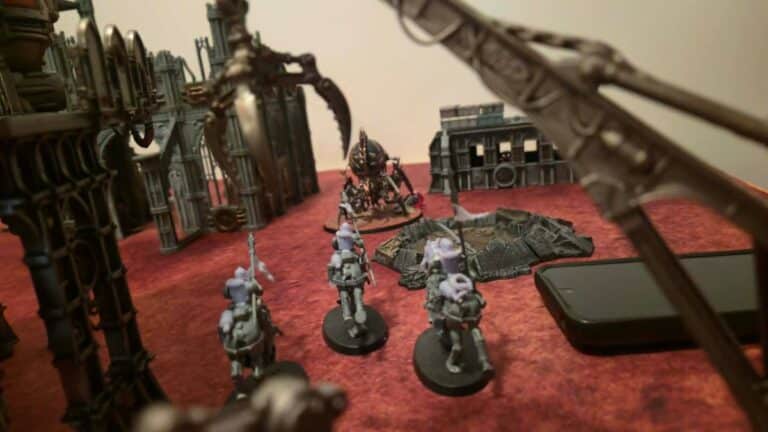
The modern battlefield
Other than the functional elimination of supported narrative play, another gripe I have of 11th is the terrain rules themselves. As I found them quite confusing, I created a little chart to help:
Restricts movement for some larger models | Provides benefit of cover to some units on the footprint & all units partially blocked by it | Can confer HIDDEN to a unit | Obscuring (Blocks line of sight when behind footprint) | Solid (Some units on ground level not visible) | |
Exposed (Craters, razor wire, scatter pieces) | ✓ | ||||
Light (Barricades, statues) | ✓ | ✓ | ✓ | ||
Dense (Buildings, ruins, containers, woods) | ✓ | ✓ | ✓ | ✓ | ✓ |
What this means is terrain such as barricades and defensive lines fully block line of sight, unless they are modelled on a base and the unit is standing on that base. Fine, just count them as exposed…which now means they cannot confer HIDDEN, which you would expect for a unit crouching behind an entrenched position. And you may wish tank traps to block, you know, tanks.
One additional issue Jeff and I encountered is how high Obscuring terrain blocks line of sight. If we have two units on third levels with a two level building between them, can they target each other? What if they’re all on the second level and the intervening two level building doesn’t obscure the units much (i.e. they’re pretty clearly visible)? The rules work fine for basic terrain, but when you add multi-level terrain with a variety of heights it starts to fall down.
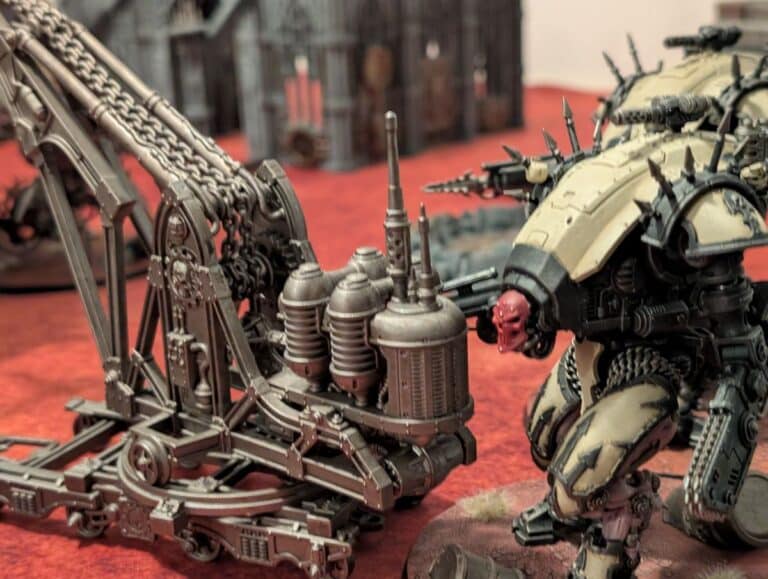
Bring out the house rules
I hear what you’re saying: just agree with your opponent and house rule it.
So what does that look like? Well, first a new type of terrain: call it “Barricades” representing low defensive lines, which can confer HIDDEN, and also restricts movement for models other than INFANTRY, SWARMS, BEASTS, and MOBILE. You could maybe add a new terrain condition to add +1 to the Armour Save for units in cover–lets call it FORTIFIED–to represent things like trenches and heavily armoured buildings. Though that might be better suited as a mission rule.
The other big change I would make is a simplified mission pack. I’ve linked to this article previously, but the Beard Bunker did a great piece a while ago about simple missions and how a pack along the lines of the Only War mission from 10th edition, with a few variations, would work really well. I think a mission pack between 6 and 12 missions would work well, and these could be updated from previous editions.
Above I was pretty down on secondary objectives, but I don’t think they’re inherently bad, just having a large deck of random, generic secondaries is difficult to parse for narrative games. We used secondary missions to great effect for the ICI V event, where every player brought a “prophet” character and every table had a unique prophecy objective which was tracked separately from the main conquest campaign score. To reference the Beard Bunker again, they did a campaign with unique Agendas (aka Crusade secondaries) that affected the veil between the warp and real space as well as morale and propaganda on the planet. Having specific, characterful objectives can be useful, and looking at the matched play mission pack for examples of a few to use can be a great starting point.
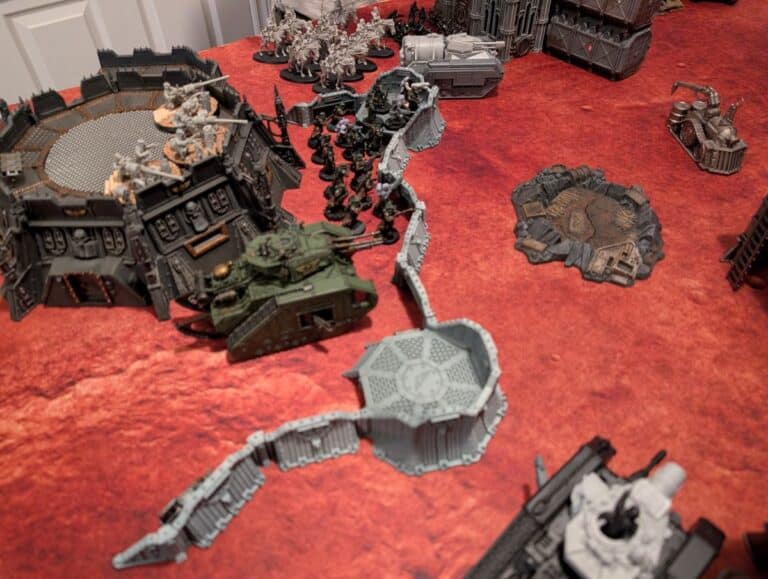
Making the game your own
As I said at the start, I play a 40k in a very specific way and if you enjoyed 10th and/or are enjoying 11th, go get ‘em. I don’t think I had a bad game of 10th because I almost always play friends and usually we’re playing custom missions.
I am, however, disappointed by 11th edition. GW said all the right words leading up to 11th, but making the game more narrative really meant removing neoprene discs (an unofficial play aid that my play group and the narrative content creators I follow didn’t use) and forcing a rough narrative on games through dispositions. Maybe that will make the odd tournament game feel more story-driven, but it does nothing for experienced narrative gamers.
I know what you’re going to say: there’s the Dominatus deck. There is and I haven’t looked at it in person, but the reviews I’ve read been mixed at best. In 10th, I picked up every Crusade book, even though I knew I wouldn’t get to use all the rules in them and, even if I did, GW’s narrative rules have typically been less than great. But those books can sit on my shelf and have great art and lore I can peruse at my leisure.
But a deck of cards? You’re telling me the lore for the only narrative product has been reduced to card flavour text?
Down but not out
I said at the outset that you should try 11th out for yourself and, after a fair amount of negativity in this piece, I still mean that. I think 10th edition–and 11th by extension–was a very divisive edition amongst the community. Modern 40k has a much more “gamey” feel than previous iterations, where the focus is ease of play rather than simulating the grimdark universe. And there’s a lot of things I like about 10th/11th, but these are outweighed by the many things I don’t and all that has been lost in the name of balance and ease of play. And while you and many others might enjoy 11th edition–the response I’ve seen online has been pretty positive–for me personally, 11th edition not only fails to address my issues with modern 40k but also feels like GW has decided to stop supporting narrative gaming with anything but a token effort.
I had (slightly) higher hopes for 11th edition: before my game with Jeff, I had been thinking about how to turn force disposition missions into a narrative weekender, or adjust the mechanics of the Dominatus deck to fit into my group’s homebrew sector. But hacking the current missions into something resembling a narrative game seems about as much effort as updating older narrative missions, so I think I know what I’d rather spend my time doing. And at the end of the day, it doesn’t matter what GW is producing: I don’t have to buy it. I’m still going to hang out with friends, write cool stories, and have fun; if I’m not doing those things, I should probably find a new hobby.
The lists
Ian’s Black Legion (1495 points)
Chaos Space Marines
Strike Force (1,500 points)
Pactbound Zealots (3 Detachment Points)
Force Dispositions: Priority Assets
CHARACTERS
Chaos Lord (90 points)
- Mark of Chaos: Khorne
- Warlord
- 1x Accursed weapon
1x Power fist
Sorcerer in Terminator Armour (80 points)
- Mark of Chaos: Tzeentch
- 1x Combi-bolter
1x Force weapon
1x Infernal Gaze
BATTLELINE
Cultist Mob (90 points)
- Mark of Chaos: Chaos Undivided
- 1x Cultist Champion
- 1x Autopistol
1x Brutal assault weapon
- 19x Chaos Cultist
- 19x Autopistol
19x Brutal assault weapon
Legionaries (170 points)
- Mark of Chaos: Tzeentch
- 1x Aspiring Champion
- 1x Accursed weapon
1x Bolt pistol
1x Close combat weapon
- 9x Legionary
- 1x Balefire tome
9x Bolt pistol
6x Boltgun
1x Chaos Icon
9x Close combat weapon
1x Havoc autocannon
1x Lascannon
Legionaries (170 points)
- Mark of Chaos: Khorne
- 1x Aspiring Champion
- 1x Accursed weapon
1x Bolt pistol
1x Close combat weapon
- 9x Legionary
- 8x Astartes chainsword
9x Bolt pistol
1x Chaos Icon
9x Close combat weapon
1x Heavy melee weapon
DEDICATED TRANSPORTS
Chaos Rhino (75 points)
- Mark of Chaos: Khorne
- 1x Armoured tracks
2x Combi-bolter
1x Havoc launcher
OTHER DATASHEETS
Chaos Terminator Squad (180 points)
- Mark of Chaos: Tzeentch
- 1x Terminator Champion
- 1x Accursed weapon
1x Combi-bolter
- 4x Chaos Terminator
- 4x Accursed weapon
3x Combi-bolter
1x Heavy flamer
Maulerfiend (130 points)
- Mark of Chaos: Slaanesh
- 1x Lasher tendrils
1x Maulerfiend fists
Possessed (120 points)
- Mark of Chaos: Slaanesh
- 1x Possessed Champion
- 1x Hideous mutations
- 4x Possessed
- 4x Hideous mutations
Venomcrawler (110 points)
- Mark of Chaos: Chaos Undivided
- 2x Excruciator cannon
1x Soulflayer tendrils and claws
ALLIED UNITS
War Dog Huntsman (140 points)
- 1x Daemonbreath meltagun
1x Daemonbreath spear
1x Reaper chaintalon
War Dog Huntsman (140 points)
- 1x Daemonbreath meltagun
1x Daemonbreath spear
1x Reaper chaintalon
Exported with App Version: v2.0.5 (128), Data Version: v886
Jeff’s Krieg Guard (some wargear was modified before the game)
+ FACTION KEYWORD: Imperium – Astra Militarum
+ DETACHMENT: Designation Force, Siege Regiment (Designated Targets)
+ TOTAL ARMY POINTS: 1500pts
+
+ WARLORD: Char2: Krieg Command Squad
+ ENHANCEMENT: Legacy Sidearm (on Char2: Krieg Command Squad – Lord Commissar)
+ NUMBER OF UNITS: 13
+ SECONDARY: – Bring It Down: (4×2) – Assassination: 2 Characters – Cull The Horde: 2×5 (before leaders attached)
+++++++++++++++++++++++++++++++++++++++++++++++
CHARACTER
Cadian Castellan (55 pts)
- 1x Power weapon
- 1x Plasma pistol
Krieg Command Squad (75 pts)
- 1x Lord Commissar
- 1x Laspistol
- 1x Plasma pistol
- 1x Power fist
- Warlord
- Legacy Sidearm (+10 pts)
- 5x Veteran Guardsman
- 4x Close combat weapon
- 2x Laspistol
- 1x Plasma gun
- 1x Chainsword
- 2x Lasgun
- Alchemyk Counteragents, Servo-scribes, Master vox, Regimental standard
BATTLELINE
Death Korps of Krieg (145 pts)
- 2x Death Korps Watchmaster
- 1x Power weapon
- 1x Plasma pistol
- 1x Boltgun
- 1x Close combat weapon
- 18x Death Korps Trooper
- 18x Close combat weapon
- 14x Lasgun
- 2x Meltagun
- 2x Plasma gun
- Death Korps of Krieg Medi-pack, Vox-caster
Death Korps of Krieg (145 pts)
- 2x Death Korps Watchmaster
- 1x Power weapon
- 1x Plasma pistol
- 1x Boltgun
- 1x Close combat weapon
- 18x Death Korps Trooper
- 18x Close combat weapon
- 14x Lasgun
- 2x Grenade launcher
- 2x Plasma gun
- Death Korps of Krieg Medi-pack, Vox-caster
OTHER DATASHEETS
Armoured Sentinels (120 pts)
- 2x Armoured Sentinel
- 2x Close combat weapon
- 2x Autocannon
Attilan Rough Riders (60 pts)
- 1x Rough Rider Sergeant
- 1x Lasgun
- 1x Laspistol
- 1x Steed’s hooves
- 1x Hunting lance
- 4x Rough Rider
- 4x Hunting lance
- 4x Lasgun
- 4x Laspistol
- 4x Steed’s hooves
Cadian Heavy Weapons Squad (65 pts)
- 3x Heavy Weapons Team
- 3x Autocannon
- 3x Laspistol
- 3x Weapons team close combat weapons
Death Riders (110 pts)
- 1x Ridemaster
- 1x Death Rider lascarbine
- 1x Frag lance
- 1x Power sabre
- 1x Steed’s savage claws
- 9x Death Rider
- 9x Death Rider lascarbine
- 9x Frag lance
- 9x Power sabre
- 9x Steed’s savage claws
Hellhound (125 pts)
- 1x Inferno cannon
- 1x Heavy flamer
- 1x Armoured tracks
Kasrkin (115 pts)
- 1x Kasrkin Sergeant
- 1x Chainsword
- 1x Hot-shot laspistol
- 9x Kasrkin Trooper
- 9x Close combat weapon
- 9x Hot-shot lasgun
Kasrkin (115 pts)
- 1x Kasrkin Sergeant
- 1x Chainsword
- 1x Hot-shot laspistol
- 9x Kasrkin Trooper
- 9x Close combat weapon
- 9x Hot-shot lasgun
Leman Russ Demolisher (190 pts)
- 1x Armoured tracks
- 1x Demolisher battle cannon
- 1x Lascannon
- 2x Multi-melta
Leman Russ Exterminator (180 pts)
- 1x Armoured tracks
- 1x Exterminator autocannon
- 1x Lascannon
- 2x Heavy bolter