An interview: Doom of Molech Campaign, Part 2
Noah and Kyle completed the first leg of their epic-scale Horus Heresy campaign last year. I had a great call with Noah about how it went and more broadly playing dead games, house ruling systems, and next steps in the campaign. You can read part one here!
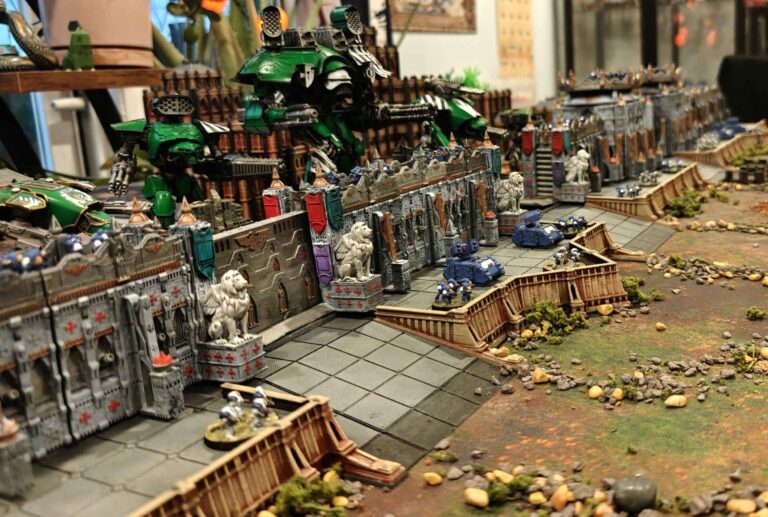
Ian: I mean, overall, it sounds like a success.
Noah: We might change what system we use for epic gaming. We used Legions Imperials this time. Next time, we might try Epic Armageddon.
They have different rule sets, and Epic Armageddon not only has a larger variety in the amount of options available to make forces more unique, but it also plays around with a very interesting leadership mechanic and a morale mechanic, which might lend to more thematic moments as less disciplined troops break and run or fail to carry out their objectives, where the more disciplined Space Marines can just do what they need to do. Something that we lacked in this game was access to a planetary defense force-style unit that could be given to the defenders that are just chaff and can be used to kind of fill out the table. Because when you’re doing a defensive scenario where the attacker is assaulting a position, if the players have even points, that’s heavily in the defender’s favor
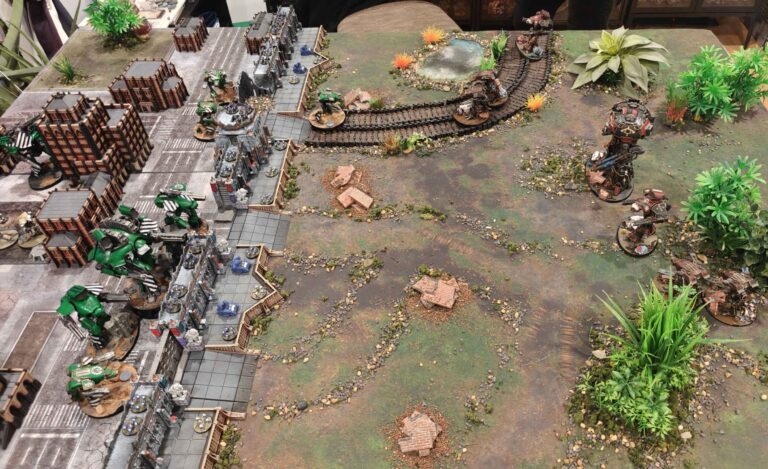
So, allowing a split where, let’s say, 75% of the points total allocated to the defenders is PDF troops, like trash, and then they have like a 25% reserve of either Space Marines or more elite troops to reinforce, will allow for enough stuff to be on the table, and there can still be some interesting decisions. But the scenario we had, because the Ultramarines were holding these strong points, is that you had Space Marines assaulting Space Marines, and the defending Space Marines were in defensive positions. So, the attacking Space Marines, the Sons of Horus and the Iron Warriors, needed a significant numbers advantage to make things work.
Having access to basic troops for the defenders will allow us to put more stuff on the table and make the engagements look more interesting.
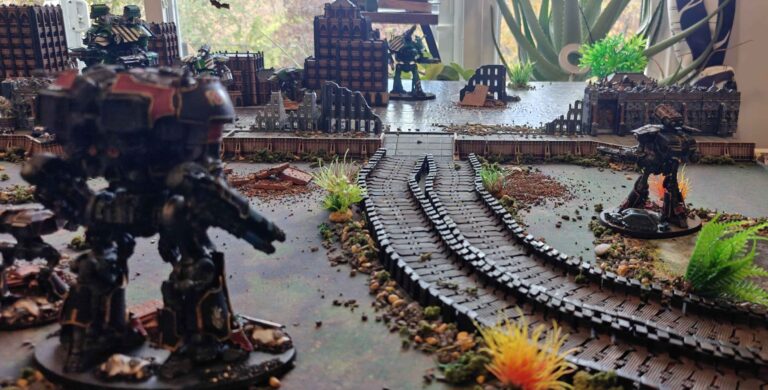
Ian: So even though it could be the same points, but it’s just, within sort of the list building, you can fill out the table with numbers, so make sure that the attacker has an advantage, which is like more elite, more better suited troops.
Noah: That’s right. They can actually form a spear tip to punch through, where that wasn’t really possible, because we didn’t have the variety of forces that would be needed. But as we do this more we’re only ever going to have more painted stuff, so our options will increase every campaign we run. That’s something I would definitely do differently.
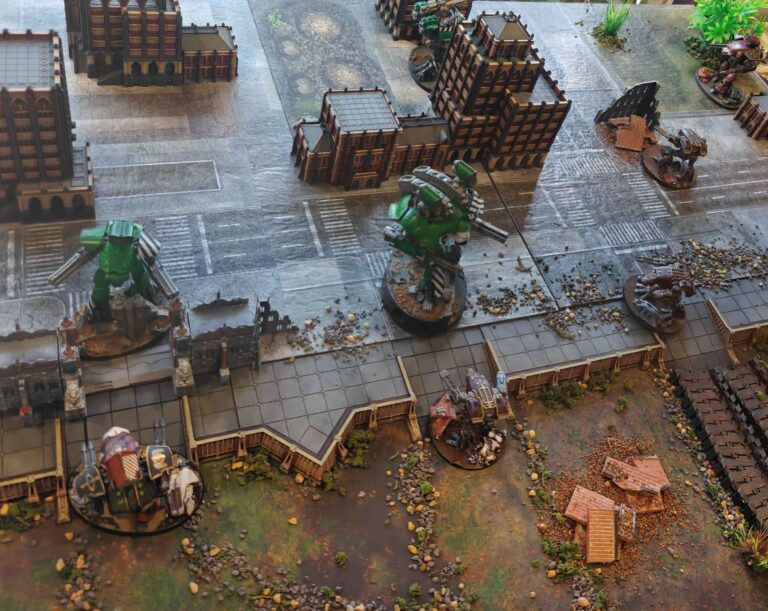
Ian: Just going back a little bit, you mentioned Legion Imperialis not being balanced. I know there was a recent update to the game. Did you guys use those rules? Or do you know if they help with the balancing?
Noah: When it comes to the list building and the overall balance of Legions, we weren’t playing matched play style games. None of our games were evenly pointed, and we weren’t using the full close combat rules, and we weren’t using the full Legion trait rules either. So any changes they did to any of that stuff, I don’t know. Kyle was introducing me to this game system, and the system that we were playing was quite basic, which served to create an interesting game where we could play and it was easy enough for me to learn because the stats were quite simple.
So, maybe? But we weren’t using enough of the rules to know. We were adjusting things on the fly, because I have no interest in any sort of matched play at this scale. It’s great for scenario play, because you can actually create scenarios at a scale that make sense.
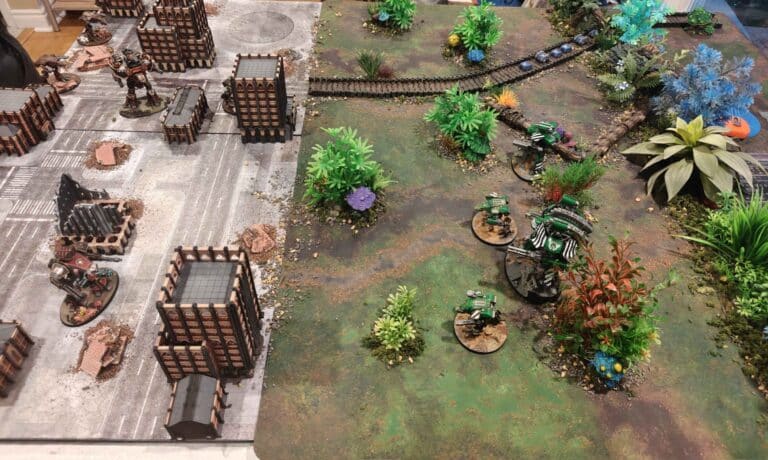
Ian: Yeah, ‘cause you would only be able to create a battle like this with apocalypse-sized armies on a huge apocalypse sized table at 28mm scale.
Noah: Which I have done with Kyle, and it took four days to play one game, and that was awesome. It was a ton of fun, but we were still using simplified 40k rules for that, and after that game, we decided that we can’t do that again. If we want to keep playing these massive scenarios that we really enjoy playing, we need to change the scale, to create games that we can complete in a reasonable amount of time.
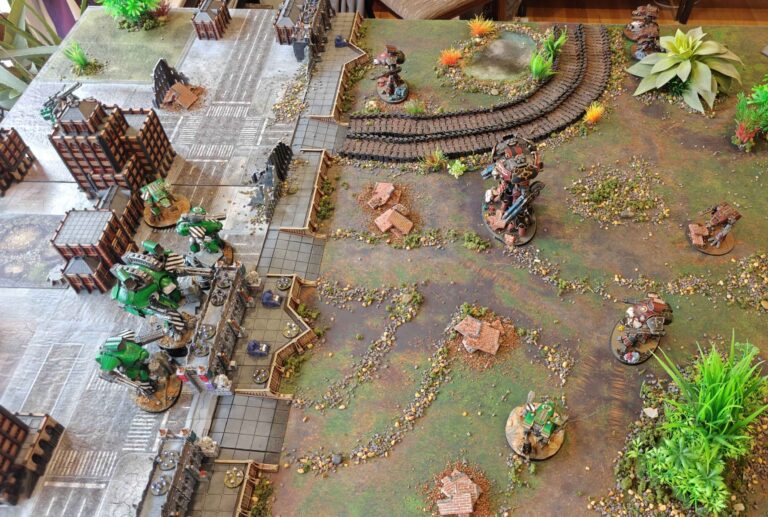
Ian: We’ve talked before about dead games, and Adeptus Titanicus is kind of one of those. It’s kind of on life support right now. You’ve talked about older editions like Epic and Epic Armageddon. What would you say are the advantages of playing a dead game, and why have you been promoting them? Or promoting them to me, at least.
Noah: Balance, as strange as that sounds. Because the game is dead, which means things only change when you want them to change. If you’re playing within a closed community, like I am, we can balance things to our own meta. If something we feel is too strong or needs to be boosted, we can just do that, and we can do that whenever we want, and it doesn’t matter, because it’s not like the rules are going to change, and then our balance patches need to be rebalanced.
If we decide that lascannons need 30 inches of range instead of 22 inches of range, it’s done. We can do that, and we can play that within the setting of our game. It also really helps when working on large-scale projects. Not having to stay compatible with a larger community is quite freeing.
The pace of change within certain living game systems is quite fast, and can be challenging if you’re trying to keep your stuff fully painted. Knowing that the system is set allows me to look at the rules, create the army I want, and then by the time I have that ready on the tabletop and ready to play, it’s going to work. I know that if I create a PDF force that works within the current rules, I can create it to the size that we want for our game, and once it’s built, it’s built, and I don’t need to edit it ever, unless we want to, because the game isn’t going to edit it for me.
That’s my attraction to these dead systems, is I can create something and put it on the shelf, and the next time I want to use it, it’s ready to go. My list is already written, my models are already painted, we can just take it out and put it on the table. I don’t need to relearn how to play, I don’t need to swap things out, it just works.
We balance on the fly, and it’s easier to do when the rules don’t change, where when the rules change, it’s hard to balance yourself, because you’re relying on an external party to do that for you. People want to play with the latest balance patch, where once the game is dead, the latest balance patch is the patch you agree on.
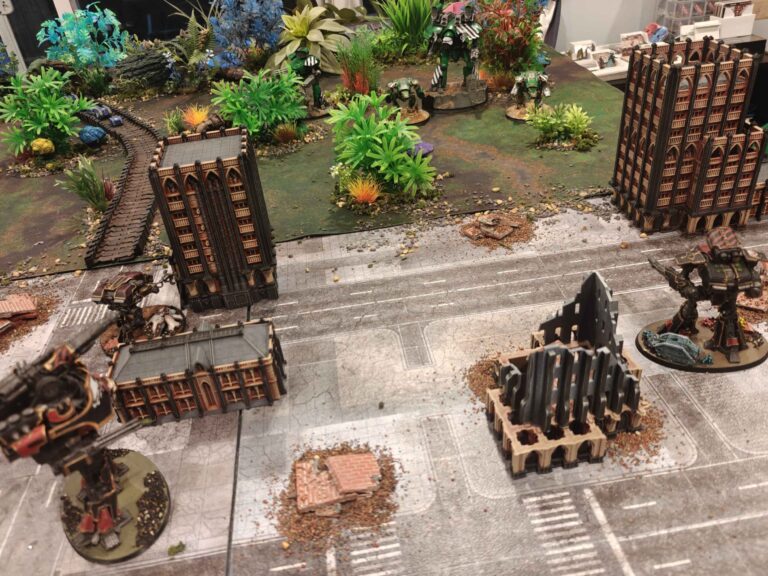
Ian: Now, for your game and your balancing, that’s just you and Kyle, but if you wanted to bring that to a larger community, how do you envision doing that? Or what would you recommend, if you have thought about it?
Noah: Well, I don’t really plan on bringing it to a significantly larger community. I don’t see these games ending up with more than 6 or 8 players total, because that’s all I need, when the community is still within that size, a document on the internet that details your changes, is all you really need. If everyone is on the same page with what you’re trying to achieve, or close enough on the same page of what you’re trying to achieve, then just simple discussion can really resolve a lot of these issues. When the game gets to a certain size, absolutely, that’s more challenging and is not realistic to do. But I have no intention of getting to that scale.
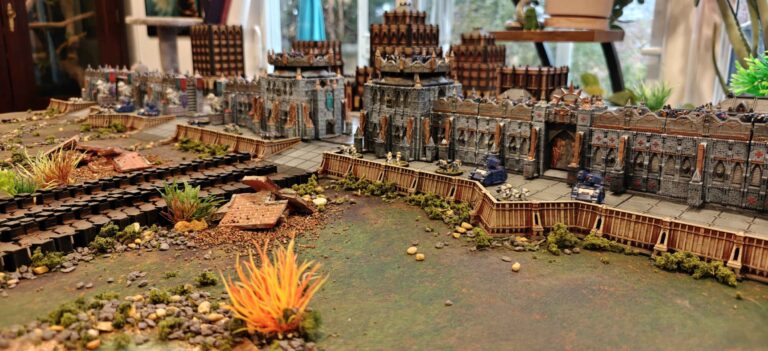
Ian: So you think if it’s staying at a smaller community, like a gaming group of a dozen people or less, you can kind of just keep amending on the fly as need be?
Noah: Exactly. As long as your community is willing to do this, then you’re all good.
And certainly as you get more people, there’s more opinions, but you should be able to largely come to a consensus. If you’re aligned, you probably will be. If you’re playing with people you like playing with, the people who are bringing stuff that’s too strong, know they’re bringing stuff that’s too strong.
Or at least aware that the power level of what they have is powerful. And again, as we balance things on the fly more and more, we need to balance things on the fly less and less, because you fix the issues that you have. Which other communities might not have those issues, because they play slightly differently.
If someone’s consistently problematic however that’s a discussion to have with that player. If that discussion doesn’t end positively they can take a hike. As an organizer you don’t owe the players anything. If they can’t find another play group for the dead game that’s their problem and a meaningful consequence.
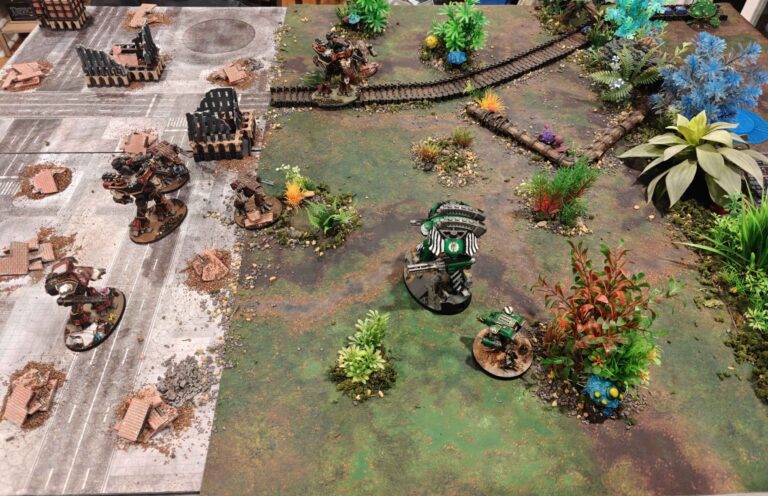
Ian: Okay, so this was a pretty big project, just based on our conversations and the pictures you sent me. You mentioned possibly doing the last two games for the Battle of Molech.
Other than that, what are your plans for the next leg of the campaign, or even the next big project you want to do?
Noah: Yeah, so for right now, I need to focus on some things outside of the hobby. But then for our next gaming event, we are going to go to Isstvan III, and play that out.
There are a number of major events during the Heresy: Isstvan III, Isstvan V, Molech, there’s Tallarn, Beta Garmon, the Solar War, the Siege of Terra, and others. Hopefully we’ll play them in order, but not necessarily. We started with Molech, which we did because I already had jungle terrain. But we’re going to go to Isstvan III next, and our intention is that each one of us will do a terrain project of some kind for that environment, and also work on providing additional forces for that environment.
So Kyle already has a Sons of Horus and an Emperor’s Children collection, and he loves the World Eaters, so he’s got a massive World Eaters collection. But he doesn’t have any Death Guard, so he’s going to work on creating a sizable force of Death Guard, and I’m going to work on creating a force of Emperor’s Children and Sons of Horus.
So when we do Isstvan III, which is when the Traitor Legions purge themselves, we have enough of each Traitor Legion to fight each other. And figuring out how to make that not super confusing is something else we’re going to have to figure out, as we have models painted in the same scheme on all the sides of the table, that are tiny. We have to figure that out still, and then I’m going to work on a set of ruined terrain for this environment.
It’s still being decided, but I think Kyle’s going to work on a set of trench networks, which we’ll be able to add on with our existing terrain to create these environments. We’re probably going to have to get a different battle mat, because I don’t have an appropriate map right now for the wasteland that Isstvan III becomes. Oh, and PDF.
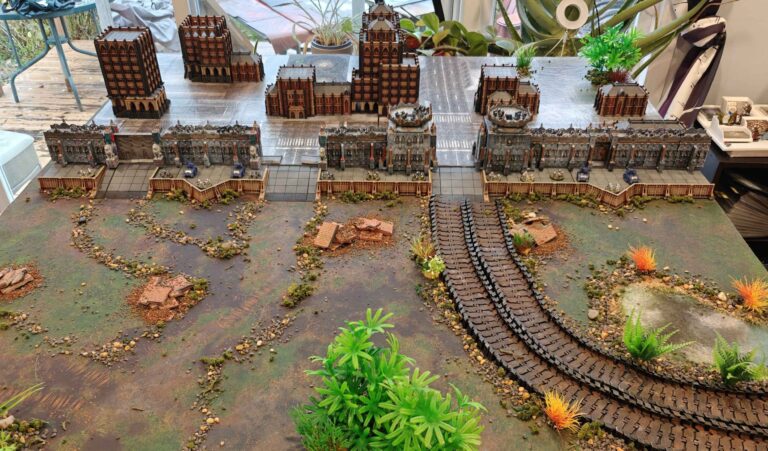
Ian: Okay, awesome. That’s about it for my questions. Is there anything you want to talk about that we didn’t touch on, or just any final thoughts you want to add?
Noah: Yeah, we talked about the hobby aspect of this. Even though this was a gaming event, these gaming events are really milestones and goalposts for my hobbying. It gives me something to work toward, and the overall outcome of these events is really just to hang out with my friend and play games.
But it gives me something to work toward and something to hobby toward. And I managed to get my hobby goals done ahead of this event, but my opponent certainly came up a little short. So we ended up spending the first day and a half of his visit working on getting that stuff to tabletop, which caused us to have to cut our game cycle a little short and just understanding that different people are able to commit different amounts of time and different amounts of resources to this thing.
Moving forward, we need to communicate better between us that, hey, if we’re not going to meet our hobby goals for whatever reason, either we should reschedule or we need to adjust our expectations to work out better with what we can get ready.
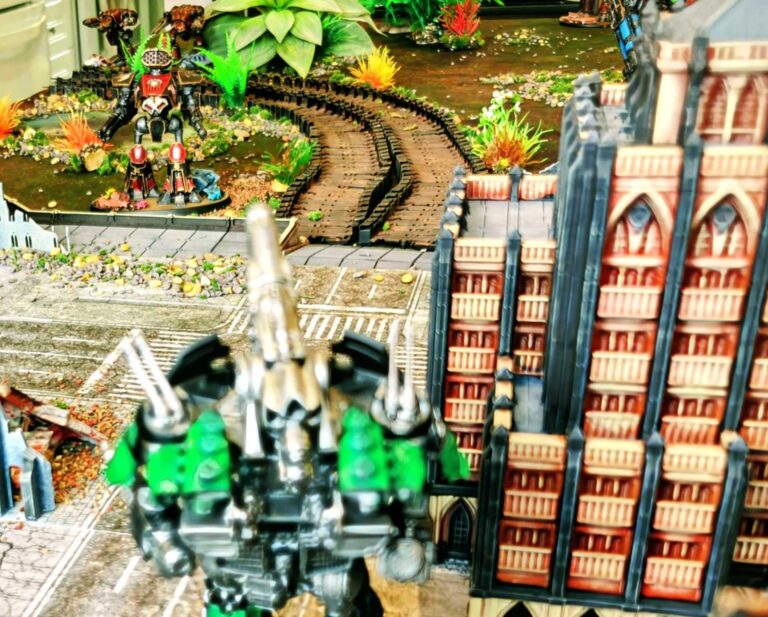
Ian: Yeah. I think that’s a very fair and mature way to approach it as well.
Noah: Just open communication. A lot of times, real life gets in the way.
Ian: As you said, the more you build up on these milestone events, the more resources you have in terms of painted models, painted terrain, it just gets easier.
Noah: It will get easier. And our hope is to end at the Siege of Terra with a big Siege of Terra campaign.
As we work on these different terrain projects, they’re certainly designed for that one specific event. But the intention is to create a collection of terrain that will work together as a whole unit so that we can create Terra with the density and the height that Terra should have. So when we go to Isstvan V and create the Dropsite Massacre, that happened in the Urgal Depression, which is a depression surrounded by cliffs.
So I need to work on a series of cliffs. I will make sure that series of cliffs can interact with our wall systems and future wall systems that we want to make so that we can create the walls that are built on top of the mountains of the Himalayas when we get to Terra. So making and planning these terrain projects with the intention of working for this one event but also creating a chunk of Terra for when we go there means when we go to Terra that we can create something truly deserving of the heart of the Imperium, which if we just try to tackle that in one chunk would be an overwhelming task.
These are little milestones that allow us to build towards the final big goal, which we might not get to for many years. And back to dead systems, with it being a dead system, if we get distracted and go do another thing for a little bit, it can just sit in boxes and it’s ready and nothing’s changed for when we want to get back to it.
That’s also really nice to know that it can just be packed up and unpacked and we can just continue where we left off without the barrier of researching and figuring out what’s changed and what we need to update and if we need to change our bases or whatever else happens when maybe you put a game down for a couple of years.
Ian: That’s awesome.
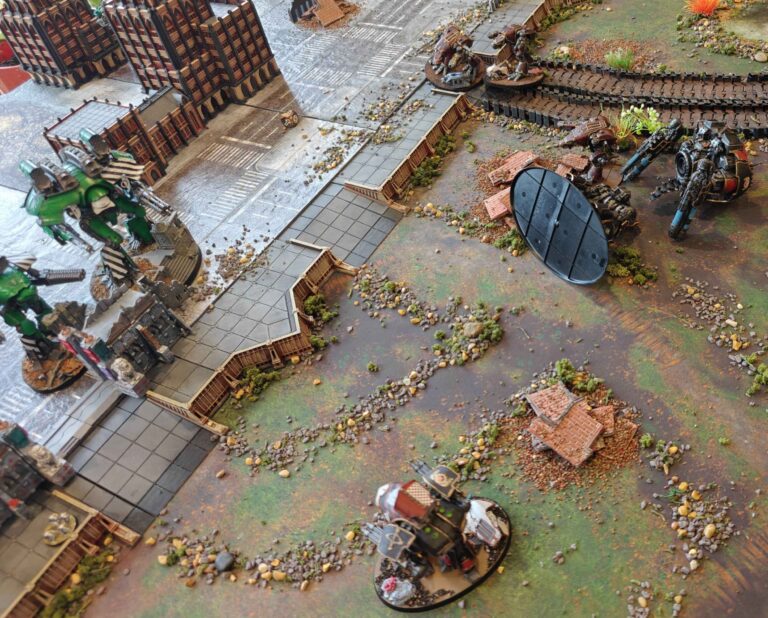
Thanks again Noah! Can’t wait to see the pictures of the next warzone that you and Kyle create!
Models by Noah and Kyle. Photos by Noah.