Proxies, Conversions, & Counts As
By Ian
If you read our year end round up last month, you would have seen some pretty sweet pics of (amongst many, many other things) a wicked game of 8mm carnage that Noah played. He and I had a long conversation about it, which we recorded for an interview; so long, in fact, that I’m still editing it.
Must be something here I can post… [roots around in the closet, pauses, and blows the dust off a manuscript]
Ah! Here we go!
Hurt feelings
I wrote the first draft of this piece right before Horus Heresy 3rd Edition dropped. You may remember a time of rules leaking, feelings hurting, and knees jerking as a ton of units and wargear options were seemingly removed from the game. GW was quick to fix the issue by releasing a large Legends document that resolved most of the issues, and, from what I hear, 3rd Edition is pretty darn good.
Unfortunately, the issues with Legend units in 40k are live and well, and one of the common responses is to just Proxy your Legends unit as something else. Whether or not players choose to do that, how their opponents feel about it, or whether event organizers will allow that obviously comes down to each individual, and this is as good a time as any to dive in and talk about Proxying models in general.
WYSIWYG, Conversions, Counts As, oh my!
Models that represent the correct rules and equipment are commonly referred to as “what you see is what you get” or “WYSIWYG” (pronounced “wiz-ee-wig”): this is essentially the opposite of Proxying; though a few of the below examples blur the lines between WYSIWYG and Proxies.
There are a couple of layers to Proxying models. At its core, Proxying is fielding a model as something different than what it normally represents or is sold as. For example, if I put my Space Marine Intercessors on the table and tell my opponent I’m running them as Terminators, this is Proxying: the Intercessors have their own unit entry/datasheet and are sold specifically as Intercessors and the Terminators have their own box and unit entry. Proxying could be wargear related – instead of Terminators, I could say the Intercessors are representing Hellblasters, which have the same type of armour but a different gun. This could get even more specific: I’m counting my Space Marine Captain modelled with a sword as armed with a power fist instead. It’s the same unit entry, but different options than those it’s modelled with. All of these are a type of Proxying.
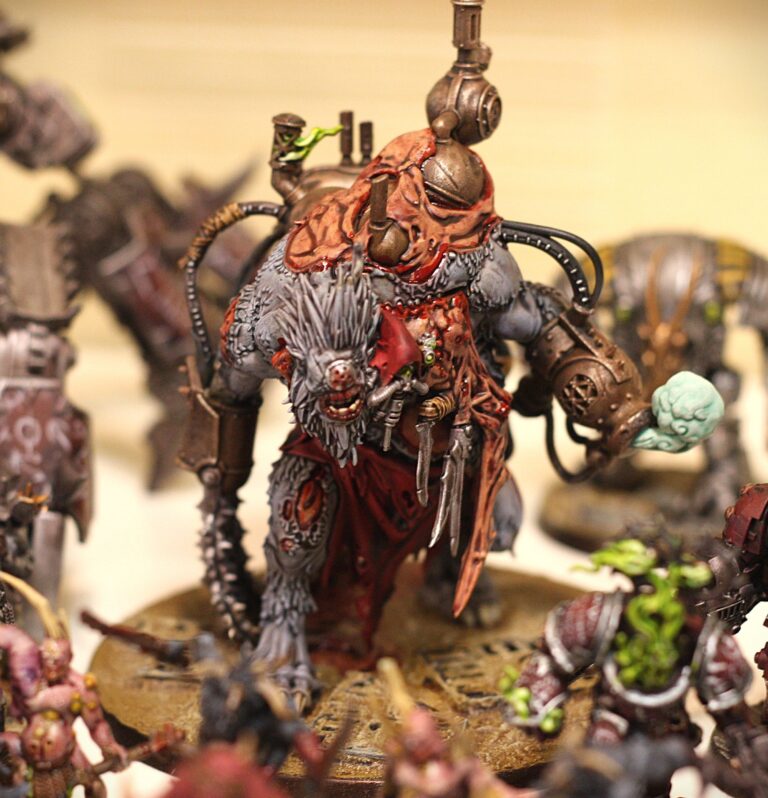
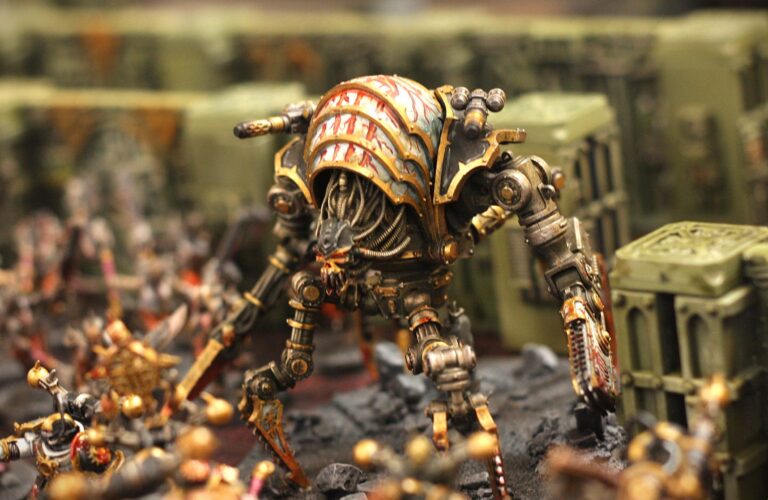
A Converted model is one that has been changed, either pieces from multiple kits combined to form it, or a few weapons or parts switched out. Conversions are often created with care to ensure that they match the unit entries and options so that they are easily recognizable by players as what they are meant to represent, or they could be converted to look cooler. For example, my Chaos Wardog Huntsmen have their melta lances converted to be harpoons (and there are no rules for harpoon-toting Wardogs).
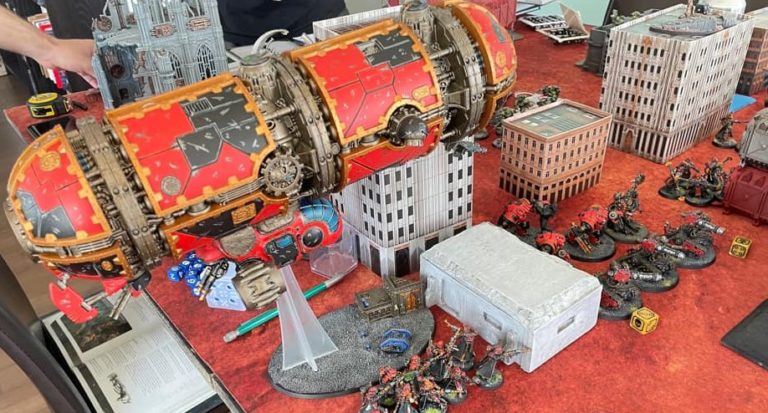
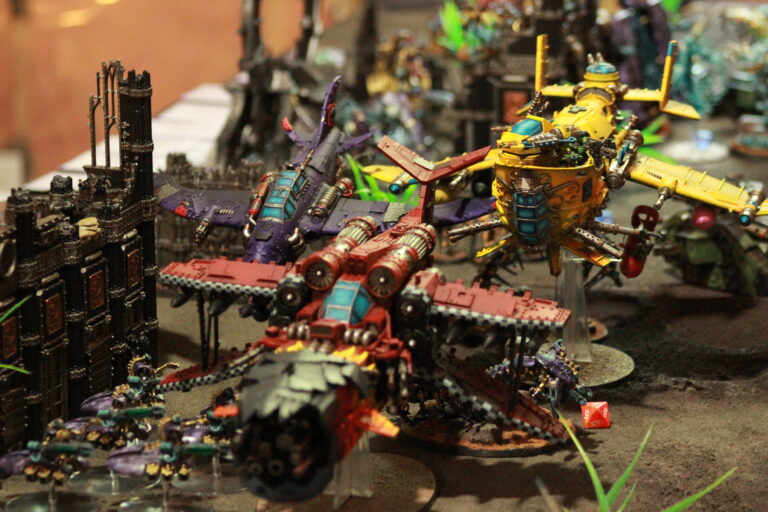
“Scratch Builds” are models built from the ground up without a recognizable base model. Sometimes these are based on non-GW models, or created with other materials such as plasticard. Noah, whose models have been featured on this blog, has a massive collection of Scratch Built Ork vehicles, including various buggies and an entire airforce. Another example is Jeff’s Mechanicus blimp. These kind of blur the line between Scratch Builds and Conversions, as some of the pieces are quite recognizable, but they are so substantially changed I’d classify them as Scratch Builds.
Counts As models are proxying models from another game system or company. The main difference between Counts As and Proxies are they don’t exist in the game you’re playing, so there’s no chance a player would mistake it for something else. I use non-GW miniatures for my Chaos Spawn (I think they’re D&D minis, but I bought them a while ago, so don’t quote me on that). Another example is I use 30k Justarean Terminators as Chaos Terminators in my Black Legion.
Why do people get so bent out of shape over Proxying?
When I was a kid, I had a Simpsons chess set, with all the pieces represented by various characters from the show: Homer was the King, Marge the Queen and so forth. By our above definitions, this would be a Proxy or Counts As, and you can find lots of chess sets like this from different popular IPs. Why would it be okay in chess and not 40k?
In chess, there are six distinct pieces or units: in 40k there are hundreds, and many of them have specific and varied wargear options. Most games of 40k have a show-and-tell phase at the start of the game where you go over your army with your opponent and you would explain any Proxies, Conversions, Scratch Builds, and Counts As so they would know what’s in your army and not get caught out by any surprises. But the more of these there are, the more your opponent needs to remember when making decisions during the game.
Of course, if you’ve taken the time and care to ensure your models read easily as what they are meant to represent (have a similar size, correct loadouts, etc.), then this shouldn’t cause an issue for your opponent. But if these are nonsensical or random, it could put your opponent at quite a serious disadvantage: hence why a lot of events ban Proxies. There’s also some extreme cases you’ll see on social media about people bringing action figures or stuffed animals to represent units.
Extreme cases like that aside, asking your opponent to remember what a unit actually represents is forcing them out of the game to do this, and can be immersion breaking. Of course, frequent readers of this blog will know we’re all about that immersion and breaking it is something to be avoided as much as possible. Having the right units with the right loadouts helps build that immersion up rather than bringing it down.
Another good example of why Proxying is problematic happened during an Apocalypse game I ran a few years back. A Dark Angels player teleported a few dozen standard Terminators into the enemy lines and the opposing team opened fire on them in their turn. In the hectic play of an Apocalypse game, it’s common for players to roll out a number of attacks and then let the recipient (who may be resolving an attack on the other side of the room) know how many saves they need to make. When the Dark Angels player came back, he informed his opponent that those regular Terminators he had placed on the board were in fact Deathwing Knights: instead of a 5+ invulnerable save, they had a 3+ invulnerable save, meaning all the high AP weapons that were just unleashed upon them were for nought.
Since then, I’ve been rather firm about not allowing Proxies at events, especially Apocalypse games.
But…
Okay, obviously there are plenty of exceptions when Proxying is acceptable, or at least more acceptable.
The first is a friendly game with a regular opponent, where you’re trying out something before committing to buying it: “I’m running these Intercessors as Hellblasters and I’m probably going to buy Hellblasters if they’re good in this game”. Your friend will probably be fine with this. If it’s the fifth game you’ve said this, they might be less than fine with it. At most events, though, I doubt this would fly.
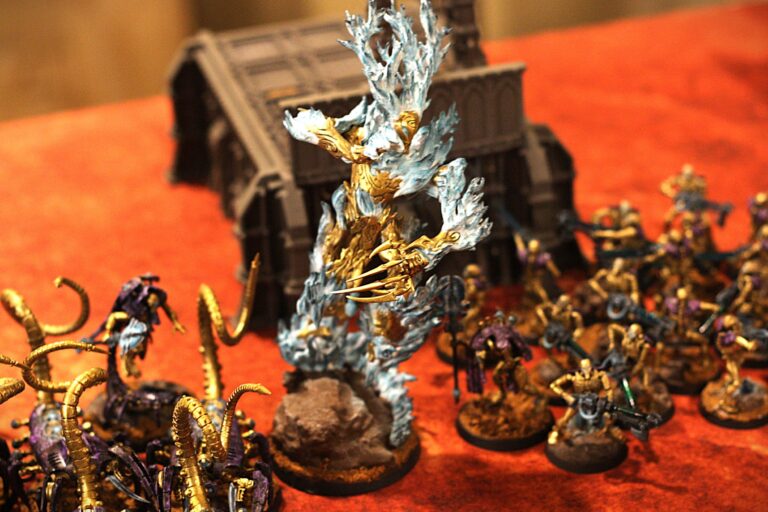
Sometimes a Conversion, Scratch Build, or Counts As doesn’t easily read as what you’re representing, but it looks so cool and you spent so much time lovingly building and painting it that you just need to put it on the table and pretty please can we count this as a Dreadnought? Often, people will apply the Rule of Cool and accept these, and those people might include event organizers. If it’s just one unit in your army that is tough to read, it’s not that difficult to remember that big gribbly monstrosity is a Dreadnought: if there are five big gribblies and they all represent different units, however, that’s asking a lot more (five times more, in fact) and you might want to consider running them all as the same datasheet.
At the ICI V, we ended up allowing specific Proxies of certain Legends units as non-Legends alternatives: specifically, there were a few Contemptor Dreadnoughts ran as Chaos Hellbrutes, and a Khorne Blood Slaughterer as a World Eaters Maulerfiend (there may have been a few more, but I don’t recall). We allowed this for two main reasons: Legends units tend to be mediocre and over-costed and asking a player to field their cool model with worse rules than their opponents felt bad. Additionally, Legends units are not in the 40k App, making referencing their rules inconvenient. In these cases, opponents would still be able to read the model as a rough equivalent: a Maulerfiend might not have the same stats as a Blood Slaughterer, but it’s still a big scary vehicle that will rip you up in close combat.
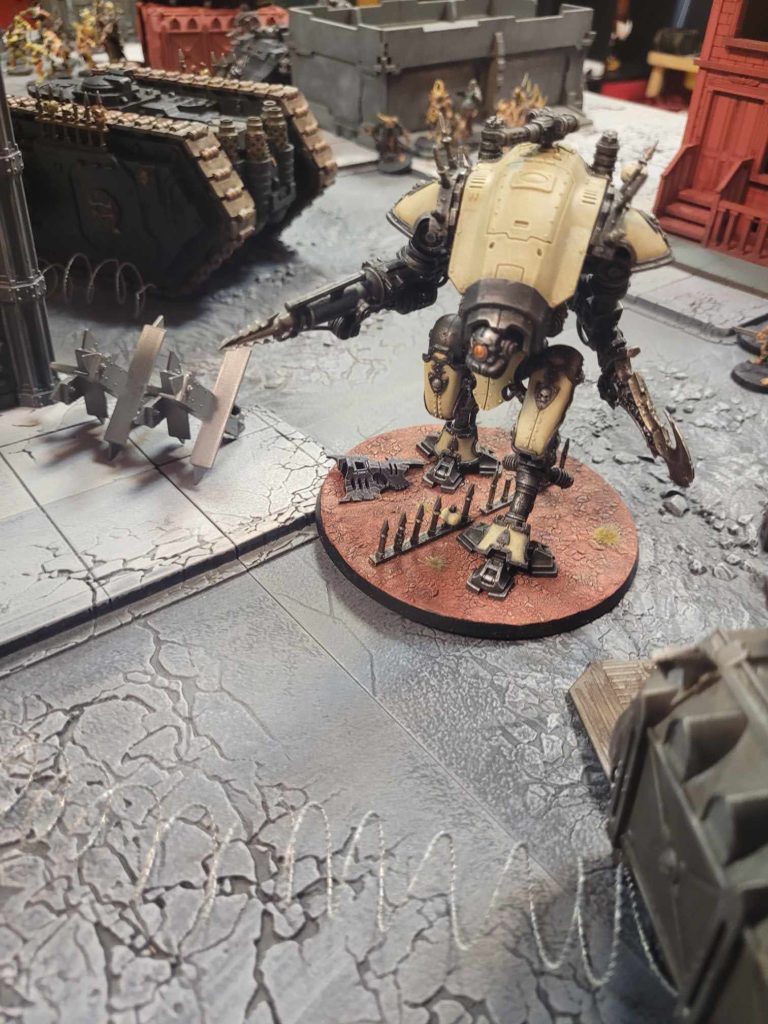
There’s also a case to be made for Proxying special characters. Newer 40k codicies have a trend of eliminating generic characters options from ranges: for example, there is no World Eaters Lord on foot, only Kharn, there is no Space Wolves Wolf Lord in Terminator Armour, only Logan Grimnar. Allowing a player to run Kharn as their bespoke World Eaters character is something you may wish to be flexible on. Though, if there is a generic option available, that’s a different story.
Finally, you may want to Proxy units because they or their loadout no longer exists. Even after the Legends document dropped, a number of units’ loadouts were still removed from the Horus Heresy. With my (relatively) small collection of Heresy miniatures, I got off rather lightly in the change to 3rd edition: at the time of writing, only four of my Cataphractii Terminators equipped with dragonscale shields and power fists are completely illegal (everything else can find a place). My plan is to run these four as a Cataphractii Command Squad, and just count them as being equipped with default ranged weapons: therefore, my opponent won’t be surprised by any sneaky meltas hidden behind shields. Obviously players can lose large chunks of their armies to edition change, and allowing them to field their toy soldiers with some Proxying is a nice courtesy that you should think about extending to your opponents.
Where I stand
There’s this great callout in the margins of the Trench Crusade rules regarding WYSIWYG:
Model Accuracy
When it comes to making sure the models in your game match their stated size, actual equipment, weapons and armour, we recommend the following maxim:
“Be strict with yourself but lenient with others”.
I think this is a great guide to proxying and WYSIWYG. Personally, I really dislike proxying and try to avoid it at all costs with myself, but I also have plenty of older models in my collection whose loadouts are no longer valid (or have moved to Legends with a hefty premium in points). I don’t hold my opponents to the same high standard, but for events I tend to require WYSIWYG unless the Proxy is approved beforehand.
For the situation of loadouts becoming invalidated, having a conversation with an opponent about house ruling a wargear item before the game is also an alternative to Proxying. For Heresy, there are plenty of equipment lists which you and your gaming group could agree that certain units gain access to. For 40k, there are often comparisons in other units that could be ported to new datasheets: for example, if I want my Space Marine Captain to have a Thunder Hammer, I can look at the Intercessor Sergeant options. The Hammer is the same as a Power Fist (which is an option for my Captain as well), but at -1 to Hit and with Devastating Wounds. That’s easy enough to port over to a Captain. This won’t fly at a large event, but for a small group or one off friendly game, it’s easy to allow.
Special characters proxying is something I really struggle with. On the one hand you have codicies like World Eaters and Space Wolves where there are significant gaps in the generic character roster (I mentioned above how Kharn is the only World Eaters lord on foot): in these situations, being lenient as an opponent or event organizer makes sense. If someone converts a generic Space Wolf Rune Priest and Proxies it as Njal Stormcaller, that’s fine (though, to be honest, I’m leaning more to house ruling these instances and allowing keywords to be swapped around: i.e. giving a Librarian the SPACE WOLVES keyword).
A player Proxying a special character because it’s cooler or better than the generic one is a tougher pill to swallow. Obviously, we all want our bespoke characters to standout on the battlefield, and the way 10th edition datasheets work really limits how you can build a cool character: counting your converted Captain as Cato Sicarius. This I’m a lot less lenient on. I wrote some Crusade house rules which would help create a more unique character for one-off games, and would suggest taking a look at those. Though, as I mention in the article, they aren’t perfect and there may be a better option…
Out with the old, in with the new
This article drops the weekend The Maelstrom: Lair of the Tyrant goes live for preorder, which contains the “Crucible of Champions” rules for making unique characters in 40k. We’re not a big enough blog to get fancy books from GW for preview, but a lot of reviews and sneak peaks have gone live and I have some thoughts.
First, narrative materials are always great to see and here at Wrong Side of the Maelstrom we always want GW to publish more of them. That being said, my knee jerk reaction for these types of rules is always looking at what’s missing. In one of GW’s previews, they even say that the Chaos Space Marines don’t have rules for making a cultist/mortal champion, which seems like a great big hole in the rules.
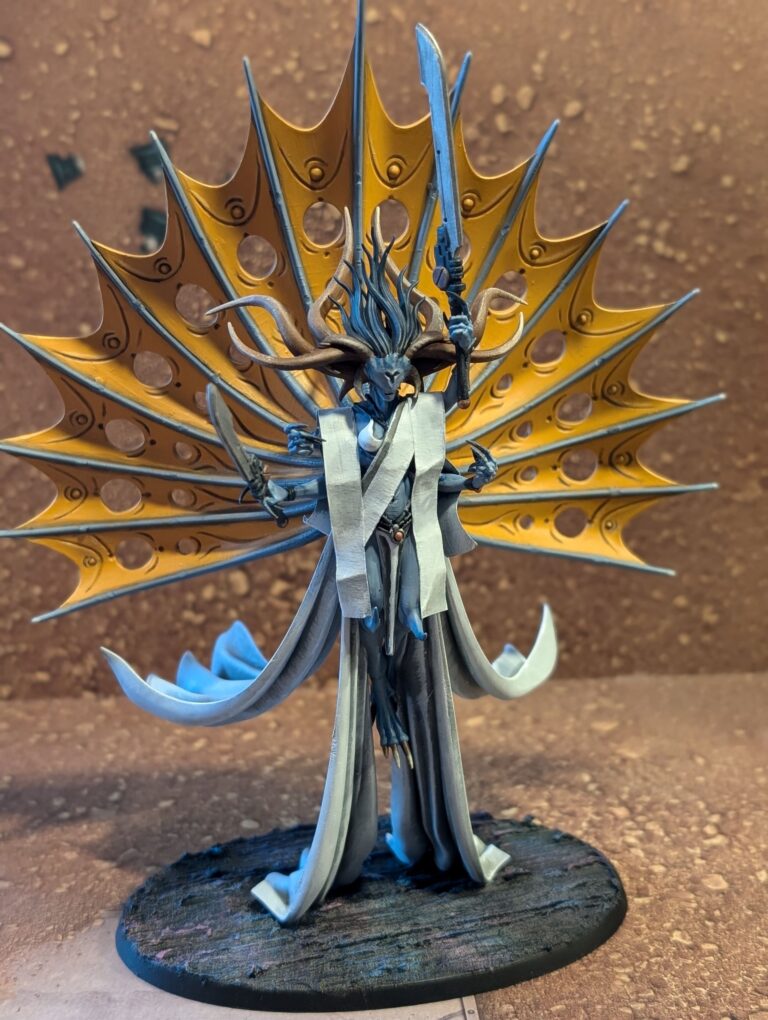
The way I’m leaning towards house ruling these for my own purposes is to just take the guard rails off. With the Crucible of Champions, we have stats and we have points and for a friendly, narrative event I think that’s enough: things like faction keywords and options can be opened up to everyone. This would allow, for example, a Chaos player to use an Astra Militarum character as the basis for their mortal champion: just switch the keywords and the units it can join, and take upgrades from the Chaos list. Want to make a psychic dreadnought? Give it Eldar upgrades. Want to make a custom C’tan? Use daemon prince stats.
Obviously, use common sense (your Chaos Lord can’t use a dreadnought power fist), but I bet this would go a long way to shoring up the holes in the Crucible.
Gut instinct
There can be a lot of abuse with Proxying and the like: sometimes people will go the extra distance to convert up a unit because it’s the competitive choice, not because it’s cool. Not often, but sometimes. Obviously, in a tournament setting, that’s one thing, but that ain’t what this blog is about.
If you’re running a narrative event, I think you have to go with your gut on this: is someone using a Proxy (or no-guard-rails Crucible rules) to do something cool or game-breaking. For me, I’m at the point where I will likely be outright banning special characters at my events and using some sort of Crucible or house rules for unique characters (sorry, Marneus Calgar doesn’t show up in the Pilgrim Sector very often), but your inclination may be different.
Where do you stand on Proxying? Why not let us know at contactus@wrongsideofthemaelstrom.com.