Multiplayer Missions – An Overview
By Ian
40k is a big game. It takes up a lot of space, it’s time consuming to prep, and it takes a long time to play. A 2,000 point game will take three to four hours (and if you want to argue that tournament games are played at two and a half hours, we can talk about how many tournament games don’t actually finish), which is many times longer than your average board game.
So why not add in a few extra players and crank up the complexity?
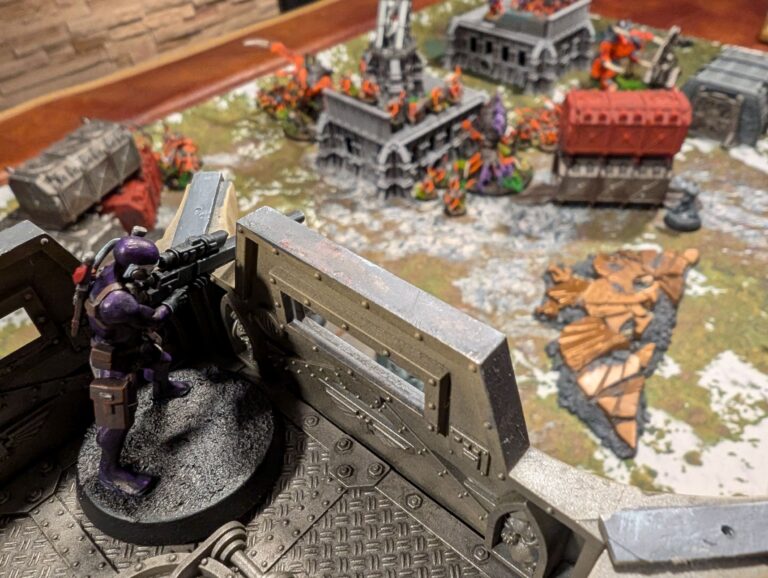
Getting the gang together
I want to distinguish, for this article, team games and multiplayer games. A team game is multiple players split between two teams, where a multiplayer game is more than two players playing as individuals (or a game with three or more teams).
Playing a multiplayer game will up the complexity of the game by a significant factor: there’ll be weird rules interactions that you’ll need to figure out on the fly (see below for some specific examples) and with a third and/or fourth player turn, things will take much longer than normal.
But if you have a third player hanging around and don’t want someone sitting out, multiplayer games are great. Also, if you have limited space and can only set up one table, doing a four player game rather than two two-player games may be ideal. They can also be a good teaching game where there are more people around the table to remind a newer player of rules (or remind a veteran Space Marine player of Oath of Moment—not me though, I’ve never forgotten a critical rule like that). When I’m planning an event, I usually throw a three-player scenario in the mission pack just in case there’s an odd number of players.
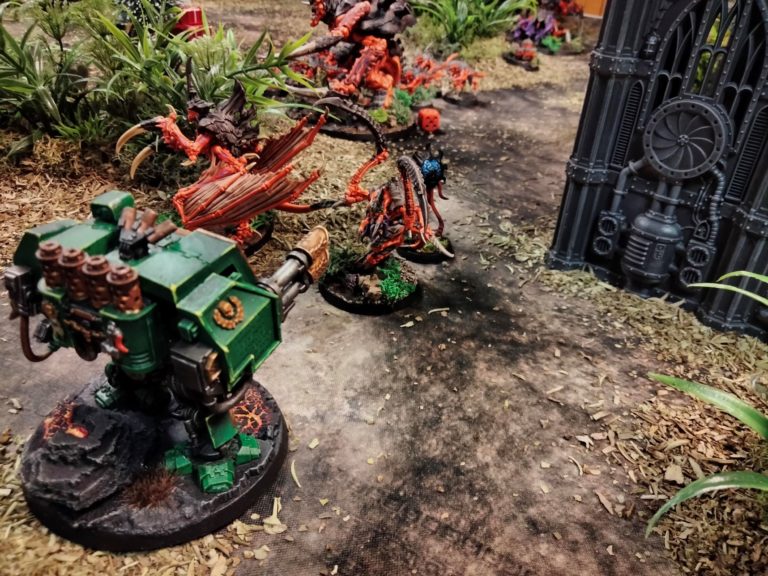
Prepping for the big game
First thing is time: this game is gonna take longer than normal, not just the extra player turn(s), but just more people around the table chatting. Set aside a lot of time, preferably a whole afternoon or day. Secondly, use a large table. We usually play on a full 6’ x 4’, rather than the smaller 60” x 44” (though, to be fair, I usually round this to 5’ x 4’ for most of my normal 40k games). If you’re playing at someone’s home, have food planned out and all the usual trappings for hosting in your home, but you may especially want something easy to prep and eat on the go rather than sitting down and breaking to eat.
I’d say you can also review everyone’s army rules and house rule stuff ahead of time, but, honestly, this is a casual setting usually played amongst friends, not a tournament with strangers. If you can’t amicably agree on rulings with your friends, you’ve got bigger problems. Or, if you can’t quickly come to an agreement, just roll for it.
What you should do though is figure out the scenario ahead of time and decide on any ancillary rules for multiplayer. This includes army size: I would strongly suggest keeping this small–probably in the 1,000 point range–to keep the game moving. If you’re going over 1,500 points per player, you may want to think about playing over a weekend rather than just a day.
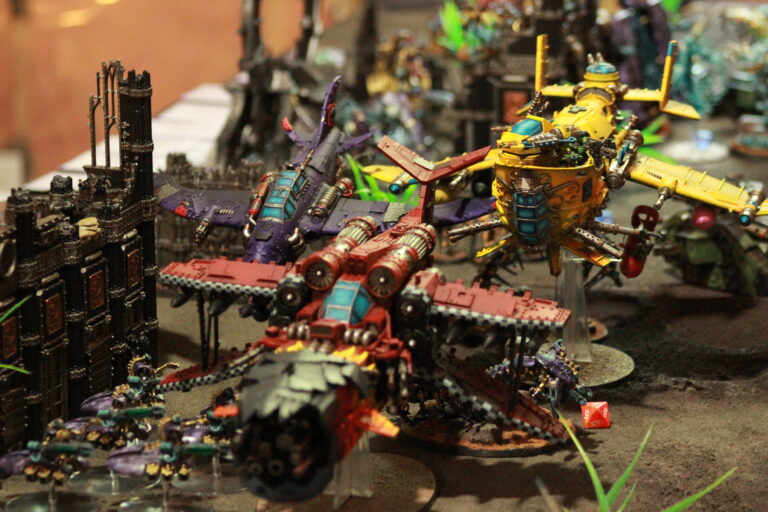
Missions
In 9th edition, Games Workshop released a fantastic narrative supplement titled Catastrophe containing 21 multiplayer scenarios for games ranging from 500 to 3,000 points, each with deployment maps for three or four players. If you plan on playing a lot of multiplayer games and can find a copy, I highly recommend it.
We’ve tried most of the incursion missions, and Twilight Assault and Buried Treasure are two of my favourites (see below regarding my house rules to the latter), though that’s not to say the others are bad. A lot of these missions use 9th edition action rules: the mission will specify when an action begins and ends, and how many units can attempt it. Keep in mind, in 9th edition, a unit cannot perform an action if it advanced or fell back, and the action fails if the unit shoots or charges (though if it fights in close combat–say if it was charged while doing the action–this does not interrupt the action). We also house-ruled that OC 0 units cannot perform actions.
If you don’t know what mission to play, the classic multiplayer mission is Carnage. This has been republished a number of times, but the first time I encountered it was in a White Dwarf battle report in 3rd edition. The mission is simple: players deploy in corners 24” from each other and one objective is placed in the centre of the table. Whoever controls the objective at the end of the game wins.
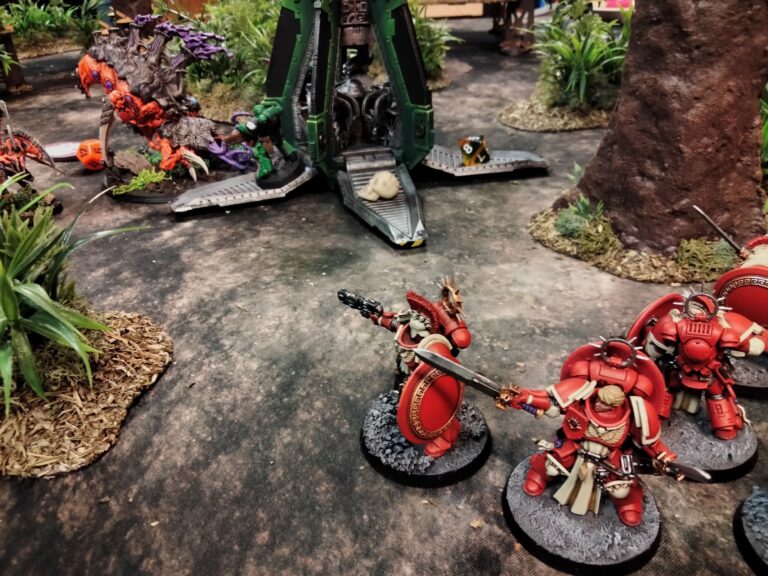
House Rules
Catastrophe has a number of house rules to deal with multiple players in a two player game, some of which my group likes and others we ignore or further house rules.
The first is turn order. There’s a bidding mechanic that doesn’t really work in 10th edition: simply rolling off to determine turn order works fine. Keep in mind that turn order will affect who activates units in the Fight Phase and other rules (i.e. the player who activates first is the player after the active player, then the next, until it comes back to the active player). In case there’s any confusion, turn order is set for the whole game, you don’t reshuffle every Battle Round. We did try this for one game and it was a lot.
There’s an underdog system which can be great for when a player is really behind, but we’ve played without it and been fine. Crusade mechanics are also plentiful in this supplement if you wanted to do a whole multiplayer crusade, but I’ve never used them so can’t really speak to it.
In the Fight Phase, Catastrophe has every unit in engagement range being eligible to be activated each Player Turn. This can make assault units very powerful, and we’ve house rules this to only units involved in combats involving the active player may be selected to fight in the Fight Phase: i.e. if it’s Amy’s turn and there’s a combat involving Jerry’s Intercessors and Mohammad’s Genestealers but none of Amy’s units are in engagement range of the Intercessors nor the Genestealers, the Intercessors and Genestealers don’t activate that turn.
There’s no rules for shooting into combat in Catastrophe, but we’ve occasionally house ruled this to allow a unit to fire into a combat that only involves enemy units, randomising which unit is hit after the hit roll. This can give quite a boon to shooty armies, but also makes narrative sense: there’s no reason an Astartes would hold her fire when Necrons and Tyranids are brawling.
Many of the missions in Catastrophe allow a player to score more than 100 points in a game: we’ve either ignored the 100 points restriction or adjusted the victory points so that no player would top out at 100 points (in one case, we would’ve had a three way tie otherwise).
For CP, we’ve left it that you gain one at the start of every player turn: who doesn’t love extra CP! You could also use Crowns, which could give you a similar number of CP. CP can also be paid to other players at any time as a bribe for an alliance or information.
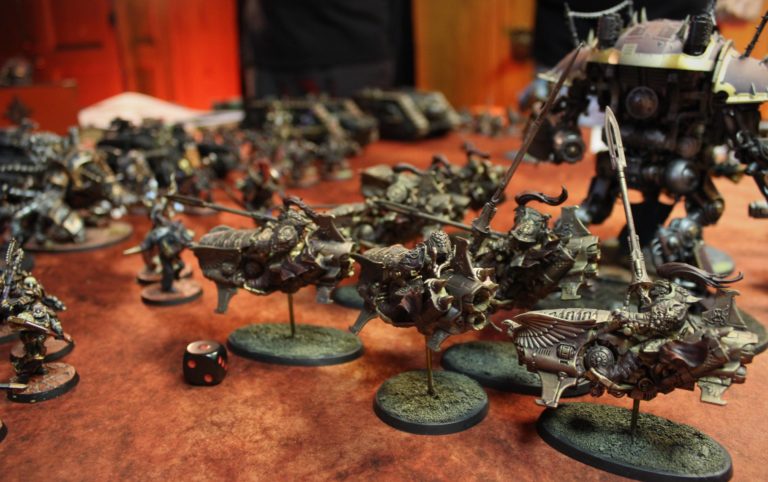
As mentioned above, any number of specific army or unit rules will need to be house ruled. Two examples from a recent game are the Tyranids’ Shadow in the Warp and the Necron detachment Hypercrypt Legion ability Hyperphasing. With Shadow in the Warp, two of the affected players’ units would have recovered from Battleshock at the start of their turns, where unleashing the Shadow would only have negligible effect. I believe we rolled to see if Battleshock would not “heal” until the subsequent turn and the Shadow persisted for the entire Battle Round. In hindsight, I’m glad it did, as it had a much larger effect and was battlefield wide rather than essentially just targeting one player (which, again, was more narrative).
Hyperphasing states that the Necron player can pull units into Strategic Reserves at the end of their opponent’s turn: in a four player game, can the Necron player then do this three times a Battle Round? We ruled he could only do this at the end of the Player Turn preceding his, which kept the ability in check and more manageable (and he usually only removed a single unit, so I don’t think it would’ve changed much).
Finally, for the mission Buried Treasure, one of six numbered objectives is the treasure. In the mission as written, you roll a D6 and cover it with a cup without seeing the number: this is the secret treasure objective, which, at the end of the game, is worth a boatload of points. Then, after performing an action on any objective, you can take a peek under the cup and even sell this info to other players for CP. Problem is, after a turn or two every player has looked under the cup, making the mechanic almost useless.
We house ruled this to use six numbered tokens in an empty dice bag. I painted numbers one through six on one side of some old bases, randomised them face down and painted red on one of the six tokens (without looking at the numbers) then dumped them in an empty dice bag. Whenever a player performed the action, they could pull a token from the bag, look at it without showing other players, and then return it to the bag. This info could also be sold to other players.
This worked much, much better, creating huge tension at the end of the game where units were on every objective, but only one player (secretly) knew which was the real objective. I highly recommend using this house rule for the mission.
I’ll just note some players might baulk at the amount of work to prep those tokens: it might sound like a lot, but took very little time. But even if it did, putting in a bit of effort can make a massive difference in the quality of your games, so don’t be afraid it won’t pay off, or that a new mechanic won’t work right. Even if it doesn’t work out, it’s a learning experience and you’ll know for next time.
Fun with friends
Some of this post may make multiplayer games sound intimidating, but they are a great way to include everyone in a game and making sure no one is sitting out. One final thought I’ll share is that in these games, probably more than most, you should try to be cognisant of other players’ enjoyment. If one player is losing badly, you can focus on another opponent, or try and spread out your attacks evenly amongst the armies so everyone is in the game for as long as possible. Multiplayer games are wild and wacky, and you should bring that attitude to the table.
If you have any tips or stories about multiplayer games, drop us a line at contactus@wrongsideofthemaelstrom.com