40k Apocalypse House Rules for 10th Edition
By Ian
Bringing out the big guns
There are a few crown jewels of 40k. Completing a fully painted army, placing in a tournament, running a successful campaign, organizing an event: these are all merit badges we proudly display as part of our gaming identity. Having a large, sprawling collection may well be one of those, but we so rarely get to play with all those toys.
Enter Apocalypse.
Originally published as a supplement in fourth edition, Apocalypse has poked its head up a few times over the lifetime of 40k. The last official iteration was released in eighth edition and was a standalone game using 40k models, complete with tokens, cards, and D12s. Though I’ve heard good things about the latest edition, it didn’t stay in print long and I’ve been trying not to add extra rules for players to learn for a game or event (though I have done it: looking at you, Zone Mortalis).
To that end, I wrote my own house rules for playing Apocalypse.
What is Apocalypse and why you should play it
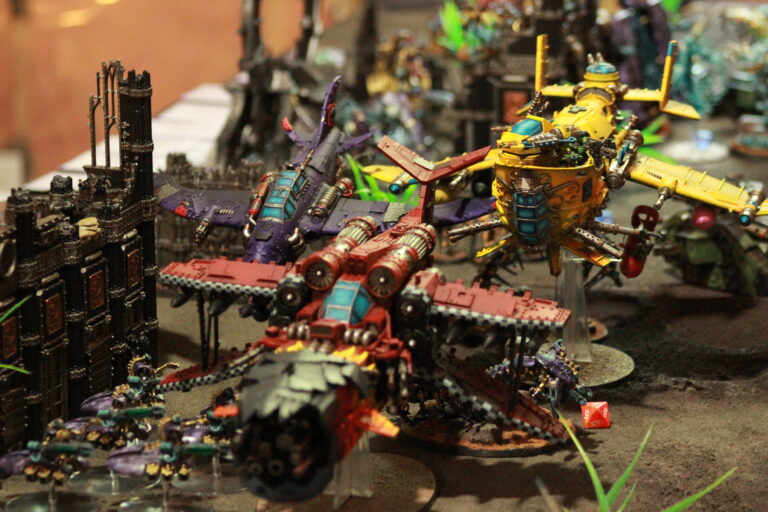
Apocalypse is essentially large format 40k, typically starting at 3,000 points a player. Titanic/super-heavy units are common and encouraged, and it’s often a staggering game to behold, played on an enormous table with players usually on teams with huge armies. These games typically take a full day to play, but can sometimes consume an entire weekend or even longer.
40k is typically a company-level game: I think of the battles in Band of Brothers being the rough equivalent, where Easy Company is often just one part of a line or offensive rather than the entire army. Apocalypse is bigger than that: it represents the entire battle. If you want to feel like a general sitting kilometers away in a leviathan command vehicle or up in orbit watching the war unfold on the oculus, Apocalypse is for you.
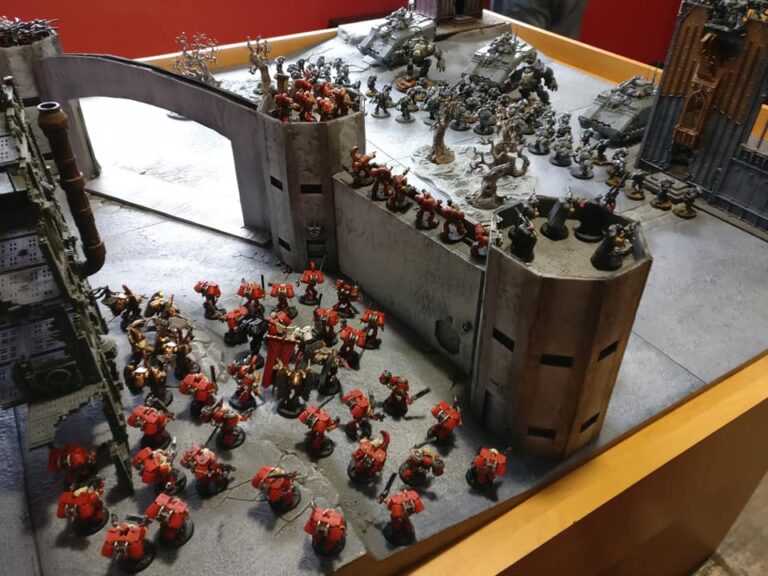
If you have a large collection, playing Apocalypse is a great way to show off your entire Battle Company of Space Marines, your fully-engaged Splinter Fleet of Tyranids, your entire Knight Household, or the gathered might of your Heretic Warband. As I said above, seeing the fully deployed armies is an amazing sight (and that goes doubly so if the game is fully-painted—an achievement I don’t think I’ve ever completed in Apocalypse).
How not to play Apocalypse
This is touched on in the various published Apocalypse books and in the house rules below, but you do not want to approach an Apocalypse game without some planning. A typical game takes eight to twelve hours: showing up “whenever” or “before lunch” is probably not going to be a great plan.
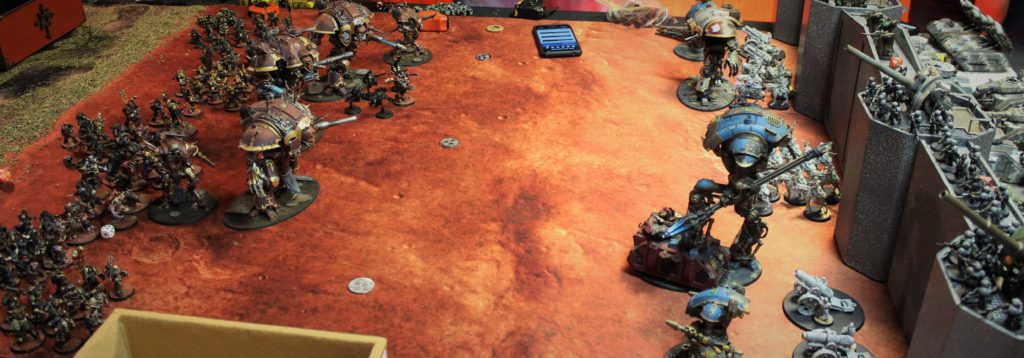
Just bringing your average 2k list with more stuff is not the best idea either. Apocalypse shines when both sides are fielding a good number of Titanic units and gets bogged down when a player has MSU (minimum sized units) spammed in their list. Having an open dialogue between teams/everyone attending is a good idea to ensure people are on the same page.
Finally, WYSIWYG (what you see is what you get) is really important. I’ll never forget an Apoc game where my teammate rolled out a ton of attacks into a Terminator wing that just deep struck into our lines only to be told by the Dark Angels player that, actually, those were all Deathwing Knights with a 3+ invulnerable save and not the regular Terminators with their 5+ invulnerable save: don’t worry about the models, I paid points for those invisible storm shields.
I have strictly enforced WYSIWYG at my Apocalypse games ever since.

Planning for success
I’m a very strong proponent of timed turns and phases, with each player/team turn taking about an hour (and this will speed up in later turns) and breaking down each phase into roughly 10-20 minute chunks. Even with our gaming group that are Apocalypse veterans, I use timed phases to keep the game on track and moving (and the last time I didn’t do this, it did get bogged down and go long). Additionally, I’d suggest starting early-to-mid morning so that the game wraps up at a reasonable (ish) hour. Having breaks built into the schedule is also strongly encouraged, not by me but also in the published books. Finally, having a “planning” or “strategy” phase at the top of each player turn baked into the schedule can be really helpful for bigger teams.
As suggested above, try and have a roughly equivalent number of Titanic units on each side and limit MSU. You don’t necessarily need to do list checks ahead of time, but checking in with team captains about how many Knights and Baneblades each side is fielding is a good call.
If you’re a veteran 40k player, you probably know that adding a third or fourth player to a game adds a lot of extra time. That goes double in Apocalypse. I have run a 3-way Apocalypse game before (and it was really cool on a “T” shaped table), but it definitely adds a lot of extra time. If you’re going to do multiple teams, make sure your planning is even more on point. Goonhammer also did an article back in the day on a 5-sided Apocalypse game: check it out if you’re going this route.
Finally, I’m going to push the idea of using Crowns for Apocalypse: having these tokens and sharing them amongst teammates really adds a lot of extra fun and banter to the game, plus the more laidback atmosphere of an Apocalypse game is practically made for Crowns. These rules have been included in the house rules below, but if you’re not going to use them, simply remove from your own gaming pack.
Why you should use these house rules
These rules have been written with two main principles in mind: adhering to the core 40k rules without requiring players to learn an alternative ruleset and keeping the game moving as expediently as possible to be able to finish within the time limit. There are other Apocalypse rules out there that add more depth (the 6th edition Apocalypse rulebook published in 2013 has a lot of very cool formations and stratagems that could be adapted) or streamline the game more (the standalone Apocalypse rules published in 8th edition mentioned earlier come to mind), but my rules are easily adopted by your average 40k player.
In an effort to speed up the game, the Fight Phase has been streamlined: the active team activates all their units (with +1 Attack for Fights First), then the non-active team fights with all their units, including models that were just killed. All models in every engaged unit fight, not just those in Engagement Range or the “second rank”. Some randomness has also been condensed into a single roll instead of rolling for every unit or model (i.e. with Deadly Demise).
As Apocalypse armies are often made up of units from multiple codicies, players create a “hand” of six stratagems they have access to (plus the generic ones). In this way, a player can have stratagems for their main army, plus any allied Knights, Daemons, Harlequins, etc. Or, alternatively, if a player is using a massive Ork collection, they could pull stratagems from different Ork detachments to represent different Kults and Klans in their army. Players still have a main army rule and detachment ability, so diluting the army with other codicies means those allied units won’t gain army rules or detachment benefits, but it’s helpful if you want to keep a big Knight alive by rotating ion shields.
These Apocalypse house rules are also the most playtested of all the rules we’re publishing this month. I wrote these back in 8th edition and have been updating them every edition. I have only played one game of Apocalypse in 10th edition, but we used these rules (as well as a bunch of other house rules that didn’t make the cut) and they worked out well.
Finally, you’ll note that there are very specific rules in the document regarding scheduling, army size, and the like. I would recommend copying these rules into your own event pack and modifying them to fit your game: please consider this permission to tweak these rules to your heart’s content. The rules are also fairly generic (i.e. there’s no fancy warzone rules or special rules for objectives), so feel free to add whatever works for your narrative, terrain, or armies.

Calling all titans
Apocalypse can be the most fun you can have playing 40k. It is a fantastic capstone to a campaign and an amazing achievement to get everyone playing together with their armies on the table. The biggest complaint about Apocalypse is that it’s disorganized and takes too long: with these rules, you will hopefully finish a full game within your time limit (I know I have many times).
If you use these rules, please drop us a line at contactus@wrongsideofthemaelstrom.com and let us know how it went! And please send pictures of the game (especially if it’s fully painted).